
Helen Frankenthaler (1928-2011) was a major American painter of Abstract Expressionism and Color Field Painting. In 1952 she invented the “soak-stain” technique, pouring diluted paint directly onto unprimed canvas.
Helen Frankenthaler(1928 — 2011)
Helen Frankenthaler
États-Unis
5 min read
Frequently asked questions
Famous Quotes
« There are no rules. That is how art is born, how breakthroughs happen. Go against the rules or ignore the rules. That is what invention is about.»
Key Facts
- Born in 1928 in New York, died in 2011 in Connecticut
- Painted “Mountains and Sea” in 1952, the founding work of the soak-stain technique
- Pioneer of Color Field Painting, influencing Morris Louis and Kenneth Noland
- A leading figure of the second generation of American Abstract Expressionism
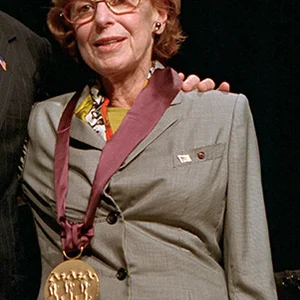
- Received the National Medal of Arts in 2001
Works & Achievements
Her first work made using the soak-stain technique; a founding painting of Color Field Painting and one of the most influential paintings in American art.
A large, award-winning abstract canvas held at the MoMA, confirming her mastery of fluid sheets of color.
A work marking her shift to acrylic painting, which offers brighter colors and sharper contours.
A vast Color Field composition illustrating the lyrical scope of her painting in the 1960s.
A monumental woodcut print in 102 colors, the pinnacle of her printmaking work, which renewed this art form.
Anecdotes
In 1952, at just 23 years old, Helen Frankenthaler painted *Mountains and Sea* by pouring oil paint heavily thinned with turpentine directly onto an unprimed cotton canvas laid out on the floor. The color soaks into the fabric like a giant watercolor: this “soak-stain” technique would revolutionize American abstract painting.
Two young painters, Morris Louis and Kenneth Noland, visited her studio in 1953 and discovered *Mountains and Sea*. Louis later said that Frankenthaler was “a bridge between Pollock and what was possible”: her technique directly inspired the entire Color Field Painting movement.
Frankenthaler often worked barefoot or in her socks, walking around her canvases spread out on the floor to pour and guide the paint, in the spirit of the “dripping” of Jackson Pollock, whom she admired. She regarded the controlled accident as an essential part of her art: “A really good picture looks as if it's happened at once.”
Born into a well-off New York family (her father was a justice of the New York State Supreme Court), she enjoyed a refined education but had to assert herself in a very male-dominated art world. She was one of the few recognized women of Abstract Expressionism, alongside Lee Krasner.
From 1958 to 1971 she was married to the painter Robert Motherwell, another major figure of Abstract Expressionism; the highly visible pair was nicknamed “the golden couple” of the New York art world.
Primary Sources
“A really beautiful picture looks as if it were born all at once.”
“There are no rules. That is what makes art so exciting: you have to break the rules.”
She was “the bridge between Pollock and what was possible.”
Key Places
Frankenthaler's birthplace and the epicenter of postwar modern art. She grew up, studied, and built most of her career here.
The college where Frankenthaler earned her degree in 1949 and received decisive artistic training under Paul Feeley.
The gallery that hosted her first solo exhibition in 1951 and launched her onto the New York art scene.
A seaside resort on Cape Cod where Frankenthaler spent her summers and worked, like many Abstract Expressionist artists.
The town where the artist settled in her final years and where she died in 2011.
Typical Objects

Raw canvas, with no priming layer, laid directly on the floor. Its porosity lets the diluted paint soak into the fibers like a dye.

Paint heavily thinned with turpentine, then water-based acrylic from the 1960s on. Poured directly onto the canvas, it creates translucent sheets of color.

Containers used to spread the liquid paint in broad pools across the canvas. Frankenthaler then guided the flow by hand, with a sponge or with a squeegee.

Tools used to spread, stretch or sponge up the paint in order to control how the color diffuses through the canvas. They often replace the traditional brush.

A printmaking studio tool; Frankenthaler produced many innovative woodcuts, notably “Madame Butterfly.” She reinvented the art of printmaking in the 20th century.
School Curriculum
Vocabulary & Tags
Key Vocabulary
Tags
Daily Life
Morning
Frankenthaler often began her day with observation and reflection, letting an idea ripen before touching the canvas. In her light-filled studio, she prepared her thinned paints and unrolled large canvases directly on the floor.
Afternoon
The afternoon was devoted to intense work: walking around the canvas laid on the ground, she poured the color and guided it by hand, with a sponge or a squeegee. A large canvas could be completed in a single session to preserve its freshness.
Evening
In the evening, she took part in New York's artistic life, dining and debating with the painters, critics and gallery owners in her circle. During her marriage to Motherwell, the couple entertained often and held a salon.
Food
Living in affluent twentieth-century New York, she had access to varied cuisine and the city's restaurants. Meals were also social occasions, well suited to discussions about art.
Clothing
In the studio, she wore simple, practical clothes, often stained with paint, and frequently worked barefoot or in her socks. In public, she adopted the polished elegance of the New York upper class.
Housing
She lived in Manhattan apartments and studios, then in a house in Connecticut. Her work spaces, vast and full of light, were designed for spreading large canvases out on the floor.
Historical Timeline
Period Vocabulary
Liens externes & ressources
Références
Œuvres
Jacob's Ladder
1957
Madame Butterfly
2000