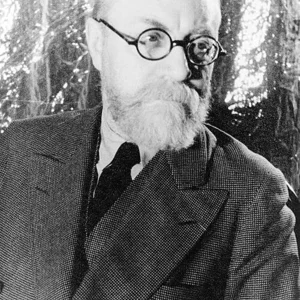

Henri Matisse was a French painter, draughtsman, printmaker and sculptor, the leader of Fauvism. Regarded as one of the major artists of the 20th century, he revolutionized the use of pure color and, late in his life, invented the technique of cut-out gouaches.
Henri Matisse(1869 — 1954)
Henri Matisse
France
5 min read
Frequently asked questions
Famous Quotes
« What I dream of is an art of balance, of purity and serenity, devoid of troubling or disturbing subject matter.»
« Exactitude is not truth.»
Key Facts
- Born in 1869 in Le Cateau-Cambrésis in northern France.
- Led the Fauvist movement in 1905 at the Salon d'Automne, which favored pure and violent color.
- Painted The Dance in 1909–1910, an iconic work of color and movement.
- From the 1940s onward developed the technique of cut-out gouaches (e.g. Jazz, 1947).
- Decorated the Chapel of the Rosary in Vence (1948–1951) and died in Nice in 1954.
Works & Achievements
A Pointillist canvas heralding the liberation of color; its title is borrowed from a poem by Baudelaire.
A portrait of his wife in clashing colors, one of the works that caused a scandal at the Fauvist Salon d'Automne.
A large composition of nude figures in a landscape of pure colors, a manifesto of Fauvism.
A ring of five red figures against a blue and green background; the pinnacle of Matisse's decorative, rhythmic painting.
A view of his studio entirely bathed in red, a radically bold treatment of space and color.
A collection of cut-out gouaches on the theme of the circus and the stage, including the famous figure of Icarus.
A vast late cut-out gouache, a kind of symbolic self-portrait on old age and music.
A total work of art bringing together architecture, stained glass, and drawings, which Matisse considered the culmination of his life.
Anecdotes
In 1905, Matisse and his friends exhibited canvases at the Salon d'Automne in Paris with colors so vivid and free that a critic, Louis Vauxcelles, spoke of a “cage of wild beasts” (*cage aux fauves*). The name stuck: Fauvism was born of a mockery.
Matisse was not destined for painting: he studied law. It was during a long convalescence, around the age of 21, that his mother gave him a box of paints to keep him occupied. He then discovered his calling and abandoned his career as a lawyer's clerk.
For years, Matisse and Pablo Picasso were both rivals and admirers. They exchanged paintings and kept a close eye on one another. When Matisse died, Picasso said he was the only person with whom he could truly talk about painting.
At the end of his life, confined to bed or to a wheelchair after a serious operation, Matisse could no longer paint standing up. He then invented the “cut-out gouaches” (*gouaches découpées*): he cut large sheets of painted paper with scissors, saying that he was “drawing with color.”
In 1941, after cancer surgery, doctors gave him little time to live. He lived another thirteen years, which he called his “second life,” and during them produced some of his most famous works, including the Chapel of Vence.
Primary Sources
What I am after, above all, is expression. [...] Expression does not lie in a passion bursting forth from a face or asserting itself through a violent movement. It lies in the entire arrangement of my picture.
Cutting straight into colour reminds me of the direct carving of sculptors.
This chapel is for me the culmination of a whole life of work and the flowering of an enormous, sincere and difficult effort.
Key Places
Town in northern France where Henri Matisse was born in 1869. A Matisse museum is located there today.
Capital where Matisse trained as a painter and exhibited at the 1905 Salon d'Automne, which revealed Fauvism.
City on the French Riviera where Matisse settled from 1917, drawn by the light of the South. He died there in 1954.
Chapel that Matisse designed entirely, from the stained-glass windows to the liturgical objects, and which he regarded as his masterpiece. Inaugurated in 1951.
Small port in southern France where Matisse spent the summer of 1905 with André Derain. Its intense light gave rise to his first Fauvist canvases.
Liens externes & ressources
Références
Œuvres
Luxe, Calme et Volupté
1904
La Femme au chapeau
1905
La Joie de vivre (Le Bonheur de vivre)
1906
L'Atelier rouge
1911
La Tristesse du roi
1952