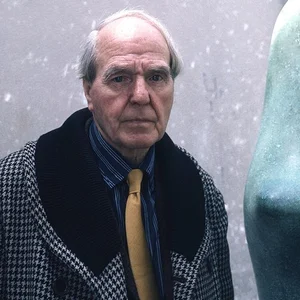

Henry Moore (1898-1986) was a leading British sculptor of the 20th century, famous for his large abstract figures in bronze and stone. His pierced organic forms and elongated figures had a profound impact on modern sculpture.
Henry Moore(1898 — 1986)
Henry Moore
Royaume-Uni, Royaume-Uni de Grande-Bretagne et d'Irlande
6 min read
Frequently asked questions
Key Facts
- Born in 1898 in Castleford, Yorkshire, the son of a miner
- Studied at the Royal College of Art in London during the 1920s
- Created air-raid shelter drawings (Shelter Drawings) during the Blitz in London (1940-1941)
- Won the International Grand Prize for Sculpture at the Venice Biennale in 1948
- Developed his emblematic series of reclining figures (Reclining Figure) and mother-and-child works until his death in 1986
Works & Achievements
First major reclining figure inspired by the pre-Columbian chacmool, a motif he would revisit throughout his life as the signature of his work.
Series of drawings of Londoners sheltering in the Underground during the Blitz, which established his national reputation and led to his appointment as a war artist.
Religious stone sculpture reconciling his modern language with tradition, a commission that broadened his audience.
Monumental bronze celebrating the post-war family, installed in front of a school in Stevenage.
Large travertine sculpture for the UNESCO headquarters in Paris, asserting his international standing.
Bronze installed at the University of Chicago commemorating the first controlled nuclear reaction; its form evokes both a skull and an atomic mushroom cloud.
Two-part bronze work for the Lincoln Center in New York, illustrating his fragmented, landscape-like figures.
Anecdotes
During the First World War, Henry Moore enlisted in the British Army at the age of 18 and was gassed at the Battle of Cambrai in 1917. After the war, he received a veterans' scholarship that allowed him to study sculpture, turning hardship into a springboard for his career.
During the Blitz in London, Moore went down into the Underground stations where thousands of civilians took shelter from the bombing. Deeply moved, he drew these sleeping crowds in his famous *Shelter Drawings*, which made him world-famous and led to his appointment as an official war artist.
Moore literally pierced holes through his sculptures, an innovation that shocked people in his early days. He explained that empty space could be just as expressive as solid mass and that “the hole can have as much meaning as a solid form.”
A visit to the British Museum, where he discovered pre-Columbian Mexican sculpture and non-Western art, marked a turning point: he rejected the Greek ideal of smooth beauty in favour of a rougher, more primitive “truth to material.”
Having become very wealthy thanks to his monumental commissions, Moore created the Henry Moore Foundation in 1977 to support the arts, refusing to let his fortune serve only his personal comfort. He continued to live modestly on his farm in Hertfordshire.
Primary Sources
A hole can have as much meaning as a solid mass. Sculpture in air is possible, where the stone contains only the space, the hole going right through.
All good sculpture should be seen in natural light, in a landscape or against the sky, for that is where it gathers its full power.
Rows of reclining figures, wrapped in blankets, like recumbent effigies in the dark tunnels of the Underground during the Blitz.
Key Places
Mining town where Henry Moore was born in 1898. The industrial landscape and slag heaps of Yorkshire shaped his relationship to material and to landscape.
School where Moore studied sculpture from 1921 and later taught. There he forged his break with classical academicism.
Museum where Moore discovered non-Western art, notably pre-Columbian Mexican sculpture, which radically transformed his vision.
Hamlet where Moore set up his home and studios (Hoglands) from 1940 and where he died in 1986. Today the seat of the Henry Moore Foundation.
Site of his large travertine “Reclining Figure” unveiled in 1958, one of his first monumental international commissions.
Typical Objects

Fundamental tools for direct carving in stone, a method Moore championed in order to respect the “truth to materials.” He often carved himself without any preliminary model.

A small preparatory maquette that Moore shaped before enlarging his works in bronze. His studio was filled with them, used to study forms and proportions.

Moore's material of choice for his monumental open-air sculptures, produced by lost-wax casting. Its strength allowed for the large pierced forms set against the landscape.

Moore gathered bones, shells, flints and pebbles that he kept in his studio as sources of inspiration. These natural forms fed his organic, hollowed-out figures.

Notebooks in which Moore sketched the London Underground shelters during the Blitz, in pencil, ink and wax crayon. They stand as a major human record of the war.

Tools Moore used for his elm-wood sculptures, whose natural grain he liked to follow. Wood was one of his favourite materials for the reclining figures of the 1930s.
School Curriculum
Vocabulary & Tags
Key Vocabulary
Tags
Daily Life
Morning
Moore rose early and went to one of the studios scattered around his Perry Green estate. He often began by drawing or handling his small maquettes and the natural objects he collected.
Afternoon
The afternoon was devoted to working with materials: modelling plaster, supervising the enlargements and bronze casting with his assistants. He liked to arrange his sculptures outdoors to judge them under natural light.
Evening
In the evening, Moore received visitors, dealers and collectors, or read and studied reproductions of ancient art and natural forms. He lived simply with his wife Irina, in an atmosphere of constant work.
Food
Coming from a modest Yorkshire background, Moore kept simple tastes and traditional English cooking. Even after he grew wealthy, he barely changed his frugal eating habits.
Clothing
In the studio, he wore practical work clothes, a smock and trousers covered in plaster and stone dust. In public, he adopted the understated suit of a British gentleman of his time.
Housing
He lived at Hoglands, a Hertfordshire farmhouse bought in 1940, which he gradually expanded with studios and sculpture gardens. His property became a vast open-air exhibition space.
Historical Timeline
Period Vocabulary
Liens externes & ressources
Références
Œuvres
Reclining Figure (Figure couchée)
1929
Shelter Drawings
1940-1941
Family Group
1948-1949
Nuclear Energy
1964-1966
Reclining Figure (Lincoln Center)
1963-1965