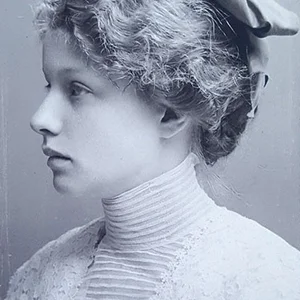

Hertha Sponer (1895-1968) was a German, later American, physicist and chemist, a pioneer in applying quantum mechanics to atomic and molecular physics. She was one of the first women to teach physics at university level in Germany before emigrating to the United States.
Hertha Sponer(1895 — 1968)
Hertha Sponer
Allemagne
6 min read
Frequently asked questions
Key Facts
- Earned her doctorate in physics at Göttingen in 1920 under the supervision of Peter Debye
- First woman to receive habilitation (Privatdozentin) in physics at the University of Göttingen in 1925
- Co-authored work with James Franck on molecular spectra (the Franck-Condon principle)
- Emigrated to the United States and became a professor of physics at Duke University in 1936
- Pioneer of molecular spectroscopy applied to quantum mechanics
Works & Achievements
A graphical technique, devised with Raymond Birge, for estimating a molecule's dissociation energy from its vibrational spectrum. Still taught in physical chemistry today.
A two-volume treatise on molecular spectra that became a standard reference for the physicists and chemists of the era.
A spectroscopy thesis that launched her research career into the light emitted and absorbed by molecules.
Work carried out at Duke with Teller and others, applying quantum mechanics to understand the electronic structure of a molecule central to chemistry.
Over thirty years, she built a molecular spectroscopy research group and trained many students and researchers.
A pioneer in using the young field of quantum mechanics to explain atomic and molecular spectra, bridging physics and chemistry.
Anecdotes
In 1925, Hertha Sponer crossed the Atlantic thanks to a Rockefeller fellowship to join the University of California, Berkeley. Working with the physicist Raymond Birge, she developed there a graphical trick to “weigh” the force holding a molecule's atoms together: by adding up the tiny energy steps of its vibrations, one can guess the energy needed to break it apart. This Birge-Sponer method is still taught to chemistry students today.
At a time when German universities were only just beginning to open their doors to women, Hertha Sponer earned her habilitation at Göttingen in the mid-1920s — that is, the official right to teach at university level. She was thus one of the very first women allowed to teach physics at a German university.
When Hitler came to power in 1933, Sponer's mentor, the Nobel laureate James Franck, resigned from Göttingen in protest against the dismissal of his Jewish colleagues. Sponer's own position became untenable as well: she left Germany in 1934 for the University of Oslo, in Norway, before making her way to the United States.
In 1936, Hertha Sponer became a professor of physics at Duke University, in North Carolina. The only woman in the department, she helped turn it into a genuine center of research in molecular spectroscopy and trained many students over thirty years.
In 1946, Hertha Sponer married James Franck, the man who had welcomed her as an assistant at Göttingen a quarter of a century earlier. Their long scientific collaboration, born in the laboratories of 1920s Germany, had grown into a lifelong companionship.
Primary Sources
The authors show that the dissociation energy of a diatomic molecule can be estimated by adding up the successive gaps between vibrational levels observed in its band spectrum, then extrapolating to the point where these gaps vanish.
A reference work in which Sponer gathers and systematizes the data of molecular spectroscopy, explaining how the analysis of spectra makes it possible to solve chemistry problems such as the structure and stability of molecules.
A detailed study of the ultraviolet absorption spectrum of benzene, in which the authors interpret its bands using quantum mechanics to understand the electronic structure of this molecule.
Key Places
City in Silesia where Hertha Sponer was born in 1895, then on German territory.
A leading center of quantum physics where Sponer earned her doctorate, became James Franck's assistant, and later taught.
Where she worked in 1925-1926 thanks to a Rockefeller fellowship and developed the Birge-Sponer method.
Sponer's refuge in 1934 as a visiting professor after she left Nazi Germany.
Where she was a physics professor from 1936 to 1966 and advanced research in molecular spectroscopy.
Place where Hertha Sponer died in 1968, having returned to her native country.
Typical Objects

A device that breaks down the light emitted or absorbed by a substance into its different colors, revealing a “spectrum.” It was the central tool of Sponer's work for studying molecules.

A light-sensitive glass plate on which spectra were recorded as fine dark lines. Researchers then measured them precisely.

A glass tube filled with gas that is excited by electricity to make it glow. The light produced contains the characteristic spectrum of the gas being studied.

A sliding calculation instrument used before the invention of the electronic calculator. Sponer used it for the many calculations involving energy levels.

A notebook where the scientist records measurements, observations, and calculations as experiments proceed. It is the written memory of research.

An everyday tool for the teacher and researcher to present equations and diagrams. Sponer used it to draw energy diagrams in front of her students.
School Curriculum
Vocabulary & Tags
Key Vocabulary
Daily Life
Morning
In the morning, Hertha Sponer joins her laboratory and prepares her apparatus: discharge tubes, a spectrograph, and photographic plates. She carefully aligns the instruments to record the light spectrum of a gas or a molecule.
Afternoon
The afternoon is split between teaching and analysis. At the blackboard, she explains energy levels to her students, then measures the spectra she has obtained line by line, slide rule in hand.
Evening
In the evening, she reads scientific journals, exchanges letters with colleagues such as James Franck, and sometimes takes part in seminars where physicists debate the latest ideas in quantum mechanics.
Food
In Germany, her diet is that of an academic of the era: bread, potatoes, soups, coffee. After emigrating, she adapts to the North American eating habits of North Carolina.
Clothing
In the laboratory, she wears plain, practical clothing, sometimes a lab coat to handle the equipment. In class, she adopts the strict professional attire expected of a female professor in the early twentieth century.
Housing
She lives in modest, functional lodgings near the university, first in the university town of Göttingen, then close to the Duke campus in the United States.
Historical Timeline
Period Vocabulary
Liens externes & ressources
Références
Œuvres
Méthode (extrapolation) de Birge-Sponer
1926
Molekülspektren und ihre Anwendung auf chemische Probleme
1935-1936
Doctorat en physique (université de Göttingen)
1920
Analyse du spectre ultraviolet du benzène
1939
Développement du département de physique de Duke
1936-1966
Application de la mécanique quantique aux molécules
années 1920-1950