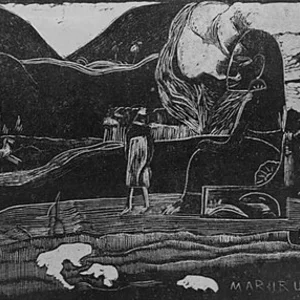

Hina is a major goddess of the Polynesian pantheon, venerated across many Pacific cultures (Tahiti, Hawaii, Māori, Samoa). The quintessential lunar figure, she embodies femininity, natural cycles, and the arts of tapa cloth-making. Her tradition is exclusively oral, passed down through myths and sacred chants since the pre-colonial era.
Hina
Hina
8 min read
Frequently asked questions
Key Facts
- Hina appears in virtually all Polynesian oral traditions — Tahitian, Hawaiian, Māori, Samoan, and Tongan — reflecting a very ancient pan-Polynesian mythological heritage.
- In the Tahitian tradition (oral source), Hina dwells in the moon and is associated with monthly cycles and fertility.
- She is credited with inventing tapa (beaten bark cloth), a fundamental female craft in pre-colonial Polynesian societies.
- In Māori mythology (New Zealand), Hina (or Hine-keha) is the goddess of the full moon, counterpart to Hine-nui-te-pō, the goddess of death.
- The stories surrounding Hina, transmitted exclusively through oral tradition, were partially transcribed by European missionaries and ethnologists from the 19th century onward (notably J.M. Orsmond for Tahiti).
Works & Achievements
Hina is credited in Polynesian myths as the inventor of tapa, a cloth made by beating the bark of the paper mulberry tree. This sacred textile art formed the foundation of the symbolic and ritual economy throughout Polynesia.
According to Samoan and Tahitian myths, the first coconut tree grew from the head of an eel who had fallen in love with Hina. Hina is thus credited with bringing into existence the most vital tree in Polynesian civilization.
By taking up residence in the moon, Hina is said to have established the lunar cycles that govern Polynesian life: fishing, agriculture, navigation, and rites of passage are all organized according to the lunar calendar she embodies.
This 2,100-line genealogical chant, a cornerstone of Hawaiian oral tradition, names Hina among the primordial deities. It stands as one of the most elaborate oral literary works in all of Polynesia.
A major narrative cycle found throughout Polynesia, in which Hina (sister or wife of the demigod Māui) plays a role of wisdom that tempers her brother's solar boldness. This myth continues to shape Māori and broader Polynesian cultural identity.
Anecdotes
Hina is often called 'Hina-i-ka-malama' in Hawaii, meaning 'Hina in the moon'. According to Hawaiian tradition, she fled to the moon to escape exhausting daily chores, and Polynesians still see her shadow today in the dark patches of the moon.
In Tahitian myths, Hina is the first woman to have made tapa, the sacred cloth obtained by beating the bark of the paper mulberry tree. This fundamental textile art was passed down from mother to daughter and was the visible sign of the bond between women and the goddess.
Among the Māori of New Zealand, Hina (or Hine-nui-te-pō) is the goddess of death and night. The demigod Māui attempted to pass through her sleeping body to win immortality for humankind, but failed — thus bringing death to all living beings.
In Samoa, Hina is associated with the sacred eel: according to the myth, the eel-god Te Tuna fell in love with her, and upon his death, his head was buried and gave rise to the first coconut tree, explaining why the coconut bears the 'face' of an eel.
In many Polynesian traditions, Hina is the sister or wife of the demigod Māui. This sibling relationship symbolizes the balance between masculine solar strength and feminine lunar wisdom — two complementary forces that structure the Polynesian cosmos.
Primary Sources
Hina was the daughter of Taaroa and lived in the moon. She beat her tapa on the sacred rock, and the sound of her beater echoed to the neighboring islands like a call for women to work.
Hina-hanaia-i-ka-malama, the woman who works in the moon, is invoked in Hawaiian cosmogony as a primordial force associated with the cycles of life.
Hine-nui-te-pō was great and terrible; her eyes were of green jade, her hair like seaweed, and her mouth like that of a barracuda.
Hina took the bark of the aute, soaked it in the water of the sacred river, and beat it until it became as supple as skin. Thus was born the first tapa, an offering to the gods.
Key Places
Hina's celestial dwelling in nearly all Polynesian traditions. According to Hawaiian and Tahitian beliefs, the goddess retreated there to find peace and still beats her tapa eternally to this day.
A sacred site in Tahiti where, according to oral tradition, Hina is said to have beaten her first tapa on the rocks of the river. The sound of the water evokes the rhythm of her ike in the stories of the elders.
A great Polynesian temple (marae) considered the spiritual center of Polynesia and listed as a UNESCO World Heritage Site. A gathering place for priests and the recitation of foundational myths, including those of Hina.
A volcanic region of Hawaii associated with Hina-i-ka-malama and the traditions of tapa weavers. Lava caves served as sanctuaries where women would invoke Hina during the making of tapa cloth.
A central region of the Māori North Island, homeland of the stories of Hine-nui-te-pō. The bubbling thermal springs were associated with the breath of the goddess of death in Māori cosmology.
Typical Objects

A grooved wooden mallet used to beat the bark of the paper mulberry tree to make tapa cloth. Hina is considered the inventor of this tool and the sacred textile technique associated with it.

A sacred fabric made by beating the bark of the aute (paper mulberry tree), a symbol of Polynesian feminine artistry. Offered to the gods during ceremonies, tapa is the emblematic work of Hina and her devotees.

A hollowed stone used for ritual preparations connected to the cycles of the moon. Associated with Hina in women's rites, it symbolizes transformation and the passage from one state to another.

A lustrous shell evoking the light of the moon, used as an ornament in ceremonies dedicated to Hina. Its iridescent mother-of-pearl was associated with the moonlight shimmering on the ocean.

A totemic animal closely linked to Hina in Samoan and Tahitian myths. The legend of the eel that loved Hina explains the origin of the coconut palm, a fundamental source of nourishment throughout Polynesia.

A traditional lamp made from the oily nuts of the kukui tree (candlenut), a symbol of the night light guided by Hina. Used during nighttime ceremonies and the recitation of myths.
School Curriculum
Vocabulary & Tags
Key Vocabulary
Daily Life
Morning
At sunrise, Hina oversees the rituals that open the day from her lunar domain. In Tahitian myths, women would invoke her name as they began their tapa work, soaking bark from the aute tree in cool river water before beating it on sacred rocks.
Afternoon
Tapa beating fills the heart of the day: armed with their ridged ike mallets, the sacred weavers work in collective rhythm under Hina's invocation. The steady sound of the beaters is understood as a form of communication with the goddess — its echo, according to legend, resounding all the way to the moon.
Evening
It is at sunset that Hina's power grows: the moon rises over the ocean and mythic recitations begin by the light of kukui torches. The priestesses keep the genealogical chants that recount her adventures and pass on lunar knowledge to initiated young women.
Food
Though a goddess and not mortal, Hina is associated in myth with foods linked to the moon and fresh water: coconuts, river fish, taro, and the fruit of the paper mulberry. Offerings made to her included these foods arranged on marae altars during full moon nights.
Clothing
Hina is dressed in immaculate white tapa — the cloth she herself invented — adorned with geometric patterns stamped using bamboo blocks dipped in natural dyes. Her dark hair is crowned with tiare flowers and pearlescent shells, and her wrists are adorned with white coral bracelets.
Housing
In myth, Hina dwells in the moon, but her earthly representations place her in marae (open-air temples) built from volcanic stone, and near rivers where aute bark grows. These sacred spaces, bordered by standing stones and breadfruit trees, make up her earthly domain where priestesses keep her memory alive.
Historical Timeline
Period Vocabulary
Visual Style
Palette lunaire aux bleus océaniques profonds et blancs nacrés, enrichie de motifs géométriques du tapa tahitien et de reflets argentés évoquant la pleine lune sur le Pacifique.
Sound Ambience
Ambiance nocturne polynésienne mêlant le ressac de l'océan, le battement rythmique du tapa et les chants féminins sacrés sous la lumière de la lune.
Liens externes & ressources
Références
Œuvres
Invention du tapa
Époque mythique précoloniale
Création du cocotier
Époque mythique précoloniale
Établissement des cycles lunaires
Époque mythique précoloniale
Kumulipo — chant cosmogonique hawaiien (rôle de Hina)
Vers XVIIe siècle (transmission orale)
Mythe de Māui et Hina
Transmis depuis au moins le XIIe siècle