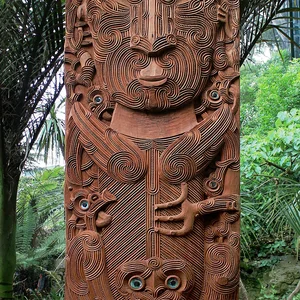

Hineahuone is the first woman in Māori cosmogony, fashioned by the god Tāne from the red earth (one) of Kurawaka. A founding figure of Māori oral tradition, she embodies the sacred bond between humanity and the earth.
Hineahuone
Hineahuone
8 min read
Frequently asked questions
Key Facts
- According to Māori oral tradition, Tāne fashioned Hineahuone from the red earth (one) of the sacred place of Kurawaka
- Her name literally means 'woman shaped from the earth' (hine = woman, ahua = form/to shape, one = earth/sand)
- She is regarded as the primordial ancestor (tīpuna) from whom all humanity descends in Māori cosmology
- Her union with Tāne gave birth to Hinetītama, a central figure in the mythological cycle of death and the afterlife
- These stories are passed down through oral tradition (kōrero tuku iho) rather than through ancient written sources
Works & Achievements
By accepting the life breathed into her by Tāne, Hineahuone inaugurates the world of mortal human beings (tangata). She is the origin of all Māori genealogies (whakapapa), the foundation of the Māori people's cultural identity.
Hineahuone receives from Tāne the mauri, the vital breath that distinguishes living beings. This cosmological gift underpins the Māori understanding of life and the soul, passed down to all her descendants.
From the union of Hineahuone and Tāne, Hinetītama is born — she who will become Hinenuitepō, guardian of the realm of the dead. Hineahuone is thus the origin of the life-death cycle that structures all of Māori cosmology.
The first hongi (a greeting through the sharing of breath) was performed by Tāne to awaken Hineahuone. This ritual gesture, still practiced at all Māori ceremonies, traces its origins to this founding act.
Anecdotes
Hineahuone, whose name literally means 'woman fashioned from the earth' (hine = woman/daughter, one = sand/earth), was shaped by the god Tāne from the red clay of Kurawaka. Tāne breathed life into her by pressing his nose against the face of this inert form, performing the first hongi — the sacred greeting gesture still practiced by Māori people today.
After Tāne had shaped Hineahuone, she awoke to life and sneezed, the first sign of her vital breath. From their union was born Hinetītama, 'the daughter of the dawn', who would later become Hinenuitepō, goddess of death — making Hineahuone the ancestral mother of all Māori humanity, and the very origin of the life-death cycle.
The site of Kurawaka, where Hineahuone was fashioned, is considered a sacred place (wāhi tapu) in Māori cosmology. The red earth from which she was made was no accident: in Māori thought, red (whero) is the color of life, blood, and birth, symbolically connecting the first woman to the fertility of the Earth mother Papatūānuku.
Unlike figures in other creation stories, Hineahuone is not a goddess but the first mortal being. This detail is fundamental to Māori cosmology: she represents the transition from the world of atua (gods) to the world of tangata (human beings), making her a pivotal figure standing between the divine and the human.
The accounts surrounding Hineahuone vary across Māori iwi (tribes), reflecting the richness of Polynesian oral tradition. Some versions emphasize her role as guardian of mauri (vital life force), while others focus on her relationship with Papatūānuku, the Earth mother, of whom she is considered the living, embodied expression.
Primary Sources
Ka hanga a Tāne i a Hineahuone i Kurawaka, ka hanga i ōna mata, ka hanga i ōna taringa, ka hanga i ōna ihu... ka hūpē, ka ōhā, ka ora.
Tāne formed the first woman from the red earth of Kurawaka, breathed life into her nostrils, and she sneezed and lived. She was called Hineahuone, the earth-formed maiden.
Ko Hineahuone te wahine tuatahi i hangaia e Tāne-nui-a-rangi ki te one o Kurawaka, arā, ko ia te tūāpuna o ngā wahine katoa o te ao.
Hineahuone was the first woman, made by Tāne from the red soil of the sacred place; her name tells her origin — she who was formed from the earth.
Key Places
Sacred site where Tāne shaped Hineahuone from red earth. This place belongs to Māori mythic geography (kō uta, kō tai — between land and sea) and remains associated with all birth ceremonies.
Cradle of Māori civilization, the land where the stories of Hineahuone were passed down from generation to generation in the whare wānanga (houses of knowledge) of the various iwi.
The city where George Grey and John White compiled the first written transcriptions of Māori myths in the 19th century, enabling the international spread of the stories of Hineahuone.
Island considered the ancestral homeland (Hawaiki) of Polynesian peoples before their migration to New Zealand. The stories of Hineahuone are thought to trace back to this shared origin of the Polynesian world.
Typical Objects

A sacred vessel used to store water and food, the hue symbolizes the womb and life itself. It is directly associated with the fertility that Hineahuone embodies as the first woman.

The red earth of Kurawaka is the very material from which Hineahuone was fashioned. Red clay (kokowai) is still used in Māori ceremonies to mark what is sacred and to celebrate birth.

Weaving (raranga) is one of the foundational arts passed down by female ancestors in Māori culture. It symbolizes creation, just as Hineahuone herself was 'woven' from the earth by Tāne.

A sacred tool made of pounamu (New Zealand greenstone), the toki is the instrument of creation par excellence. It evokes the creative act of Tāne shaping Hineahuone's form.

A sacred stone concentrating the mauri, or life force. As the first mortal being, Hineahuone was the first to receive the mauri bestowed by Tāne, and these ritual stones commemorate that gift.

A central plant in Māori culture, harakeke is used to weave mats, baskets, and garments. The plant itself serves as a metaphor for family: its central shoot represents the child, symbolizing the lineage descended from Hineahuone.
School Curriculum
Vocabulary & Tags
Key Vocabulary
Tags
Daily Life
Morning
In Māori cosmology, Hineahuone belongs to the mythic time before human daily life. Her 'morning' is that of creation itself: the awakening of consciousness, the first breath shared with Tāne, the discovery of Papatūānuku — the Earth Mother of whom she is the earthly expression.
Afternoon
Hineahuone's mythic afternoon is one of discovery — exploring the living world: the sacred forest shaped by Tāne, the birds, the plants, the spring waters. She learns to recognize medicinal plants, to listen to the language of the earth from which she came, and to weave the first mats from harakeke.
Evening
Hineahuone's evening is a time of gathering and passing on: the first stories told around the fire, the first songs (waiata) that would become the memory of the Māori people. It is in this primordial vigil that the Polynesian oral tradition is born — the tradition that would carry her memory forward for millennia.
Food
Hineahuone, a being of the earth, lives on the first gifts of Papatūānuku: fernroot (aruhe), forest berries, and fish from sacred rivers. Her diet reflects the relationship of reciprocity between humans and the nurturing earth — a founding principle of the Māori relationship with the environment.
Clothing
Hineahuone's mythic garments are woven from harakeke (flax) fibers and adorned with the feathers of sacred birds. Her adornment of leaves and natural fibers symbolizes her organic connection to the earth: she literally wears Papatūānuku upon her, a reflection of her clay-born origins.
Housing
Hineahuone's original whare (home) is Tāne's sacred forest itself — those vast trees the god had planted to clothe Papatūānuku. Later, Māori whare would always be built according to principles that recall this primordial bond between human dwelling and the Earth Mother.
Historical Timeline
Period Vocabulary
Visual Style
Art inspiré des motifs maoris traditionnels — spirales koru, terres rouges ocre et verts jade — représentant Hineahuone émergeant de la glaise de Kurawaka dans la lumière de la première aube.
Sound Ambience
Paysage sonore de la forêt primordiale d'Aotearoa à l'aube : chants d'oiseaux endémiques (tūī, korimako), souffle du vent dans les fougères arborescentes, murmure de l'océan lointain — la terre vivante dont Hineahuone fut tirée.
Liens externes & ressources
Références
Œuvres
Naissance de l'humanité maorie (acte de création)
Temps mythiques
Transmission du mauri (force vitale)
Temps mythiques
Maternité de Hinetītama
Temps mythiques
Fondation du rite du hongi
Temps mythiques, pratiqué jusqu'à aujourd'hui