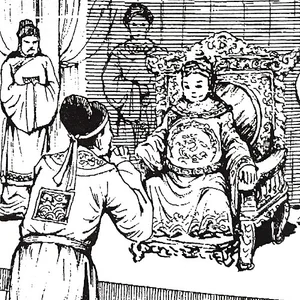

Title held by the semi-legendary rulers of the kingdom of Văn Lang, founded by the Lạc Việt people and attested between the 7th and 2nd centuries BCE [1]. Eighteen generations of kings are said to have held this title, but their historicity remains debated among historians [1].
Hùng Vương
Hùng Vương
Vietnam
7 min read
Frequently asked questions
Key Facts
- According to legendary tradition, the first Hùng Vương is said to have ascended the throne in 2524 BCE, as the son of Lạc Long Quân [1] — status LEGEND, not documented by contemporary historical sources.
- The kingdom of Văn Lang, founded by the Hùng Vương, is said to have spanned 18 generations of rulers [1] — status SEMI-LEGENDARY.
- The kingdom of Văn Lang is believed to have existed between the 7th and 2nd centuries BCE, according to historical estimates (distinct from the legendary chronology) [1].
- In 258 BCE, Thục Phán (An Dương Vương), chief of the Âu Việt people, is said to have defeated the last Hùng Vương and founded the kingdom of Âu Lạc [1] — status SEMI-LEGENDARY.
- The name “Hùng Vương” appears in late Chinese sources (Taiping Guangji, 10th century, citing the Nam Việt chí, 5th century) in a form close to “Lạc Vương,” suggesting a possible scribal confusion between the two characters [1] — not documented with certainty.
Works & Achievements
The first Hùng Vương founds the kingdom, establishing the capital at Phong Châu [1].
Administrative organization of the territory of Văn Lang into fifteen districts (Giao Chỉ, Chu Diên, Cửu Chân...) [1].
Creation of a hierarchy of civil and military officials identified by bronze seals [1].
According to legend, a Hùng Vương has a text engraved on the shell of a sacred turtle sent to Emperor Yao, giving rise to a calendar; an episode not confirmed by official sources [1].
Tradition attributes to the era of the Hùng Vương the emergence of practices such as weaving, rice cultivation, the making of rice wine, and protective tattooing [1].
Anecdotes
According to the founding legend recorded in the Lĩnh Nam chích quái, Lạc Long Quân and Âu Cơ are said to have had one hundred sons born from a sack of eggs; the couple later separated, with fifty sons following their father toward the sea and fifty following their mother toward the mountains. The eldest son, who stayed with Âu Cơ at Phong Châu, was enthroned by his brothers and took the title of Hùng Vương [1]. This account, transmitted relatively late (during the Lý-Trần dynasties), belongs to the realm of legend rather than factual history [1].
The first Hùng Vương is said to have founded the kingdom of Văn Lang and divided the territory into fifteen “bộ” (administrative districts), including Giao Chỉ, Chu Diên, and Cửu Chân, with Phong Châu as the capital [1]. This administrative organization is reported by the Đại Việt sử ký toàn thư, written nearly two thousand years after the events supposedly took place [1].
A tradition reported in the Đại Việt sử ký toàn thư explains the origin of tattooing among the Bách Việt: mountain dwellers, attacked by “giao long” (a kind of crocodile or water dragon) while fishing in rivers, are said to have had their bodies tattooed with aquatic monster motifs on the order of the Hùng Vương to ward off these creatures [1]. The text presents this account as the legendary origin of a practice that was indeed real and attested among the Bách Việt [1].
According to a tradition related in the same source, a Hùng Vương is said to have sent an ambassador to offer the Chinese emperor Yao (around 2257 BCE) a sacred thousand-year-old turtle bearing on its back an inscription in “khoa đẩu” script recounting the history of the world since its creation; the emperor is said to have had its content copied, calling it the “Quy lịch” (turtle calendar) [1]. The source itself notes that this is a legend with no confirmation in the official Chinese annals [1] — to be classified as LEGEND.
A better-attested episode concerns the kingdom of Việt Thường (associated with the Văn Lang area): in 1110 BCE, an envoy is said to have offered a white pheasant to King Zhou Cheng Wang of China, an event reported in the Chinese annals themselves [1]. This case is presented by the source as belonging to official Chinese history rather than to Vietnamese legend alone [1] — status SEMI-LEGENDARY / better documented than the previous episodes.
Primary Sources
Account of the Hồng Bàng lineage: Kinh Dương Vương, Lạc Long Quân, then Âu Cơ and the hundred eggs that gave birth to the Hùng kings.
“The Hùng King ascended the throne, named the kingdom Văn Lang, and divided the land into 15 regions... establishing the capital in the region of Văn Lang, Phong Châu.”
“During the reign of King Trang of the Zhou dynasty... a strange man appeared who, through magic, subdued the tribes and proclaimed himself Hùng King, establishing his capital at Văn Lang... The title of Hùng King was passed down through 18 generations.”
“Giao Chỉ commandery had the Lạc fields... There were the titles of Lạc King and Lạc marquis, and each district appointed its own Lạc generals, who wore bronze seals with blue ribbons.”
“The land of Giao Chỉ commandery was very fertile; in ancient times there was a chieftain called the Hùng King, assisted by the Hùng Marquis.”
Key Places
Legendary capital of the kingdom of Văn Lang under the Hùng Vương kings, traditionally associated with the present-day region of Việt Trì (Phú Thọ province, Vietnam) [1].
Kingdom founded by the first Hùng Vương, divided into fifteen bộ, covering mainly the present-day Red River delta [1].
Lake said, according to legend, to be the origin of the wife of the Dragon King (Long Vương), legendary grandmother of the Hùng Vương through Lạc Long Quân [1].
Mountain range mentioned in legend as the place where Đế Minh, a mythical ancestor, is said to have met the mother of Lộc Tục (Kinh Dương Vương) [1].
Liens externes & ressources
Références
Œuvres
Fondation du royaume de Văn Lang
date légendaire : vers 2524 av. J.-C.
Division en quinze bộ
non précisée
Mise en place des titres Lạc Hầu / Lạc Tướng
non précisée
Quy lịch (calendrier de la tortue)
vers 2257 av. J.-C. (légende)
Introduction de coutumes fondatrices (vêtement, riziculture, tatouage)
non précisée