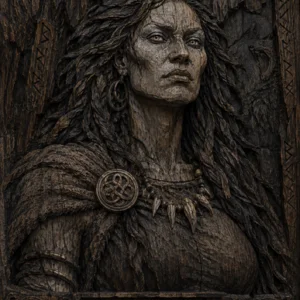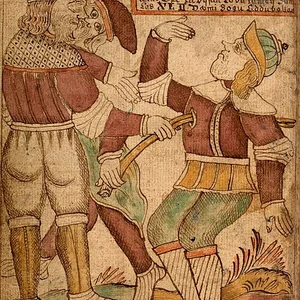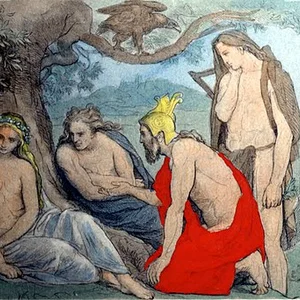

Goddess of Norse mythology, Idunn is the keeper of the golden apples that preserve the eternal youth of the Æsir gods. Her abduction by the giant Thiazi causes the gods to age, illustrating her central role in the Viking cosmic order.
Idunn
Idunn
8 min read
Frequently asked questions
Key Facts
- Idunn is mentioned in Snorri Sturluson's Prose Edda (c. 1220) as the keeper of the apples that preserve the gods from aging
- Her abduction by the giant Thiazi (with Loki's complicity) is one of the major myths in the Gylfaginning
- The gods age and weaken as soon as Idunn is absent from Asgard, emphasizing her vital role in the divine order
- Loki is forced to rescue her by transforming into a falcon and bringing back Idunn turned into a nut
- She also appears in 10th-century Icelandic skaldic poems (Haustlöng by Þjóðólfr of Hvinir), attesting to the antiquity of the myth
Works & Achievements
Skaldic poem by Þjóðólfr of Hvinir, one of the oldest attested sources on the abduction of Idunn by Thiazi. It serves as a fundamental reference predating Snorri for understanding the oral transmission of the myth.
Written by Snorri Sturluson, this work contains the most complete accounts of Idunn: the description of her apples, her abduction by Thiazi, and her rescue by Loki. It is the primary source for any study of the figure.
Eddic poem where Loki insults the gods at a banquet. The mention of Idunn, though brief, confirms her central place in the pantheon and her connection to tales of betrayal and honor.
Painting by the Swedish artist depicting Idunn distributing her apples to the Aesir gods. It illustrates the Romantic rediscovery of Norse mythology in the 19th century and Idunn's iconic place in the Scandinavian imagination.
Pictorial work depicting the abduction of Idunn by Thiazi transformed into an eagle. It bears witness to the European fascination with Norse myths during the Victorian and Pre-Raphaelite era.
Anecdotes
Idunn is one of the most precious goddesses in the Norse pantheon: she alone possesses the golden apples (eski) that keep the Æsir young and immortal. Without her, the gods age and lose their strength — showing how youth was seen as a fragile and precious gift in Viking cosmology.
The giant Thiazi (Þjazi), who could transform into an eagle, managed to force Loki to deliver Idunn to him. Loki convinced her to leave Asgard by promising to show her even more beautiful apples in the nearby forest. Once outside the divine walls, Thiazi seized her and took her to his icy home of Thrymheim in Jotunheim.
Deprived of Idunn's apples, the gods began to turn pale, wrinkle, and lose their faculties. This scene of collective aging among the Æsir, described in the *Prose Edda*, illustrates how the entire cosmic order depends on the presence of this quiet but indispensable goddess.
It was Loki who repaired his mistake: forced by the furious gods to find her, he borrowed Freyja's falcon feather cloak, flew to Thrymheim, turned Idunn into a nut, and sped back to Asgard. Thiazi, transformed into an eagle, chased him but was killed by the flames lit by the gods on the walls.
In the eddic poem *Lokasenna*, during a banquet where Loki insults each god in turn, he also attacks Idunn, accusing her of having kissed the murderer of her brother. This scene, though provocative, reveals that Idunn was respected by all — and that attacking her was a true transgression.
Primary Sources
Loki took the form of a falcon and flew to Jotunheim. He found Idunn alone, turned her into a nut that he held in his talons, then flew as fast as possible toward Asgard, while Thiazi in eagle form pursued him furiously.
The giant with eagle's wings carried Idunn away from the gods; without her, the Æsir grew old and their radiance died like an ember under the cold ash of winter.
Idunn keeps in her casket the apples that the gods must bite when they begin to age; at once they grow young again, and so it will be until Ragnarök.
Loki said to Idunn: 'Of all women, you are the one who has most loved men with white arms, you who embraced the slayer of your brother.'
Key Places
Celestial realm of the **Æsir** gods, home of **Idunn** and her husband **Bragi**. Here she distributes her apples to the gods at divine feasts, guaranteeing their eternal youth and cosmic order.
Frosty fortress of the giant **Thiazi**, perched in the mountains of **Jotunheim**, where Idunn was imprisoned after her abduction. Her absence from Asgard plunged the gods into rapid aging and deep disarray.
Realm of the giants (*jötnar*), the natural enemies of the **Æsir**. In this hostile, frozen world Idunn was held captive, symbolizing the constant threat chaos forces pose to divine order.
The cosmic tree linking the nine worlds of Norse cosmology. **Idunn**, whose apples sustain divine life, is intimately connected to this image of the eternal tree supporting the entire universe.
Where the **Eddas** were written down in the 12th–13th centuries, first recording Idunn's myths in writing. Without medieval Icelandic literate culture, the figure of Idunn would be lost today.
Typical Objects

Kept in a magic casket, these apples are Idunn's essential attribute. Biting into them restores the youth of the Æsir gods — without them, the immortals would age and die before Ragnarök.

According to the *Prose Edda*, Idunn keeps her precious apples in a wooden container, probably made of ash, a sacred tree linked to Yggdrasil. This casket symbolizes the protection of divine immortality.

Lent by Freyja to Loki so he could fly to Jötunheimr and rescue Idunn. This magical object enables transformation into a falcon and symbolizes the gods' ability to cross boundaries between worlds.

To save her, Loki turned Idunn into a nut so he could carry her easily in his falcon talons. This metamorphosis illustrates the transformative power of Norse magic and makes the nut a symbol of preserved life.

Instrument of her husband Bragi, god of poetry. In Asgard, Idunn is often associated with his music during divine banquets — a symbol of the cultural as well as biological fertility of the Æsir.
School Curriculum
Vocabulary & Tags
Key Vocabulary
Tags
Daily Life
Morning
Idunn begins her day in the sacred orchards of Asgard, tending her golden-fruited apple trees that grow only thanks to her divine presence. She checks the condition of each apple in her ash-wood casket, ensuring the supply of immortality is intact for the gods who may need it.
Afternoon
During the afternoon, Idunn walks through the bright halls of Asgard in the company of her husband Bragi, god of poetry and music. She attends the gods' deliberations in the great council halls, sometimes offering her apples to those who begin to show the first signs of aging.
Evening
In the evening, Idunn takes her place at the great banquets of the Aesir in the divine palaces. She distributes her precious apples as needed, listening to Bragi's poems echo under the golden rafters, while mead horns circulate among the immortal guests in the warm glow of the hearths.
Food
As a goddess associated with youth and natural renewal, Idunn nourishes herself with fruits from her sacred orchard and divine mead (the gods' hydromel). Her food is light and nature-bound—wild berries from Asgard's forests, milk, honey, and barley bread—in keeping with her role as guardian of vitality.
Clothing
Idunn is depicted wearing light robes in spring colors: pure white, soft green, and bright gold. Her garments are adorned with floral embroidery inspired by Norse craftsmanship, with gilded bronze fibulae shaped like leaves. She wears a crown of spring flowers woven into her blond hair.
Housing
Idunn resides in a bright palace in Asgard, surrounded by a golden apple orchard of which she is the sole guardian. Her home is simple but bathed in Nordic light, with walls of carved wood featuring interlacing motifs (Urnes style), a central hearth always lit, and precious wooden chests to store her magical apples.
Historical Timeline
Period Vocabulary
Visual Style
Style inspiré de l'illustration romantique scandinave et de l'entrelacs viking : déesse lumineuse aux tons dorés et verts de printemps, entourée de pommiers sacrés dans un Asgard baigné d'une lumière nordique dorée et brumeuse.
Sound Ambience
Ambiance sonore d'Asgard et de la mythologie nordique : foyers divins, cornes de brume, corbeaux sacrés et harpe du skalde Bragi, contrastant avec les vents glacés de Jotunheim lors de l'enlèvement d'Idunn.
Liens externes & ressources
Références
Œuvres
Haustlöng (L'Automne long)
vers 900
Prose Edda — Skáldskaparmál et Gylfaginning
vers 1220
Lokasenna (Edda Poétique)
vers XIIIe siècle
Peinture : Idun og æblerne (Nils Blommér)
1846
Peinture : The Theft of Idun's Apples (James Doyle Penrose)
1890