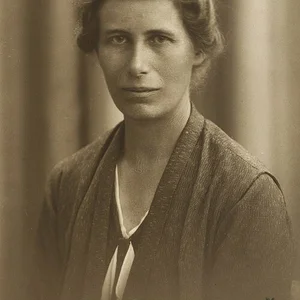

Danish seismologist (1888–1993), Inge Lehmann discovered in 1936 that the Earth has a solid inner core, through the analysis of seismic waves. This fundamental discovery reshaped our understanding of Earth's internal structure.
Inge Lehmann(1888 — 1993)
Inge Lehmann
Royaume de Danemark
8 min read
Frequently asked questions
Key Facts
- Born on May 13, 1888, in Copenhagen, Denmark
- Publishes in 1936 the paper “P’” proposing the existence of a solid inner core within the Earth
- Analyzes the seismic waves from the Murchison earthquake (New Zealand, 1929) to support her theory
- The “Lehmann discontinuity” (~220 km deep in the mantle) is named in her honor
- Dies on February 21, 1993, at the age of 104, after an exceptionally long scientific career
Works & Achievements
Lehmann's landmark paper in which she demonstrated, through analysis of P seismic waves at large epicentral distances, the existence of a solid inner core within the Earth's liquid outer core. It stands as one of the major discoveries in twentieth-century geophysics.
Lehmann designed, installed, and managed for nearly thirty years a network of seismographic stations covering Denmark and Greenland, producing high-quality data for the international seismological community.
After her retirement, Lehmann identified a discontinuity in the Earth's upper mantle — now known as the "Lehmann discontinuity" — making a second major contribution to our understanding of the internal structure of the globe.
An autobiographical text in which Lehmann traces the development of seismology throughout the twentieth century, offering an irreplaceable firsthand account of the human and instrumental history of the discipline.
Anecdotes
In 1936, Inge Lehmann published her revolutionary discovery in a scientific paper of striking brevity, titled simply 'P''. This text of only a few pages overturned the understanding of Earth's internal structure and was gradually accepted by the scientific community, despite initial skepticism.
Without a computer or electronic calculator, Lehmann performed all her calculations by hand. She cut out dozens of small slips of paper that she pinned to hatbox lids to organize and compare seismic data from different stations. Her methodological rigor allowed her to identify an anomaly that no one had noticed before her.
As a woman in a male-dominated scientific world, Inge Lehmann had to fight her entire life to be taken seriously. Her school principal, Hanna Adler, was known for treating girls and boys in a strictly equal manner — an early experience that forged her self-confidence and her conviction that women could excel in science.
Inge Lehmann lived to the exceptional age of 104, continuing to publish scientific papers well past retirement age. She gave her last lecture at over 80 years old and remained intellectually active until the end of her life, corresponding with colleagues from around the world.
In 1997, four years after her death, the American Geophysical Union established the Inge Lehmann Medal to honor scientists who contribute to the understanding of Earth's internal structure. It is one of the highest distinctions in geophysics, a testament to the lasting importance of a discovery made with the rudimentary means available in the 1930s.
Primary Sources
Data from seismic stations reveal, at certain epicentral distances, arrivals of P waves that can only be explained by the existence of a distinct inner core, whose propagation velocity is higher than that of the outer core.
In the early decades of the twentieth century, seismology was still a nascent science. Seismographs were imprecise, data were scarce, and the work of interpretation demanded extraordinary patience and rigor.
Analysis of seismic wave travel times in the upper layers of the mantle reveals the existence of significant discontinuities in propagation velocity, indicating changes in the composition or state of the materials through which the waves pass.
I believe that the anomaly observed in the recordings from the shadow zone can only be explained by the presence of a solid body at the center of the core. Travel time calculations seem to confirm this.
Key Places
Inge Lehmann's birthplace and the center of her entire scientific career. She worked there at the Geodetic Institute of Denmark and spent virtually her whole life in the city.
The institution where Lehmann spent the bulk of her professional career, developing and overseeing the Danish and Greenlandic network of seismographic stations, and where she conducted the research that would lead to her 1936 discovery.
Site of one of the key seismographic stations managed by Lehmann, whose recordings of distant seismic waves directly contributed to her analyses of the deep structure of the Earth.
A seismically active area where a major earthquake struck in 1929, whose waves were analyzed by Lehmann. Data from stations in this region played a crucial role in the discovery of the inner core.
The city where Lehmann stayed after her official retirement, working in particular at the Institute for Advanced Study, where she continued her research on the structure of Earth's mantle well into old age.
Liens externes & ressources
Références
Œuvres
Réseau sismographique danois et groenlandais
1925–1953
Études sur la discontinuité dans le manteau supérieur (discontinuité de Lehmann)
1959–1961
Seismology in the days of old (mémoires scientifiques)
1987