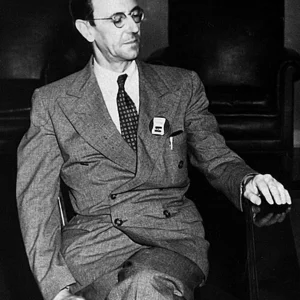

British physicist (1891–1974), James Chadwick discovered the neutron in 1932, earning him the Nobel Prize in Physics in 1935. He later led the British contribution to the Manhattan Project.
James Chadwick(1891 — 1974)
James Chadwick
Royaume-Uni
7 min read
Frequently asked questions
Key Facts
- Born on 20 October 1891 in Bollington, England
- Discovery of the neutron in 1932, published in Nature
- Nobel Prize in Physics in 1935 for this discovery
- Led the British mission (Tube Alloys) integrated into the Manhattan Project (1943–1945)
- Died on 24 July 1974 in Cambridge
Works & Achievements
Short letter published in the journal Nature announcing for the first time the existence of the neutron. This one-page text permanently changed our understanding of the structure of matter.
Full article published in the Proceedings of the Royal Society, describing in detail the experiments and calculations that led to the discovery of the neutron.
Speech delivered at the Nobel Prize in Physics ceremony, in which Chadwick outlines the properties of the neutron and the prospects this discovery opens up for nuclear physics.
Top-secret British scientific report concluding that an atomic bomb using enriched uranium was feasible, to which Chadwick contributed and which accelerated American involvement in the Manhattan Project.
A comprehensive reference work co-authored with Rutherford that served for years as the authoritative educational resource on radioactivity and the properties of the atomic nucleus.
Anecdotes
In August 1914, Chadwick was in Berlin for a research placement with Hans Geiger when the First World War broke out. Classified as an enemy alien, he was interned at the Ruhleben civilian camp near Berlin for four years. Rather than giving in to despair, he obtained permission from the German authorities to carry out small experiments inside the camp, keeping his passion for physics alive even in captivity.
In February 1932, after reading a paper by the Joliot-Curies describing a mysterious radiation emitted by bombarded beryllium, Chadwick immediately sensed that this must be the neutron — the chargeless particle Rutherford had postulated a decade earlier. He worked relentlessly for ten days, running experiments day and night, before announcing his discovery in a letter to the journal Nature on 27 February 1932. His director Rutherford is said to have told him: “Now I believe in your neutron.”
When he received the Nobel Prize in Physics in 1935, Chadwick was so naturally reserved that he made no effort whatsoever to publicise his achievement. Colleagues described him as rigorous, taciturn, and sometimes brusque, yet possessed of absolute scientific integrity. He would often say that his discovery would not have been possible without decades of collective work in Rutherford’s school.
During the Manhattan Project (1943–1945), Chadwick served as the British government’s official liaison to the Americans at Los Alamos. He played a delicate diplomatic role, ensuring that Britain’s scientific contribution was acknowledged and that information about the atomic bomb could be passed back to London. When he witnessed the Trinity test explosion in July 1945, he stood in silence, fully aware of the irreversible change that moment represented for humanity.
Chadwick suffered from anxiety and chronic insomnia throughout his life, which he himself attributed to his years of internment in Germany. Despite this, he led the physics department at the University of Liverpool with great effectiveness from 1935, transforming the laboratory into one of the United Kingdom’s foremost nuclear research centres, complete with one of the first cyclotrons built in Britain.
Primary Sources
It is possible to suppose that the radiation consists of particles of mass 1 and charge 0, or neutrons. The capture of the proton then gives a deuton.
The neutron hypothesis is supported by experiments on the recoil atoms. If we suppose that the 'beryllium radiation' consists of particles of mass 1 and charge 0, we can give a consistent account of all the observations.
The simplest hypothesis one can make about the nature of the neutron is to suppose that it is a new kind of particle with a mass approximately equal to that of the proton but without any charge.
I think I have found the neutron… I am sending you a letter for Nature. Please look at it and if you think it is all right, send it off at once.
Key Places
Birthplace of James Chadwick, born on 20 October 1891 in this small town in the north-west of England.
One of the world's leading centres for physics, where Chadwick worked under Rutherford's supervision from 1919 and where, in 1932, he conducted the experiment that led to the discovery of the neutron.
A German civilian internment camp where Chadwick was held throughout the First World War (1914–1918), during which he nonetheless managed to carry out small scientific experiments.
Chadwick served as full professor of physics here from 1935 to 1948, transforming the department into a major centre for nuclear research in the United Kingdom.
The secret site of the Manhattan Project where Chadwick led the British scientific delegation between 1943 and 1945, contributing to the development of the first atomic bomb.
Typical Objects

Chadwick used this instrument to detect and measure the radiation emitted during his experiments on beryllium. It was thanks to this detector that he was able to quantify the energy of the recoil particles and identify the neutron.

Beryllium, bombarded by alpha particles from a polonium source, was the central element of the experiment that led to the discovery of the neutron in 1932.

Polonium, the highly radioactive element discovered by Marie Curie, was used by Chadwick as an emitter of alpha particles to bombard his beryllium target.

Placing a block of paraffin (rich in hydrogen) between the source and the detector allowed Chadwick to observe the recoil of protons, proving that the mysterious radiation consisted of particles with a mass close to that of the proton.

Chadwick had worked alongside Hans Geiger, the inventor of this radiation detector. He used similar instruments throughout his career to characterize nuclear radiation.

After his discovery of the neutron, Chadwick had one of the first British cyclotrons built at the University of Liverpool to produce accelerated particles and continue nuclear research.
School Curriculum
Vocabulary & Tags
Key Vocabulary
Tags
Daily Life
Morning
Chadwick arrived early at the Cavendish Laboratory, often before his students. He devoted the first hours to reading international scientific literature — particularly German journals — and to meticulously planning the day's experiments. He was known for his strict punctuality.
Afternoon
Afternoons were entirely dedicated to experimental work: calibrating detectors, preparing radioactive sources, repeated measurements, and data verification. Chadwick personally supervised every step, insisting on the reproducibility of results before any publication.
Evening
In the evenings, Chadwick compiled the day's results, drafted notes, and answered scientific correspondence. Having suffered from chronic insomnia since his internment in Germany, he would sometimes return to his calculation notebooks in the middle of the night.
Food
Like most British middle-class contemporaries, Chadwick ate simply: porridge in the morning, sandwiches or hot meals at lunch in the university cafeteria. His long years of rationing in an internment camp had left him undemanding about food.
Clothing
In the laboratory, Chadwick wore the suit and tie typical of British scientists of the 1920s–1940s, usually covered by a white lab coat. Understated in his dress, he avoided any outward sign of distinction, even after receiving the Nobel Prize.
Housing
In Cambridge, Chadwick lived in a comfortable middle-class house near the university, as did most fellows of Gonville and Caius College, of which he was a member. The academic environment of Cambridge, with its centuries-old colleges and gardens, was at the heart of his daily life.
Historical Timeline
Period Vocabulary
Liens externes & ressources
Références
Œuvres
Possible Existence of a Neutron
27 février 1932
The Existence of a Neutron
Juin 1932
Conférence Nobel : The Neutron and Its Properties
12 décembre 1935
Rapport MAUD (contribution)
1941
Radioactivity and Radioactive Substances
1921