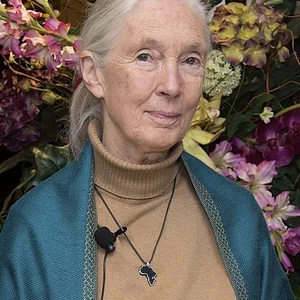

British ethologist and primatologist born in 1934, Jane Goodall is world-renowned for her pioneering research on chimpanzees in the Gombe forest of Tanzania. Her observations transformed our understanding of animal behaviour and human origins.
Jane Goodall(1934 — 2025)
Jane Goodall
Royaume-Uni
9 min read
Frequently asked questions
Famous Quotes
« You cannot get through a single day without having an impact on the world around you. What you do makes a difference, and you have to decide what kind of difference you want to make.»
« The greatest threat to our planet is the belief that someone else will save it.»
Key Facts
- 1960: begins chimpanzee research at Gombe Stream, Tanzania, commissioned by Louis Leakey
- 1965: earns her doctorate in ethology from Cambridge with no prior undergraduate degree
- 1977: founds the Jane Goodall Institute for conservation and research
- 1986: attends a conference that permanently transforms her into an environmental activist
- 2002: appointed UN Messenger of Peace by the United Nations
Works & Achievements
Goodall's first major popular science book on her research at Gombe, translated into dozens of languages. It revealed to the general public the intimate details of chimpanzee social life and established her as a globally recognized scientific figure.
A landmark seven-hundred-page scientific monograph synthesizing twenty-five years of behavioral data. A foundational work in modern field primatology, still cited as a reference in the scientific literature.
An international organization founded to support primate research and forest conservation in central Africa. The Institute now runs community conservation programs in more than thirty countries.
A global youth network dedicated to protecting the environment, animals, and human communities. Considered one of Goodall's most enduring legacies, it brings together millions of young people in more than sixty countries.
An intellectual autobiography in which Goodall explains why, despite widespread environmental destruction, she remains hopeful. A key book for understanding her transition from scientific research to global environmental activism.
A reforestation and community development initiative around Lake Tanganyika, linking forest conservation with improvements in local living conditions. An innovative model that has shaped participatory conservation policies across Africa.
Anecdotes
In October 1960, during her first weeks at Gombe, Jane Goodall observed a chimpanzee she nicknamed David Greybeard fashioning a grass stem to extract termites from a termite mound — a behavior never before recorded in a non-human animal. The discovery prompted paleoanthropologist Louis Leakey to send her a famous telegram: “Now we must redefine tool, redefine man, or accept chimpanzees as humans.” Until then, toolmaking had been considered the exclusive domain of Homo sapiens.
Jane Goodall had no university degree when Louis Leakey hired her in 1957 as a secretary at the natural history museum in Nairobi. He believed that the lack of academic training was actually an advantage: she would observe animals without preconceived ideas. She was admitted to Cambridge to pursue a doctorate based directly on her field notes, and earned it in 1965 — one of the very few people ever to have done so without a bachelor's degree.
The scientific community of the 1960s sharply criticized Goodall for giving chimpanzees names rather than numbers. Her peers argued that this practice anthropomorphized the subjects of study and compromised scientific objectivity. She stood her ground, maintaining that each chimpanzee had a distinct personality — a conviction now widely accepted in ethology and validated by decades of comparative research.
In 1986, Goodall attended an international conference on chimpanzees in Chicago where she saw satellite maps for the first time showing the massive destruction of African forests. She entered the room as a researcher and left as an activist, declaring: “I arrived as a scientist and left as an activist.” She almost entirely gave up fieldwork and devoted the rest of her life to traveling the world to champion animal and environmental causes.
In 1991, Jane Goodall founded the Roots & Shoots program in her living room in Dar es Salaam with about a dozen Tanzanian high school students. The idea: to mobilize young people to take concrete action for their communities, animals, and the environment. Over the decades, Roots & Shoots grew to unite several million young people in more than sixty countries, becoming one of the world's largest networks of engaged youth.
Primary Sources
David Greybeard picked up a piece of grass, stripped off the leaves, and poked it into the termite mound. After a moment he withdrew it, and I saw that it was covered with termites. He ate them off and then dipped it in again. [...] I had witnessed a chimpanzee not only using but actually making a tool.
Now we must redefine tool, redefine man, or accept chimpanzees as humans.
Tool use in chimpanzees is not a unitary phenomenon. Different populations use different tools in different ways, suggesting cultural transmission of learned behaviors across generations rather than purely genetic determination.
The chimpanzees of Gombe show a complex social structure with strong family bonds, political alliances, and learned cultural behaviors transmitted across generations — characteristics long believed unique to human societies.
Every individual matters. Every individual has a role to play. Every individual makes a difference. We cannot live through a single day without making an impact on the world around us — and we have a choice about what sort of impact we make.
Key Places
Tropical forest on the shores of Lake Tanganyika where Goodall settled in 1960 and conducted her research for more than thirty years. This is the site of all her major discoveries regarding tool use, social behaviour, and warfare between chimpanzee groups.
Goodall earned her doctorate in ethology here in 1965 under the supervision of Robert Hinde, being one of the few people admitted without a prior undergraduate degree. Cambridge gave her the academic legitimacy that amplified the international reach of her work.
Coastal town in Dorset where Jane Goodall was born on 3 April 1934 and grew up. Her love of nature and animals was awakened in the gardens and clifftops of this seaside town, where her mother encouraged her curiosity about the living world from an early age.
The place where Jane Goodall met Louis Leakey in 1957, while she was working as a secretary. This decisive encounter was the starting point of her entire scientific career and of her departure for Gombe.
Tanzania's economic capital, where Goodall coordinated part of her activities and where, in 1991, she founded the Roots & Shoots programme with a group of secondary school students, laying the foundations for the world's largest youth environmental network.
Liens externes & ressources
Références
Œuvres
In the Shadow of Man
1971
The Chimpanzees of Gombe: Patterns of Behavior
1986
Jane Goodall Institute
1977
Programme Roots & Shoots
1991
Reason for Hope: A Spiritual Journey
1999
Programme TACARE
1994