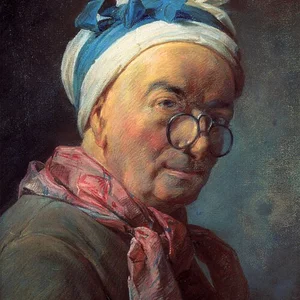

Jean Siméon Chardin (1699-1779) was an 18th-century French painter, a master of still life and genre scenes. Going against the rococo painting of his time, he celebrated domestic life and everyday objects with a subtle touch and a rare sense of light.
Jean-Baptiste Chardin(1699 — 1779)
Jean Siméon Chardin
France
7 min read
Frequently asked questions
Famous Quotes
« We use colors, but we paint with feeling.»
Key Facts
- Born in Paris in 1699 into a family of cabinetmaker artisans
- Admitted to the Royal Academy of Painting in 1728 thanks to “The Ray”
- Specialized in still life and genre scenes (Saying Grace, The Return from Market)
- Appointed treasurer of the Royal Academy in 1755 and given lodgings at the Louvre
- Died in Paris in 1779, rediscovered in the 19th century by the Goncourt brothers
Works & Achievements
Striking still life of a gutted fish, accompanied by a cat and kitchen utensils. The reception piece that opened the doors of the Academy to Chardin in 1728.
Young boy absorbed in building a fragile structure of cards. An emblematic image of childhood concentration and the vanity of worldly things.
Portrait of a child gazing at a spinning top. A masterpiece in which time seems suspended by play.
A servant setting down her loaves of bread on returning from her errands, in a plain interior. A tribute to the dignity of everyday gestures.
A mother teaching her children the prayer said before meals. Presented to Louis XV, it embodies the intimate genre painting so dear to Chardin.
A mouth-watering still life of a golden brioche topped with an orange blossom. A celebration of the simple pleasures of the table.
A pastel in which the aging painter depicts himself wearing a cap, glasses perched on his nose. A lucid, unflinching testimony of a master growing old.
Anecdotes
In 1728, the young Chardin displayed his paintings outdoors on the Place Dauphine, during the “Exposition de la Jeunesse” (Youth Exhibition). The famous painter Largillierre, believing he was admiring Flemish works, was astonished to learn that they were by this complete unknown. A few months later, Chardin was admitted to the Royal Academy of Painting thanks to his “The Ray”.
Chardin painted with extreme slowness, patiently layering tiny touches of color. Seen up close, his paintings look like a rough sketch of blotches; you have to step back a few paces for the objects to come to life. The philosopher Diderot, marveling, exclaimed that one “understood nothing of this magic”.
Late in his life, his eyesight failed and the fumes of oil paint bothered him. Around 1771, he turned to pastel and created striking self-portraits, wearing a cap and an eyeshade, with spectacles perched on his nose: at more than 70 years old, he depicted himself without flattery, just as he was.
Chardin lodged at the Louvre Palace, where the king granted studios to artists. For years he was also the Salon's “tapissier” (hanging supervisor): it was he who decided how the paintings were hung in the Salon Carré, a delicate task in which everyone wanted the best spot.
In 1740, Chardin was presented to Louis XV at Versailles and gave him two genre scenes, including “The Benediction”, which shows a mother teaching her children to say grace before the meal. Thus the king of the château's splendors welcomed into his collections modest scenes of everyday bourgeois life.
Primary Sources
O Chardin! It is not white, red, or black that you grind on your palette: it is the very substance of objects, it is air and light that you take with the tip of your brush and fix onto the canvas.
The object is disgusting, but it is the very flesh of the fish, it is its skin, it is its blood; the actual sight of the thing would affect us no differently.
He worked with great slowness and was never satisfied until he had rendered the truth with exactness.
Key Places
Street in the Saint-Germain-des-Prés district where Chardin was born in 1699, into the family of a master cabinetmaker. He spent his youth there.
Institution housed in the Louvre, where Chardin was admitted in 1728, later becoming councillor, treasurer and tapissier (hanging supervisor). It governed the careers of the kingdom's artists.
Large hall in the Louvre where the Salon was held, the public exhibition of the Academy's works. Chardin showed his paintings there and arranged their hanging.
Studio-apartment granted to Chardin by the king within the Palace of the Louvre. He worked there and died there in 1779.
Royal residence where Chardin was presented to Louis XV in 1740 and offered him two genre scenes. The king thus acquired works by the painter.
Typical Objects

The painter's basic tools, on which Chardin ground and mixed his colors. He layered thin strokes to render the very substance of objects.

Sticks of powdery color that Chardin took up late in life, when oil painting strained his eyes. They made his last self-portraits possible.

Cauldrons, saucepans, and basins of red copper that fill his kitchen still lifes. Chardin excelled at rendering their reflections and their wear.

A golden pastry crowned with an orange blossom, the subject of a famous 1763 still life. It reflects Chardin's taste for the simple pleasures of the table.

Playing cards stacked into a fragile structure, the motif of a celebrated painting. In Chardin's work, it symbolizes the fragility of things and the carefree spirit of childhood.

A small top set spinning with a flick of the finger, at the center of the painting *Boy with a Teetotum*. It evokes the suspended time of a child's play.

Old-fashioned eyeglasses that Chardin wears in his pastel self-portraits, a rimmed frame perched on his nose. They bear witness to his failing eyesight.
School Curriculum
Vocabulary & Tags
Key Vocabulary
Daily Life
Morning
Chardin began his day in his studio at the Louvre, in the north-facing light, ideal for painting. He carefully arranged the objects of his still lifes — fruit, pitchers, game — before laying down his first brushstrokes.
Afternoon
In the afternoon, he painted slowly, returning again and again to the same canvas, layering the colors one over another. When he served as treasurer of the Academy, he also devoted time to the accounts and to preparing for the Salon.
Evening
In the evening, Chardin rejoined his family and sometimes welcomed fellow artists and art lovers. The conversations revolved around painting, commissions, and news from the Academy.
Food
In 18th-century Paris, people ate bread, soup, vegetables from the market, and sometimes meat or fish. Chardin's still lifes reflect this middle-class fare: brown bread, fruit, game, and kitchen utensils.
Clothing
Chardin wore the plain attire of a Parisian bourgeois: a justaucorps, a waistcoat, breeches, and stockings. In his self-portraits, he appears wearing a simple work cap tied with a ribbon, far from the powdered wigs of the courtiers.
Housing
He lived for many years in his lodging-studio at the Louvre, granted to artists by the king. It was a modest, functional interior, much like the plain rooms he loved to depict in his genre scenes.
Historical Timeline
Period Vocabulary
Liens externes & ressources
Références
Œuvres
La Raie
vers 1725-1728
Le Château de cartes
vers 1737
L'Enfant au toton (Le Fils de M. Le Noir)
1738
La Pourvoyeuse (Le Retour du marché)
1739
La Brioche
1763
Autoportrait aux bésicles
vers 1771