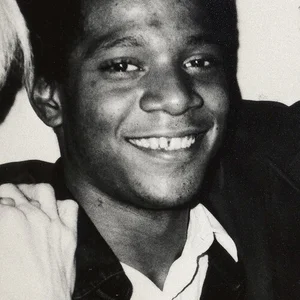

American painter of Haitian and Puerto Rican descent, a major figure of Neo-Expressionism and New York street art in the 1980s. First a graffiti artist under the pseudonym SAMO, he became an international star before his untimely death at the age of 27.
Jean-Michel Basquiat(1960 — 1988)
Jean-Michel Basquiat
États-Unis
6 min read
Frequently asked questions
Famous Quotes
« I don't think about art when I'm working. I try to think about life.»
Key Facts
- Born on December 22, 1960 in Brooklyn (New York) to Haitian and Puerto Rican parents
- From 1977, tagged the walls of Manhattan under the pseudonym SAMO alongside Al Diaz
- 1981-1982: meteoric rise on the art scene, exhibitions and international recognition
- Collaborated with Andy Warhol between 1984 and 1985
- Died of an overdose on August 12, 1988 in New York, at the age of 27
Works & Achievements
Poetic and provocative phrases tagged on the walls of Manhattan, which introduced Basquiat to the urban scene under an enigmatic pseudonym.
A canvas depicting a skull-head in vivid colors, which became emblematic of his style blending primitivism and anatomy.
A New York street scene illustrating his graphic energy and his attachment to everyday urban culture.
A work with electric, colorful figures, reflecting the artist's most prolific year; sold for 48.8 million dollars in 2013.
A canvas denouncing racial stereotypes in American cinema, in which Basquiat portrays himself alongside his rapper friends.
A series of canvases painted four-handed, blending Warhol's pop imagery with Basquiat's raw signs.
One of his last works, a human figure riding a skeleton, often read as a premonition of his death.
Anecdotes
As a teenager, Basquiat tagged the walls of southern Manhattan with his friend Al Diaz under the signature 'SAMO©' (for 'Same Old Shit'). Their poetic, provocative phrases so intrigued the art world that, at first, no one knew who was behind the pseudonym.
Before he was recognized, Basquiat sold hand-painted postcards and t-shirts on the street. One day, he reportedly dared to sell one to Andy Warhol while the artist was sitting in a restaurant: amused, Warhol bought one, and the two artists would later become close friends and collaborators.
At just 21, in 1982, Basquiat became one of the youngest artists ever invited to Documenta in Kassel, Germany, one of the most prestigious contemporary art exhibitions in the world. His international fame was meteoric.
As a child, Basquiat was hit by a car and hospitalized. His mother gave him the famous anatomy manual 'Gray's Anatomy'. The book left a deep mark on him: throughout his life, skeletons, skulls, and organs would recur in his paintings.
His death at 27, in 1988, placed him in the infamous '27 club', the artists who died at that same age. In 2017, one of his canvases depicting a skull sold for 110.5 million dollars, a record for an American artist.
Primary Sources
“SAMO© as an end to mosh*t” and “SAMO© saves idiots” — slogans spray-painted in the SoHo and Lower East Side neighborhoods.
“I don't think about art when I'm working. I try to think about life.” Basquiat reflects on his instinctive relationship with painting.
Cover story presenting Basquiat as the new star of the New York art market, illustrating his meteoric rise to fame.
First major group exhibition including Basquiat's works alongside other artists of the New York urban scene.
Key Places
The neighborhood where Basquiat was born, growing up in a middle-class family of Haitian and Puerto Rican descent.
The neighborhoods where the young Basquiat tagged his SAMO© inscriptions and frequented New York's underground art scene.
Warhol's studio-workshop where Basquiat collaborated with him in the early 1980s and became acquainted with the artistic elite.
The city that hosts the prestigious Documenta exhibition; in 1982, Basquiat was the youngest artist exhibited there, a sign of his international recognition.
The loft Basquiat rented from Andy Warhol, where he lived and worked until his death in 1988.
Liens externes & ressources
Références
Œuvres
Inscriptions SAMO©
1977-1980
Untitled (Crâne)
1981
Boy and Dog in a Johnnypump
1982
Dustheads
1982
Collaborations avec Andy Warhol
1984-1985
Riding with Death
1988