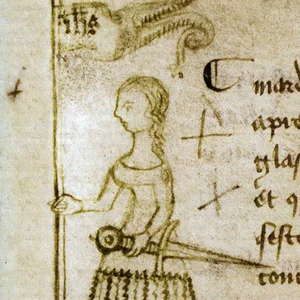

Joan of Arc (1412–1431) was a French heroine who played a decisive role during the Hundred Years' War. Inspired by religious visions, she led the French armies to several victories against the English. Captured, tried for heresy, and burned at the stake in Rouen, she became an iconic figure of France.
Frequently asked questions
Famous Quotes
« Act, and God will act.»
« One deed is worth more than a thousand words.»
Key Facts
- 1429: Lifting of the siege of Orléans, first major military victory against the English
- 1429: Coronation of Charles VII at Reims, legitimizing his kingship
- 1430: Captured at Compiègne by the Burgundians and handed over to the English
- 1431 (May 30): Tried in Rouen for heresy and witchcraft
- 1431 (June 8): Executed by burning at the stake; canonized in 1920
Works & Achievements
In just nine days, Joan of Arc and the French captains liberate Orléans from the English. This military feat reverses the course of the Hundred Years' War and restores hope to the French camp.
A decisive victory over the English archers, capturing the renowned captain Talbot. This battle erases the trauma of Agincourt and opens the road to Reims for the coronation of Charles VII.
Joan leads the royal army from Gien to Reims through enemy territory. With the coronation accomplished, she holds her banner at the king's side, fulfilling the central objective of her mission.
Joan dictates several official letters to the enemies of France, asserting that she acts in God's name. These documents are unique historical records that bear witness to her moral and political authority.
Joan leads the assault on Paris, then in the hands of the Anglo-Burgundians. She is wounded in the thigh by a crossbow bolt but continues to command until the king orders the retreat.
Anecdotes
At only 17 years old, Joan of Arc presented herself to the lord Robert de Baudricourt in Vaucouleurs to request an escort to reach the Dauphin Charles. Initially mocked and sent back home, she returned with such determination that he eventually granted her request. This tenacity in the face of adult disbelief impressed her contemporaries.
During her meeting with Dauphin Charles VII at Chinon in February 1429, Joan identified him among his court even though he had mingled with his courtiers to deceive her. She revealed to him a 'secret sign' that only he could have known, which convinced the Dauphin to grant her his trust. This episode remains one of the most mysterious of her life.
During the siege of Orléans in May 1429, Joan was wounded by an arrow in the shoulder. She removed the bolt herself, briefly tended to her wound, and returned to combat that same day to galvanize the French troops. Her bravery astonished both soldiers and captains alike.
During her trial in Rouen in 1431, the ecclesiastical judges repeatedly attempted to trap her with learned theological questions. Joan, illiterate and untrained, responded with remarkable subtlety. When asked 'Are you in a state of grace?', she declared: 'If I am not, may God place me there; if I am, may God keep me there.' This answer left her judges speechless.
Condemned to be burned at the stake on May 30, 1431, in Rouen, Joan asked an English soldier to make her a small cross from two pieces of wood. She held it tightly against her chest until her final moments. According to eyewitness accounts, her last words were the name of Jesus.
Primary Sources
Asked whether she knew that God hated the English, she replied: 'Of the love or hatred that God has for the English, I know nothing; but I know well that they will be driven out of France, except those who die there.'
Jean Pasquerel, her confessor, testified: 'She often wept and commended herself to God and to the Virgin Mary. Never did I see her blaspheme, never did I hear her swear.'
I require and beg you, as earnestly as I can, that you be careful and diligent in the provisioning of the said city of Orléans, with powder, bolts, and other things necessary for the conduct of war.
The Maid wore white armor and rode a black horse, holding in her hand a white banner strewn with fleurs-de-lis, and called upon the English to surrender into the hand of God.
On the eighth day of May 1429, the siege of Orléans was lifted by the English, a most wondrous thing, for in but a few days the Maid had accomplished what the captains had been unable to do in many long months.
Key Places
Joan of Arc's birthplace, where she grew up and received her first visions around the age of 13. The family home, still standing today, is listed as a historic monument.
A city besieged by the English since October 1428, Joan entered it on April 29, 1429 and lifted the siege on May 8. This victory earned her the nickname 'the Maid of Orléans'.
The site of Charles VII's coronation on July 17, 1429, in Joan of Arc's presence. This coronation legitimized the King of France against English claims and represented the fulfillment of Joan's mission.
It was in the great hall of Chinon castle that Joan met the Dauphin Charles in March 1429 and convinced him to entrust her with an army. This meeting proved decisive for the course of the war.
A city under English control where Joan was tried, condemned, and burned at the stake on May 30, 1431. The Place du Vieux-Marché now houses a church and a memorial in her memory.
A town in Lorraine where Joan traveled twice to convince captain Robert de Baudricourt to provide her with an escort to the Dauphin. It marks the starting point of her remarkable journey.
Typical Objects

Joan carried into battle a white standard embroidered with fleurs-de-lis and depicting Christ in majesty. She declared she held this standard dearer than her sword, as it symbolized the divine mission she believed herself entrusted with.

After the lifting of the siege of Orléans, Joan received a complete set of plate armor forged to her measure, of a brilliant white. This armor protected her in battle and gave her an imposing presence on the battlefield.

According to Joan, voices told her that an ancient sword was buried behind the altar of the church of Sainte-Catherine-de-Fierbois. It was indeed found there, and Joan made it her weapon of choice.

During her trial in Rouen, Joan was dressed in men's clothing throughout the interrogations. The wearing of male attire was one of the charges brought against her by the ecclesiastical tribunal.

At the moment of her execution, Joan asked a soldier to make her a rough wooden cross. She held it pressed against her chest until her death, bearing witness to her deep faith and courage in her final moments.

Before the siege of Orléans, Joan dictated a letter of summons to the English commanders ordering them to leave France. This document, dictated because she was illiterate, reveals her confidence and her sense of mission.
School Curriculum
Vocabulary & Tags
Key Vocabulary
Daily Life
Morning
During her military campaign, Joan would rise at dawn to attend Mass, a practice she observed scrupulously every day. Her confessor Jean Pasquerel testified that she confessed and received communion very frequently, sometimes daily. She would then begin organizing troop movements with the captains.
Afternoon
The afternoon was devoted to military activities: inspecting fortifications, preparing assaults, or reconnaissance rides. Joan actively took part in combat, carrying her banner at the head of the troops rather than fighting with a sword. She also dictated letters to enemies or to towns being called upon to submit.
Evening
In the evening, Joan held council with the military commanders, sometimes disagreeing with them on strategy. According to testimonies, she slept little and often wept at the sight of the wounded and the dead. Before falling asleep, she prayed at length and refused the company of loose women who followed the army.
Food
Joan ate frugally, preferring bread soaked in wine diluted with water. She did not take part in the military banquets and feasts of the time. Her diet was that of a Lorraine peasant: rye bread, vegetables, and a little meat on feast days.
Clothing
On campaign, Joan permanently wore her full suit of white plate armour, which was unusual for a woman and formed one of the charges brought against her at her trial. Under the armour, she wore men's clothing (breeches, doublet) for practical reasons. She had short hair cut in a round crop, in the fashion of men of war.
Housing
In Domrémy, Joan lived in a modest half-timbered stone house shared with her parents Jacques d'Arc and Isabelle Romée, and her brothers and sisters. On campaign, she lodged with townspeople or in military quarters, always refusing to share space with men. In Rouen, she was imprisoned in a tower of the castle, chained and guarded by English soldiers.
Historical Timeline
Period Vocabulary
Visual Style
Style inspiré des enluminures gothiques tardives et de la peinture flamande du XVe siècle, avec une palette riche en bleus lapis, ors et écarlates, typique des manuscrits royaux de l'époque.
Sound Ambience
Un mélange de sons ruraux lorrains du XVe siècle, de bruits militaires de campagne et de résonances religieuses gothiques, évoquant à la fois la paix du village natal et la violence des batailles.
Liens externes & ressources
Références
Œuvres
Levée du siège d'Orléans
8 mai 1429
Victoire de Patay
18 juin 1429
Sacre de Charles VII à Reims
17 juillet 1429
Lettres de sommation aux Anglais et aux Hussites
1429
Tentative de reprise de Paris
8 septembre 1429