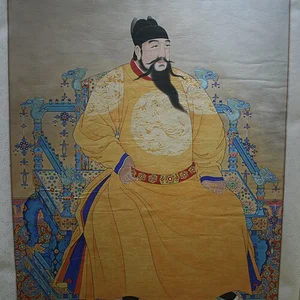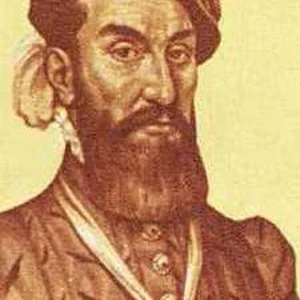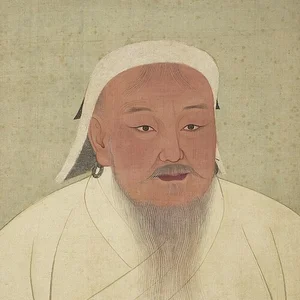

Founder and first Great Khan of the Mongol Empire, Genghis Khan unified the nomadic tribes of Central Asia in the early 13th century. His conquests created the largest contiguous empire in history.
Gengis Khan(1162 — 1227)
Genghis Khan
Empire mongol
7 min read
Frequently asked questions
Famous Quotes
« The greatest happiness is to vanquish your enemies, to chase them before you, to rob them of their wealth, to see those dear to them bathed in tears, to clasp to your bosom their wives and daughters.»
Key Facts
- c. 1162: birth of Temüjin, the future Genghis Khan, on the Mongolian steppe
- 1206: proclaimed Genghis Khan (universal ruler) at the great kurultai, unification of the Mongol tribes
- 1211–1215: invasion of northern China (Jin dynasty), capture of Beijing in 1215
- 1219–1221: conquest of the Khwarezmian Empire (Central Asia, Persia)
- 1227: death of Genghis Khan during the campaign against the Xi Xia kingdom
Works & Achievements
Over twenty years of warfare and alliances, Temüjin brought all the nomadic tribes of the Mongol steppe under his authority. This founding act ended centuries of internal conflict and gave birth to the Mongol nation.
An oral law code proclaimed at the Kurultai of 1206, the Yasa governed military, civil, and criminal life across the empire. It notably guaranteed religious freedom and established meritocracy within the army.
A network of horse relay stations spanning the entire empire, the Yam enabled messages to be transmitted and armies to move at speeds previously unheard of. This system allowed effective administration of a vast territory.
Military campaigns that extended the Mongol Empire from Manchuria to Persia, permanently reshaping the political order of Eurasia. These conquests brought the Silk Road under Mongol protection, facilitating trade and exchange between East and West.
Genghis Khan structured his army into units of 10, 100, 1,000, and 10,000 men (the tümen), cutting across tribal affiliations. This revolutionary organization broke down clan loyalties and forged a military force entirely devoted to the Khan.
Anecdotes
According to Mongol tradition, Genghis Khan was born clutching a blood clot in his hand — an omen of his warrior destiny. His real name was Temüjin, which he only changed to 'Genghis Khan' (universal ruler) in 1206, at the great gathering of Mongol tribes on the banks of the Onon River.
Captured as a child by a rival tribe, Temüjin managed to escape by hiding in a river with only his face above water. This episode, recorded in the Secret History of the Mongols, illustrates the cunning and resilience that defined his entire life.
Genghis Khan established the Yasa, an oral code of laws that notably guaranteed religious freedom throughout the empire. He received Buddhist monks, Christian priests, and Muslim ulema alike, seeking to understand each religion without adopting any of them.
To keep his armies moving at speed, Genghis Khan created a network of horse relay stations called the Yam, enabling messengers to cover up to 300 kilometers a day. This communication system — a forerunner of the postal service — eventually spanned the entire empire from China to Persia.
Before his death in 1227, Genghis Khan asked to be buried in a secret location with no monument or inscription, so that no enemy could desecrate his tomb. According to legend, the soldiers who carried his body killed anyone who crossed their path, and his burial site has never been found.
Primary Sources
There was at the beginning of the world a blue-grey wolf, born with his destiny written in heaven, and a fallow doe. They crossed the inland sea together and settled at the headwaters of the Onon.
Temüjin was of great stature, of robust constitution, vigorous, with cat-like eyes. He surpassed all his contemporaries in courage and ability.
Chingis Cham was at first a simple individual, then became the greatest conqueror the world had ever known. He divided his army in the Roman fashion, into tens, hundreds, and thousands.
From the face of the earth, he wiped out the cities that had been the ornaments of the world, and he destroyed the greater part of the human race.
Key Places
A sacred mountain where Genghis Khan took refuge and prayed after an enemy attack during his youth. He regarded this place as his spiritual protector, and some sources say he wished to be buried there.
Capital of the Mongol Empire, founded around 1220 on the banks of the Orkhon River. The empire's administrative and commercial hub, it welcomed artisans, merchants, and diplomats from across Eurasia.
A great metropolis of the Silk Road, conquered and partially destroyed by Genghis Khan in 1220. Its capture symbolizes the conquest of Central Asia and the brutal rupture with the region's Islamic civilizations.
Capital of the Jin Empire, taken in 1215, whose sack represents the first major Mongol victory against an organized sedentary power. It later became Khanbaliq under Kublai Khan.
The birthplace of Temüjin, cradle of the Mongol tribes and site of the great Kurultai of 1206. It was here that the empire was born and Temüjin received the title of Genghis Khan.
Typical Objects

Made from bone, wood, and sinew, this short but powerful bow allowed Mongol horsemen to shoot with accuracy at 300 meters. It was the iconic weapon of conquest, used from the saddle at full gallop.

A circular, collapsible tent made of wool felt, the yurt was the nomadic home of the Mongol people. Genghis Khan himself lived and held court in a large yurt, a symbol of Mongol mobility and adaptability.

A symbolic engraved mark affixed to safe-conduct passes and imperial decrees, the tamga authenticated the authority of Genghis Khan. It facilitated the growth of trade along the Silk Road under Mongol protection.

A banner made of white or black horsehair, the tugh was the emblem of Genghis Khan's power. According to tradition, the standard bearing nine white horsehairs represented his authority in times of peace, the black one in times of war.

The close-combat weapon of Mongol warriors, the saber was used in hand-to-hand fighting after archer charges. Genghis Khan carried one set with jade and gold, a symbol of his military sovereignty.

A gold, silver, or wooden plaque engraved with the imperial seal, the paizi guaranteed its bearer protection and free passage throughout the entire empire. Genghis Khan distributed them to his ambassadors and merchants to secure trade.
School Curriculum
Vocabulary & Tags
Key Vocabulary
Tags
Daily Life
Morning
Genghis Khan rose before dawn, like any steppe nomad attuned to the rhythm of the seasons. He began his day with ritual offerings to the ancestral spirits (onggon) and the Eternal Sky (Tengri), then inspected his horses — the most prized possessions of a Mongol chief.
Afternoon
Afternoons were devoted to military and political affairs: audiences with generals (noyons), receiving ambassadors, and planning campaigns on felt maps. Equestrian tournaments and communal hunts (nerge) also trained warriors and supplied the camp with meat.
Evening
In the evening, Genghis Khan gathered his close companions and advisors in the great yurt for a feast of boiled meat and koumiss (fermented mare's milk). Musicians played the morin khuur and shamans recited warrior epics; it was also the time for important decisions made around the central fire.
Food
The Mongol diet was overwhelmingly meat-based: mutton, horse, and game, either boiled or dried into strips (borts) for campaigns. Koumiss, a fermented alcoholic drink made from mare's milk, was ever-present; dried cheese (aaruul) and millet soup rounded out daily meals.
Clothing
Genghis Khan wore a long tunic of felt wool or silk depending on the occasion, layered with a fur coat (deel) for the harsh steppe winters. On campaign, he donned lamellar armor of leather and metal, topped with a conical iron helmet; sable fur signaled his rank as Great Khan.
Housing
The yurt (ger) was the universal dwelling of the Mongols, assembled and dismantled in under an hour to follow the migration routes. Genghis Khan's was a large white yurt mounted on an ox-drawn cart — a symbol of power; inside, colorful rugs and wooden chests housed his personal treasures, weapons, and imperial seals.
Historical Timeline
Period Vocabulary
Visual Style
Palette des steppes mongoles : terres ocres et bruns chauds, avec le rouge et l'or des étendards, dans un style inspiré des miniatures persanes et des enluminures d'Asie centrale du XIIIe siècle.
Sound Ambience
Ambiance des grandes steppes d'Asie centrale : vent, chevaux au galop, feu de camp et musique nomade mongole traditionnelle.
Liens externes & ressources
Références
Œuvres
Unification des tribus mongoles
1190-1206
Le Yasa — Code de lois mongol
1206
Création du système postal Yam
vers 1210
Conquête de l'Asie centrale et de la Chine du Nord
1209-1227
Organisation de l'armée en décimales
1206