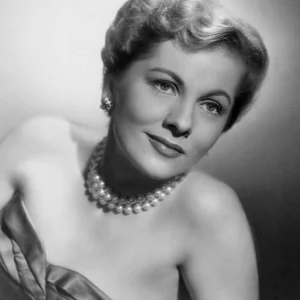

A British actress born in 1917 in Japan and died in 2013, Joan Fontaine became a major Hollywood star in the 1940s. She won the Academy Award for Best Actress in 1942 for Alfred Hitchcock's Suspicion, cementing her place among the great stars of classic American cinema.
Joan Fontaine(1917 — 2013)
Joan Fontaine
États-Unis, Royaume-Uni
8 min read
Frequently asked questions
Key Facts
- Born on October 22, 1917, in Tokyo, to British parents
- Won the Academy Award for Best Actress in 1942 for Suspicion (Alfred Hitchcock)
- Nominated for the Oscar for Rebecca (1940) and The Constant Nymph (1943), earning three consecutive nominations
- Sister of actress Olivia de Havilland, with whom she maintained a famous rivalry throughout their lives
- Died on December 15, 2013, in Carmel-by-the-Sea, California, at the age of 96
Works & Achievements
Alfred Hitchcock's first American film, adapted from Daphne du Maurier's novel. Joan Fontaine plays a young woman haunted by the ghost of her husband's first wife, earning her first Oscar nomination.
An Alfred Hitchcock thriller in which Joan Fontaine plays a woman convinced that her husband (Cary Grant) is plotting to kill her. The role earned her the Academy Award for Best Actress in 1942, a historic win in Hitchcock's filmography.
An adaptation of Charlotte Brontë's classic novel directed by Robert Stevenson, with Orson Welles as Rochester. Joan Fontaine brings a romantic sensitivity to the title role that perfectly suits her signature style.
A film by Max Ophüls, widely regarded by critics as one of Joan Fontaine's finest performances. She plays a woman hopelessly in love with a pianist who never remembers her, set against a hauntingly beautiful fin-de-siècle Vienna.
Joan Fontaine's memoirs, in which she reflects on her career, her four marriages, and her fraught relationship with her sister Olivia de Havilland. The book is a valuable primary source on the behind-the-scenes reality of Hollywood.
Anecdotes
Joan Fontaine and her sister Olivia de Havilland are the only sisters in Oscar history to have both won the Best Actress award. Their legendary rivalry, which lasted decades, reportedly began on the very night Joan received her Oscar in 1942: Olivia, nominated the same year, is said to have turned her back on her sister after the ceremony.
During the filming of Rebecca (1940), Alfred Hitchcock asked Joan Fontaine to genuinely feel intimidated by her co-stars. He reportedly told her in secret that the entire crew disliked her — a manipulation that allowed her to portray, with unsettling authenticity, the fragility of the nameless heroine in the face of the imposing Mrs. Danvers.
Born Joan de Beauvoir de Havilland in 1917 in Tokyo, Joan chose the stage name 'Fontaine' to distinguish herself from her sister Olivia, who was already an established presence in Hollywood. She took the name as a tribute to her stepfather, George Fontaine, determined to build an independent career without living in her older sister's shadow.
Joan Fontaine was the first actress to win an Oscar for a Hitchcock film. Paradoxically, the director initially opposed her casting in Suspicion (1941), preferring another actress. The film's success and its Academy recognition ultimately proved him wrong — and vindicated her against the objections of the RKO studio producers.
Primary Sources
I have never been able to say with certainty what my nationality is. Born in Tokyo of British parents, raised in California, I became an American citizen only after years of working in Hollywood.
Joan Fontaine accepts the Best Actress award for Suspicion, becoming the first — and to this day the only — actress to have won an Oscar for a film directed by Alfred Hitchcock.
Hitchcock told me I was surrounded by people who disliked me. I believed him completely. It made my performance possible. That was his genius — he understood how to use fear.
Miss Fontaine is hired for the female lead in Suspicion under the direction of Mr. Hitchcock. Studio management expresses reservations about her suitability for the role, but agrees to the screen test.
Key Places
Joan Fontaine was born in 1917 in the Japanese capital, where her father worked as a patent lawyer. This exotic, cosmopolitan upbringing shaped her entire life and contributed to the ambiguity of her national identity.
It was in Hollywood's studios that Joan Fontaine built her career throughout the 1930s–1960s, working notably for RKO Pictures and Universal. Hollywood was then the world capital of cinema and the heart of the star system.
It was under contract with RKO that Joan Fontaine filmed Suspicion with Alfred Hitchcock, the film that earned her the Academy Award in 1942. RKO was one of the five major studios of Hollywood's Golden Age.
The venue for the Academy Awards ceremonies in the 1940s, it was here that Joan Fontaine received her Best Actress award in 1942. This iconic theatre is a symbol of the Golden Age of American cinema.
Joan Fontaine settled in this elegant coastal California town for her final years and passed away there in December 2013 at the age of 96. This quiet, artistic community suited the cultured and private image she maintained away from the studios.
Typical Objects

Joan Fontaine received the golden statuette in 1942 for Suspicion, becoming one of the rare actresses to beat her own sister at the same ceremony. This Oscar symbolizes both her artistic triumph and the beginning of a legendary sibling rivalry.

Like all great actresses of Hollywood's golden age, Joan Fontaine worked through her scripts with care, annotating every line and stage direction. The handwritten script was the central tool in an actor's preparation process in the 1940s.

The costumes worn by Joan Fontaine in films such as Rebecca or Letter from an Unknown Woman, designed by leading Hollywood costume designers, embodied the feminine elegance characteristic of classic cinema. These gowns contributed to her image as a romantic and vulnerable woman.

Publicity stills were essential to film promotion and the building of star mythology. Joan Fontaine was immortalized by some of Hollywood's greatest photographers, and these images helped forge her glamorous persona, which was distributed worldwide.

In the era of the star system, actresses signed exclusive contracts with major studios such as RKO or Universal. The contract bound Joan Fontaine to her employers and defined which roles she could or could not accept, symbolizing the studios' absolute control over careers.

Joan Fontaine, a cultured and independent woman, wrote her autobiography No Bed of Roses herself in 1978. The personal typewriter reflects this intellectual dimension of an actress who was never reducible to her screen image.
School Curriculum
Vocabulary & Tags
Key Vocabulary
Tags
Daily Life
Morning
An actress under contract with a major studio in the 1940s was called to the makeup department as early as 6 a.m. for several hours of hair and makeup work. Joan Fontaine arrived at the studio before dawn, as demanded by the Hollywood production schedule, where several films could be shot simultaneously.
Afternoon
Afternoons were dedicated to the actual filming of scenes, often repeated many times to satisfy perfectionist directors like Hitchcock. Between takes, Joan Fontaine studied her lines for the following day, received journalists approved by the studio, or posed for press photographers.
Evening
Hollywood evenings blended social obligations with private life: film premieres, dinners with producers, receptions at agents' homes. Joan Fontaine frequented the finest tables in Beverly Hills and the jazz clubs along Sunset Boulevard, though she was also known for preferring intimate intellectual gatherings to noisy parties.
Food
The diets of Hollywood stars in the 1940s were governed by the demands of the camera and their contracts: strict regimens imposed by the studios, medical supervision, and regular weigh-ins. Joan Fontaine, naturally slender, nonetheless enjoyed the light California cuisine and the abundant fresh fruit available throughout Southern California.
Clothing
On set, Joan Fontaine wore period costumes designed by Hollywood's greatest costume designers, such as Edith Head and Adrian. In everyday life, her personal style was elegant and understated — tailored suits, flowing jersey dresses — reflecting the refined English sensibility of a woman who never yielded to the excesses of California fashion.
Housing
Joan Fontaine lived in several homes in Beverly Hills and Bel-Air, the exclusive residential neighborhoods favored by Hollywood stars, before eventually settling on the Monterey Peninsula later in life. These California-style villas, surrounded by lush gardens, served both as private retreats and as picturesque settings for press photography.
Historical Timeline
Period Vocabulary
Visual Style
Esthétique glamour du Hollywood classique des années 1940 : photographie de plateau en clair-obscur, costumes d'époque en soie et fourrure, atmosphère de mélodrame hollywoodien en noir et blanc.
Sound Ambience
L'ambiance sonore des plateaux hollywoodiens des années 1940, entre le bourdonnement des caméras 35mm, les orchestres d'enregistrement et l'effervescence créative d'un studio en pleine production.
Liens externes & ressources
Références
Œuvres
Jane Eyre
1944
No Bed of Roses (autobiographie)
1978