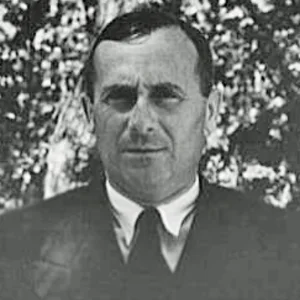

Joan Miró was a Spanish painter, sculptor, engraver, and ceramicist, and a major figure of Surrealism. Born in Barcelona, he developed a poetic visual language made of signs, vivid colors, and biomorphic shapes. His work, deeply rooted in Catalan culture, left a lasting mark on 20th-century art.
Joan Miró(1893 — 1983)
Joan Miró
Espagne
6 min read
Frequently asked questions
Famous Quotes
« I am looking for a motionless movement, something that would be the equivalent of what is called the eloquence of silence.»
Key Facts
- Born in 1893 in Barcelona, Catalonia
- Painted Harlequin's Carnival (1924-1925), an emblematic work of his Surrealist period
- Created the series of Constellations during the Second World War (1939-1941)
- Founded the Joan Miró Foundation in Barcelona in 1975
- Died in 1983 in Palma de Mallorca
Works & Achievements
A meticulous depiction of the family farm at Mont-roig, a turning point between detailed realism and poetry; it was bought by the writer Ernest Hemingway.
A teeming Surrealist masterpiece full of fantastical creatures and signs, painted in a state of hallucinatory hunger.
A spare, poetic image of a dog facing the moon, which became emblematic of Miró's visual language.
Twenty-three gouaches made during the war, peopled with stars, birds and figures, like a dreamlike escape away from the chaos.
A triptych of large blue canvases of rare austerity, close to abstraction and meditation.
Two large decorative walls (the Wall of the Sun and the Wall of the Moon) created with Josep Llorens Artigas for the UNESCO headquarters in Paris.
A monumental, colorful sculpture installed in a park in Barcelona, given to the city by the aging artist.
Anecdotes
As a child, young Joan hated school and preferred to draw. By the age of just eight, he was already filling sketchbooks with birds, flowers, and Catalan landscapes — an early sign of his calling.
Around 1911, after starting work as an accountant to please his father, Miró fell seriously ill (typhoid fever and depression). His convalescence at the family farm in Mont-roig was a revelation: he decided to give it all up and become a painter.
Miró claimed he wanted to “murder painting” in its traditional form. He sought to break art's bourgeois conventions by inventing a language of signs, stars, and floating figures, half dream and half child's game.
To spark his imagination, Miró recounted that he would sometimes paint on an empty stomach: hunger triggered hallucinations that he turned into shapes on the canvas. Food and the lack of it literally fed his art.
In 1974, at over 80 years old, Miró designed an enormous tapestry for the World Trade Center in New York. Destroyed in the attacks of September 11, 2001, it is among the few major works by the artist lost forever.
Primary Sources
No landscape simplified or schematized. Only the things that touch me deeply interest me. A blade of grass is as important to me as a tree or a mountain.
It is difficult for me to talk about my painting, because it is always born in a state of hallucination. I find my titles as I go along, while I work.
I want to murder painting. I have a deep contempt for painting. Only raw matter, pure impulse, interests me.
The spectacle of the sky overwhelms me. I am overwhelmed when I see, in an immense sky, the crescent of the moon or the sun.
Key Places
Miró's birthplace, whose Catalan culture and Gaudí's architecture deeply permeate his work.
A family property in southern Catalonia, a refuge and source of inspiration; there he painted *The Farm*, a tribute to his native land.
Capital of the avant-garde where Miró settled in **1920** and joined the Surrealists around **André Breton**.
An island in the Balearics where Miró settled in **1956** in a vast studio; he lived and worked there until his death.
A museum founded in **1975** on the hill of Montjuïc to preserve his work and share it with the public.
Typical Objects

Miró's fundamental tools; he applied bright colors in clean, flat areas, especially blue, red, yellow, green, and black.

Miró filled notebooks with drawings, signs, and notes where his compositions took shape before reaching the canvas. He also jotted down the poetic titles of his works there.

For his sculptures, Miró assembled found objects: pebbles, pitchforks, roots, and rusty tools, transformed into poetic figures by casting them in bronze.

Miró was a prolific printmaker: he made etchings and lithographs, producing many prints to spread his art widely.

With his friend Josep Llorens Artigas, Miró created ceramics and monumental walls, such as those at the UNESCO headquarters in Paris.

In his studio in Majorca, Miró finally had the space to paint immense canvases with colored backgrounds and pared-down signs.
School Curriculum
Vocabulary & Tags
Key Vocabulary
Daily Life
Morning
Miró was a man of order and discipline: he rose early, did gymnastics or boxing to stay sharp, then headed to his studio first thing in the morning. Steady work, almost like that of a laborer, gave structure to his days.
Afternoon
In the afternoon, he continued his sessions of painting, engraving, or ceramics, often working on several pieces at once. He liked to let a canvas rest so he could return to it with a fresh mind, reworking its signs and colors.
Evening
In the evening, Miró shunned the noisy social life he found exhausting. Reserved and quiet, he preferred the company of a few close friends, music, and the reading of poetry, which nourished his imagination.
Food
Devoted to his Catalan homeland, Miró enjoyed simple Mediterranean cooking: vegetables, fish, olive oil, and bread. During his poor youth in Paris, he sometimes ate very little, and he used to say that hunger brought on the visions he painted.
Clothing
Far from the image of the bohemian artist, Miró dressed with sober, careful elegance, in an impeccable suit and tie. This bourgeois attire contrasted with the revolutionary boldness of his art.
Housing
After a youth in Barcelona and modest years in Paris, Miró fulfilled his dream in Majorca in 1956: a vast, light-filled studio designed by the architect Josep Lluís Sert, where canvases, found objects, and works in progress piled up.
Historical Timeline
Period Vocabulary
Liens externes & ressources
Références
Œuvres
Le Carnaval d'Arlequin
1924-1925
Le Chien aboyant à la lune
1926
Série des Constellations
1939-1941
Bleu I, II, III
1961
Murs de céramique de l'UNESCO
1958