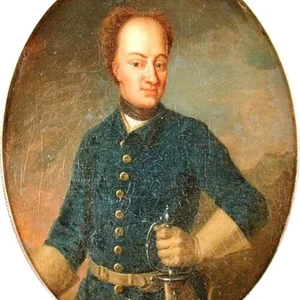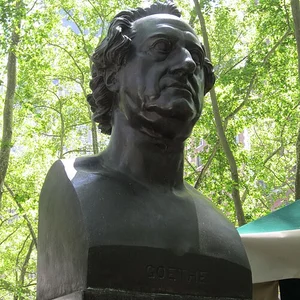

German writer, poet, and scholar (1749–1832), Goethe is the author of Faust and The Sorrows of Young Werther. A central figure of the Sturm und Drang movement and later Weimar Classicism, he embodies the Enlightenment ideal of the universal man.
Johann Wolfgang von Goethe
Johann Wolfgang von Goethe
grand-duché de Saxe-Weimar-Eisenach
8 min read
Frequently asked questions
Famous Quotes
« Knowing is not enough; we must apply. Willing is not enough; we must do.»
« In the beginning was the Deed.»
« Two souls, alas, dwell within my breast, each seeks to separate from the other.»
Key Facts
- 1749: born in Frankfurt am Main
- 1774: publication of The Sorrows of Young Werther, a European success that helped found the Romantic movement
- 1775: settles at the court of Weimar, where he will serve as a minister
- 1808: publication of Faust (Part One), a masterpiece of world literature
- 1832: dies in Weimar; Faust (Part Two) is published the same year
Works & Achievements
An epistolary novel telling the story of a sensitive young man whose unhappy love affair leads him to take his own life. A founding work of European pre-Romanticism, it made Goethe famous across the continent and sparked an unprecedented wave of identification among educated youth.
The undisputed masterpiece of German literature, this philosophical drama tells of a scholar's pact with the devil Mephistopheles in exchange for knowledge and pleasure. Goethe worked on Faust for more than sixty years, from his youth until his final days.
A neoclassical play inspired by ancient Greece, embodying Goethe's humanist ideal. It portrays the triumph of reason and morality over barbarism, and stands as a central work of Weimar Classicism.
A coming-of-age novel tracing the journey of a young middle-class man in search of his artistic and human calling. This book established the literary genre of the Bildungsroman (novel of formation), which became enormously influential throughout 19th-century European literature.
A scientific treatise in which Goethe develops a theory of color perception grounded in human experience, in opposition to Newtonian physics. Though contested by scientists, it had a profound influence on painters and philosophers alike.
A four-volume autobiography in which Goethe recounts his youth and intellectual development. The title deliberately highlights the interweaving of genuine memory and literary reconstruction, making this work a pioneering meditation on memory and identity.
Anecdotes
In 1774, Goethe wrote The Sorrows of Young Werther in barely six weeks, in a state of intense creative fever. This epistolary novel triggered a sweeping cultural phenomenon across Europe: young men adopted Werther's blue-and-yellow outfit, and what became known as 'Werther fever' was associated with a wave of copycat suicides — a phenomenon psychologists still refer to today as 'the Werther effect'.
In 1808, at the Congress of Erfurt, Napoleon Bonaparte summoned Goethe to a private audience. Having read Werther seven times during his military campaigns, the Emperor greeted the writer with the now-famous words: 'Voilà un homme!' — 'There is a man!' — a mark of respect extraordinarily rare from him. The two men spoke for nearly an hour about literature and philosophy.
Goethe spent several hours each day observing nature and conducting scientific experiments. He spent his entire life challenging Newton's theory of color, arguing that white light is not made up of overlapping colors. His Theory of Colors (1810) was long ridiculed by physicists, but it profoundly influenced painters such as Turner and philosophers such as Wittgenstein.
During his stay in Rome between 1786 and 1788, Goethe lived under the pseudonym 'Monsieur Philippe Miller', seeking to blend into Roman life without being recognized. Those two Italian years radically transformed his view of art and life, and he always regarded them as the happiest and most decisive period of his existence.
His last words, spoken on March 22, 1832, are said to have been 'Mehr Licht!' — 'More light!' Some historians see this as a practical request (his room was dark), while others interpret it as a final metaphor for his lifelong pursuit of knowledge and enlightenment.
Primary Sources
I withdraw into myself and find a world! But a world of dim forebodings and obscure desires rather than of strength and life. And everything fades before my senses like a dream.
Two souls, alas, dwell within my breast, each seeking to be parted from the other. One clings to the world through the organs of sense, burning with earthly love; the other forcefully lifts itself from the dust toward the realm of our high ancestors.
I then saw that poetry was not, as I had believed, a special gift granted to a few, but that any person who possesses a keen feeling and a language capable of expressing it can be a poet.
Here I am at last in this capital of the world! To think that I am here, that my eyes behold all this — I can scarcely take it in. But it is truly so, and I pinch myself to make sure I believe it.
Knowing is not enough; we must apply. Willing is not enough; we must do.
Key Places
Goethe's birthplace, where he grew up in a bourgeois townhouse now converted into a museum (Goethe-Haus). It was in Frankfurt that he received his early education and wrote his first texts.
The city where Goethe lived from 1775 until his death in 1832, in the service of Duke Karl August. There he directed the ducal theatre, pursued his scientific research, and transformed Weimar into the cultural capital of German Classicism.
Goethe stayed in Rome from 1786 to 1788 during his formative journey through Italy. His discovery of classical Antiquity and the Renaissance profoundly transformed his aesthetic sensibility and his vision of the humanist ideal.
Goethe studied law here (1770–1771) and met the philosopher Herder, who introduced him to Shakespeare and folk poetry. The Gothic cathedral dazzled him and led him to rediscover Germany's artistic heritage.
It was in this city in Thuringia that Goethe met Napoleon Bonaparte in October 1808, during the Congress of European Sovereigns. The Emperor, an admirer of Werther, granted the writer an audience and invited him to come to Paris.
Typical Objects

Goethe frequently dictated his texts to a secretary, but also wrote himself with a quill pen for his poems and his prolific correspondence. He exchanged more than ten thousand letters with the greatest minds of his time.

Central to his research on light and color, the prism allowed him to reproduce Newton's experiments in order to challenge them. His Theory of Colors grew out of these daily observations.

Goethe was a passionate mineralogist who owned a vast collection of rocks, crystals, and fossils. A mineral was even named after him: goethite, an iron oxide that is still studied today.

As part of his anatomical studies, Goethe kept a human skull in his study. He is credited with discovering the intermaxillary bone in humans, confirming an anatomical continuity between species.

During his Italian Journey, Goethe filled notebooks with observations, drawings, and reflections. These notes became the material for a travel narrative that is now a classic of European travel literature.

The Weimar court was a major center of musical life, and Goethe kept company with composers and musicians. Many of his poems, such as The Erlking, were set to music by Schubert — whose work Goethe discovered late in life, but came to admire.
School Curriculum
Vocabulary & Tags
Key Vocabulary
Daily Life
Morning
Goethe rose early and dictated his texts to his secretary from his study or sometimes from his bed. Mornings were devoted to writing, correspondence — he exchanged more than ten thousand letters over the course of his life — and to scientific observation of plants, minerals, and optical phenomena.
Afternoon
In the afternoons, Goethe fulfilled his duties as privy councillor in the service of Duke Karl August of Saxe-Weimar: overseeing the mines, supervising ducal finances, and directing the court theatre. He regularly walked through the Ilm Park, which he had designed himself, to observe nature and let his ideas take shape.
Evening
Evenings were often social affairs: performances at the ducal theatre, court receptions, and readings aloud in Weimar's literary salons. Goethe also received visitors from across Europe at his home — artists, scholars, admirers — sometimes well into the night.
Food
Goethe had a moderate appetite and fairly simple tastes, though he appreciated fine dining at receptions. Since his stay in Italy, he had developed a fondness for Mediterranean dishes, fruit, and light Rhenish wine. He avoided excess and rarely drank spirits.
Clothing
In his youth, Goethe wore the classic court dress: velvet or fine wool, knee breeches, silk stockings, buckled shoes, and a powdered wig. As he grew older, he adopted a more sober, bourgeois style — a dark frock coat, white cravat, and greatcoat — in keeping with the fashion of the turn of the nineteenth century.
Housing
Goethe lived in an elegant townhouse in the heart of Weimar, on the Frauenplan, given to him by Duke Karl August. He had furnished it according to his neoclassical tastes: a study lined with books, a mineral collection, and plaster casts of ancient statues brought back from Italy. The house is today the Goethe-Nationalmuseum, one of the most visited literary museums in Germany.
Historical Timeline
Period Vocabulary
Visual Style
Le style visuel marie la chaleur intime des intérieurs bourgeois allemands des Lumières au dépouillement néoclassique inspiré par l'Italie, avec une palette de tons ambrés et terreux caractéristique de l'époque de Weimar.
Sound Ambience
L'ambiance sonore évoque le quotidien studieux d'un conseiller-écrivain à la cour de Weimar à la fin du XVIIIe siècle : silence du cabinet de travail, musique classique feutrée, bruits de la vie aristocratique et bourgeoise d'une petite ville allemande cultivée.