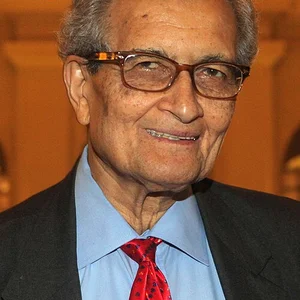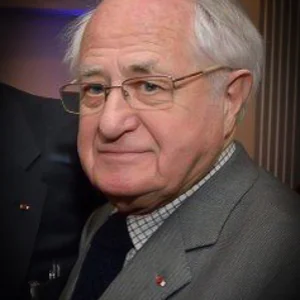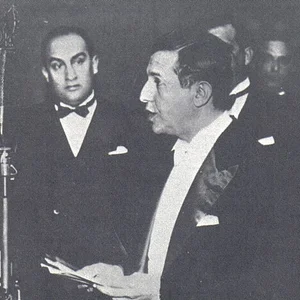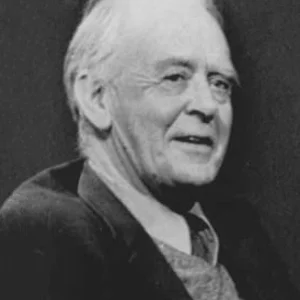

British economist, one of the major figures of 20th-century economic thought. He helped formalize Keynesian theory and develop modern microeconomics, which earned him the Nobel Prize in Economics in 1972.
John Hicks(1904 — 1989)
John Hicks
Royaume-Uni, Royaume-Uni de Grande-Bretagne et d'Irlande
6 min read
Frequently asked questions
Key Facts
- Born in 1904 in Warwick (United Kingdom) and died in 1989
- Published the 1937 article 'Mr. Keynes and the Classics', introducing the IS-LM model
- Published 'Value and Capital' in 1939, a major work of microeconomics and general equilibrium theory
- Received the Nobel Prize in Economics in 1972 (shared with Kenneth Arrow)
- Knighted in 1964, becoming Sir John Hicks
Works & Achievements
Hicks's first major work on wage formation; in it he introduces the concept of the elasticity of substitution between factors of production.
A foundational paper that translates Keynes's thinking into a graphical model, which became the standard framework of macroeconomics for decades.
A major work of microeconomics: general equilibrium theory, demand analysis, substitution and income effects.
A study of economic cycles combining the multiplier and the accelerator to explain fluctuations in economic activity.
A sweeping interpretation of the shift from traditional societies to the market economy, blending economics and history.
A reflection on the role of time and capital in production, extending his research on dynamic equilibrium.
An award received together with Kenneth Arrow for his contributions to general equilibrium theory and welfare economics.
Anecdotes
In 1937, when he was only 33 years old, John Hicks published an article titled “Mr. Keynes and the Classics” that invented the famous IS-LM diagram. This diagram, still taught today in lecture halls around the world, sums up Keynes's entire thinking in just two curves: Hicks thus made accessible a book that many found unreadable.
Hicks used to say that he had first come to economics somewhat by chance: as a student at Oxford, he had begun with mathematics, then turned to philosophy, politics, and economics. He admitted with humor that he had long been an economist “mediocre at mathematics” compared to the younger generations he nonetheless helped to train.
When he received the Nobel Prize in Economics in 1972 (shared with Kenneth Arrow), Hicks confided that he did not feel entirely comfortable with the award. He later declared that he regretted some of his own youthful theories, judging that the real economy was more complex and more historical than the equilibrium models he had helped to build.
His wife, Ursula Webb, was herself a respected economist specializing in public finance. The couple worked and traveled extensively together, notably in India and Nigeria, and Hicks acknowledged Ursula's profound intellectual influence on his own research.
Hicks was knighted by the Queen in 1964 and became “Sir John Hicks.” When he received the Nobel Prize money in 1972, he donated it to the library of the London School of Economics, the institution where he had begun his teaching career.
Primary Sources
This article offers a reading of Keynes's General Theory as a system of equations whose graphical representation would become the IS-LM model, linking the goods market and the money market.
In this work, Hicks develops general equilibrium theory and the analysis of demand without resorting to measurable utility, and introduces tools such as the substitution effect and the income effect.
Here Hicks offers an interpretation of the economic evolution of societies, from the customary and command economy toward the market economy.
Hicks takes a critical look back at his own IS-LM model, highlighting its limitations and the need to reintroduce time and uncertainty into the analysis.
Key Places
Town in central England where John Hicks was born in 1904, the son of a local journalist.
Prestigious college at the University of Oxford where Hicks studied mathematics and then political economy in the 1920s.
London institution where Hicks began his teaching career in 1926 and developed his first major theories.
University where Hicks was a professor from 1946 and worked on national accounting.
Hicks was appointed Drummond Professor of Political Economy here in 1952; he carried out his mature work here until his retirement.
English village where Hicks spent his final years and died in 1989.
Typical Objects

A two-curve graphical representation that summarizes Keynesian theory by crossing the equilibrium of the goods market (IS) with that of money (LM). It is Hicks's most famous teaching tool.

The everyday tool of the economics teacher for drawing curves and equations in front of students. Hicks used it to sketch his famous equilibrium diagrams.

The tool for writing academic articles and manuscripts before the computer age. Hicks typed his foundational works on it, such as Value and Capital.

A mechanical calculating instrument used by economists and mathematicians before electronic calculators. It was used for equilibrium and marginal calculations.

A gold medal awarded by the Royal Swedish Academy of Sciences, the symbol of the highest scientific distinction. Hicks received it in 1972 for his work on general equilibrium and welfare theory.

A 1939 work in which Hicks rebuilt the theory of general equilibrium and consumption. It profoundly renewed modern microeconomics.
School Curriculum
Vocabulary & Tags
Key Vocabulary
Tags
Daily Life
Morning
A methodical academic, Hicks devoted his mornings to reading and writing, sketching equations and curves in his notebooks. The quiet of his study, in Manchester and later Oxford, allowed him to construct his theoretical models.
Afternoon
Afternoons were often set aside for teaching and seminars, where he engaged in discussion with colleagues and students. Hicks enjoyed intellectual exchange, even though he was reserved by temperament and not given to grand public speeches.
Evening
In the evening, he continued his reading, in economics but also in history and philosophy, two disciplines that nourished his broad vision of economic science. He often shared his reflections with his wife Ursula, herself an economist.
Food
Hicks led the sober life of a middle-class British academic: meals taken at college (high table) or at home, traditional English cooking. Afternoon tea punctuated the day, as it did for many English people of his time.
Clothing
He wore the classic attire of an Oxbridge professor: a tweed or dark wool suit, shirt, tie, and academic gown for university ceremonies. A discreet and tidy appearance, in keeping with his personality.
Housing
Hicks lived in comfortable university accommodation and, at the end of his life, in a house in the village of Blockley, in the Gloucestershire countryside. His surroundings reflected the studious tranquility he sought.
Historical Timeline
Period Vocabulary
Liens externes & ressources
Références
Œuvres
The Theory of Wages
1932
Mr. Keynes and the Classics (modèle IS-LM)
1937
Value and Capital
1939
A Contribution to the Theory of the Trade Cycle
1950
A Theory of Economic History
1969
Capital and Time
1973
Prix Nobel d'économie
1972