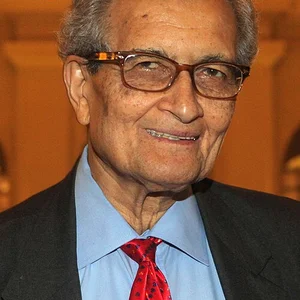

Amartya Sen is an Indian economist and philosopher born in 1933. Winner of the Nobel Prize in Economics in 1998, he reshaped the analysis of well-being, poverty and famines, and founded the “capability” approach.
Amartya Sen(1933 — ?)
Amartya Sen
Inde
6 min read
Frequently asked questions
Key Facts
- Born in 1933 in Santiniketan, in Bengal (British India)
- Author of major works on welfare economics and social choice
- His research on famines (notably the Bengal famine of 1943) shows that they stem less from a lack of food than from unequal access to resources
- Develops the “capability” approach, which underpins the UNDP's Human Development Index (HDI)
- Receives the Nobel Prize in Economics in 1998 for his contribution to welfare economics
Works & Achievements
A major work that extends Arrow's social choice theory and shows how to link collective decisions with individual well-being.
A study of the tools used to measure inequality, proposing new and fairer indicators.
A demonstration that famines result from the loss of access to food (entitlements) rather than from a simple overall shortage.
A theoretical framework that assesses well-being based on what people can actually be and do, not just their income.
Together with Mahbub ul Haq, Sen inspired a UNDP indicator that measures health, education, and income.
An accessible synthesis defining development as the expansion of individuals' real freedoms.
A collection of essays on India's long tradition of debate, tolerance, and public reason.
A major philosophical work proposing to fight concrete injustices rather than to define a perfect society.
Anecdotes
When Amartya Sen was nine, he witnessed the terrible Bengal famine of 1943, which killed millions of people. Later, he realized that the granaries were not empty: the food existed, but the poorest people could no longer afford to buy it. This observation shaped his entire thinking as an economist.
At the age of 11, the young Amartya saw a Muslim laborer, Kader Mia, stagger into the family garden covered in blood after being stabbed during riots between Hindus and Muslims. The man had come looking for work in a dangerous neighborhood because his family was starving. Sen said this tragedy revealed to him, very early on, the link between poverty and the loss of freedom.
It was the poet Rabindranath Tagore, a friend of his family, who chose the name “Amartya” for the baby: the word means “immortal” in Sanskrit. Sen spent part of his childhood at Tagore's experimental school, Santiniketan, where lessons were held outdoors, without grades or strict exams.
As a student at Cambridge, Sen was diagnosed with oral cancer. He had to undergo very heavy radiotherapy, a treatment he chose himself after studying the survival statistics. He survived, but was left with lasting effects for the rest of his life — an experience that fueled his interest in health and people's real well-being.
When he received the Nobel Prize in Economics in 1998, Sen used part of the money to found an organization supporting literacy and health in India and Bangladesh, the Pratichi Trust. He maintained that educating girls was one of the most powerful levers against poverty.
Primary Sources
Famine is the characteristic of some people not having enough food to eat. It is not the characteristic of there being not enough food to eat.
Development can be seen as a process of expanding the real freedoms that people enjoy.
Our understanding of the nature and demands of justice cannot do without reasoned public discussion.
What moves us, reasonably enough, is not the realization that the world falls short of being completely just — which few of us expect — but that there are clearly remediable injustices around us which we want to eliminate.
Key Places
Town of the school founded by Tagore where Sen was born and grew up. The education he received there was open-minded, steeped in the arts and debate.
City where Sen began his higher studies in economics and witnessed firsthand the tensions of decolonization.
English university where Sen studied, earned his doctorate, and later served as Master of the college (1998-2004).
American university where Sen taught economics and philosophy for many years.
Site of the Nobel Prize in Economics award ceremony in December 1998.
Liens externes & ressources
Références
Œuvres
Collective Choice and Social Welfare
1970
On Economic Inequality
1973
Poverty and Famines
1981
Approche par les capabilités
années 1980
Contribution à l'Indice de développement humain (IDH)
1990
Development as Freedom
1999
The Argumentative Indian
2005