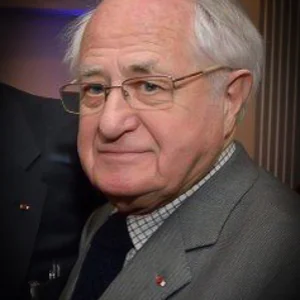

A senior French civil servant and business executive, Antoine Veil served as an inspector of finances and led major corporations. Married to Simone Veil since 1946, he shared her life and her commitments. Their ashes were transferred together to the Panthéon in 2018.
Antoine Veil(1926 — 2013)
Antoine Veil
France
8 min read
Frequently asked questions
Key Facts
- Born on 7 January 1926 in Paris
- Married Simone Jacob (the future Simone Veil) in 1946
- Career as an inspector of finances and corporate executive
- Died on 6 October 2013 in Paris
- Interred at the Panthéon on 1 July 2018 alongside Simone Veil
Works & Achievements
After graduating from ENA near the top of his class, Antoine Veil joined one of the French civil service's elite corps, taking part in the oversight and auditing of public finances during France's postwar reconstruction and the Trente Glorieuses.
Following the path of *pantouflage* — the French tradition of senior civil servants moving into the private sector — Antoine Veil rose to executive positions at several large corporations, including UTA (Union des Transports Aériens), exemplifying the central role played by former senior officials in running major national companies.
Without holding any official role, Antoine Veil was Simone's first and steadfast supporter during the difficult parliamentary debates over the legalization of abortion, providing a human and moral foundation that proved essential to the passage of this landmark reform.
During Simone Veil's presidency of the European Parliament, Antoine arranged his own professional life to allow his wife to carry out her duties in Strasbourg and Brussels — an example of marital partnership that was rare for the time.
After his death in 2013, his ashes were transferred to the Panthéon alongside those of Simone Veil — a symbolic gesture acknowledging that two lives devoted to the French Republic were, in the end, inseparable.
Anecdotes
A graduate of the École Nationale d'Administration who ranked among the top of his class, Antoine Veil could have laid claim to the highest positions in the French state. Yet he deliberately chose to remain in the background, supporting his wife Simone's political career without ever seeking personal gain from it — a selflessness that earned him the quiet admiration of France's senior civil service.
In November 1974, during the heated debates in the National Assembly over the bill on voluntary termination of pregnancy, Antoine Veil accompanied Simone every day, offering her unwavering moral support. Witnesses recalled him waiting in the corridors of the Palais-Bourbon, composed and steady, while his wife faced the most brutal attacks of her political life.
A senior civil servant from the Inspection des Finances, Antoine Veil went on to have what the French call a *pantouflage* career, moving into executive positions at major private companies, particularly in the aviation sector. This transition from public service to the private sector was the well-trodden path for members of France's *grands corps de l'État*, and Antoine Veil became one of its most accomplished examples.
Antoine Veil and Simone had met in Parisian student circles in 1946, shortly after the liberation of the camps. Simone Jacob, a survivor of Auschwitz-Birkenau, and Antoine Veil, a promising young student, married that same year. Those close to them testified that their marriage was, throughout their sixty-seven years together, a true partnership between equals.
When their ashes were transferred to the Panthéon on July 1, 2018, the French Republic made a gesture of profound symbolic weight: rarely had a husband been enshrined there alongside his wife. This consecration honored not only Simone Veil's exceptional destiny, but also the unbreakable bond of a couple who had faced together the trials and triumphs of the twentieth century.
Primary Sources
Antoine always supported me, never seeking to influence my decisions or to take advantage of my position. He was the one who gave me the strength to hold on during the abortion debates, when the attacks were at their most violent.
I say this with full conviction: no woman turns to abortion lightheartedly. Abortion is not a decision taken lightly. One only has to listen to women.
I do not forget what I owe to Antoine, whose constant and discreet support allowed me to accomplish what I have accomplished, without ever feeling alone in the face of hardship.
Simone Veil did not fight alone. Antoine Veil, her husband, companion of a lifetime, chose to put his intelligence and talent at the service of their shared destiny.
Key Places
The historic heart of French administration, the 7th arrondissement is home to government ministries, the great bodies of state, and republican institutions. Antoine Veil spent much of his career as a senior civil servant here and lived in the district with his family.
Founded in 1945 to train France's top civil servants, the ENA is the institution where Antoine Veil received his formation before joining the Inspectorate of Finance. It embodied the meritocratic ideal of postwar French reconstruction.
The setting for the historic debates on the Veil Law of 1974–1975, which Antoine followed with great attention, the National Assembly represents the heart of French political life — a life to which he contributed indirectly through his unwavering support for Simone.
The supreme monument of the French Republic, the Panthéon received the remains of Antoine and Simone Veil during a national ceremony on 1 July 2018. Antoine Veil rests there beside his wife, a symbol of their inextricably intertwined destinies.
Located on the rue de Rivoli, overlooking the Tuileries Gardens, the Inspectorate General of Finance is the elite corps where Antoine Veil began his career and laid the foundations of his professional life after graduating from the ENA.
Typical Objects

An indispensable tool for senior civil servants, the fountain pen was used to sign inspection reports, briefing notes, and contracts. The Montblanc Meisterstück was the emblematic mark of members of France's *grands corps de l'État* throughout the 20th century.

The sober, high-quality leather briefcase carried confidential files, inspection reports, and ministerial notes. It symbolized the rigor and discretion expected of members of the Inspectorate of Finance.

An official document produced following audit and oversight missions, the report distilled economic analyses and recommendations for the minister into a concise summary. These reports circulated at the highest levels of the state and could shape major economic policy decisions.

The diary structured an executive's daily life between board meetings, business lunches, and ministerial appointments. It reflected the social codes of France's post-war economic and administrative elite.

A central instrument of communication in businesses and ministries from the 1950s to the 1980s, it enabled direct exchanges between executives and senior officials. It represents the network of relationships essential to the career of a discreet but influential figure.

An internal document of the French administration, the briefing note summarized the key issues of a complex file in a few pages for the minister's attention. Mastering the art of the briefing note was the foremost skill of any senior civil servant in the Fifth Republic.
School Curriculum
Vocabulary & Tags
Key Vocabulary
Daily Life
Morning
Antoine Veil began his days early, in keeping with the habits of senior civil servants trained at ENA. After a simple breakfast, he would read the economic and political press — *Le Monde*, *Les Échos* — before heading to his office, whether in government buildings or at the companies he led.
Afternoon
Afternoons were devoted to working meetings, hearings, and exchanges with management teams. During his years as a senior civil servant, he prepared meticulous inspection reports; once he moved into corporate leadership, he chaired strategic committees and met with business partners.
Evening
Evenings were divided between family life and dinner engagements — a common feature of Parisian business and upper civil service circles. Antoine and Simone Veil regularly hosted political and intellectual figures, maintaining the networks that were essential to each of their respective commitments.
Food
Like most senior executives of his generation, Antoine Veil favored classic French bourgeois cuisine: business lunches at brasseries and restaurants in the 7th arrondissement, family meals on weekends with their three sons. The dinner table was as much a space for socializing as it was a daily necessity.
Clothing
Antoine Veil wore the understated, well-groomed attire typical of senior French civil servants: dark or grey suits, plain ties, well-polished shoes. This discreet elegance reflected the codes of his milieu — standing out through quality rather than ostentation, in keeping with the ethos of the upper administration.
Housing
The Veil couple lived in a Haussmann-era apartment in one of Paris's affluent neighborhoods, the classic setting for France's administrative and political elite. They also had a secondary residence where the family gathered during holidays, away from the packed schedules of Parisian life.
Historical Timeline
Period Vocabulary
Liens externes & ressources
Références
Œuvres
Carrière à l'Inspection générale des finances
vers 1950-1960
Direction de grandes entreprises françaises (dont UTA)
1960-1990
Soutien décisif lors des débats sur la loi Veil
1974-1975
Accompagnement de la carrière européenne de Simone Veil
1979-1982
Panthéonisation commune avec Simone Veil
1er juillet 2018