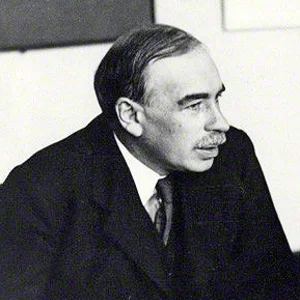

British economist, founder of modern macroeconomics. His general theory, published in 1936 in response to the Great Depression, argues for government intervention to support demand and employment.
John Maynard Keynes(1883 — 1946)
John Maynard Keynes
Royaume-Uni, Royaume-Uni de Grande-Bretagne et d'Irlande
6 min read
Frequently asked questions
Famous Quotes
« In the long run, we are all dead.»
Key Facts
- Publishes “The Economic Consequences of the Peace” in 1919, a critique of the Treaty of Versailles
- Publishes “The General Theory of Employment, Interest and Money” in 1936, the founding work of Keynesianism
- Takes part in the 1944 Bretton Woods Conference, which reorganizes the international monetary system
- Champions stimulus through public spending to combat the mass unemployment of the 1930s
- Born in 1883 in Cambridge, died in 1946
Works & Achievements
A resounding critique of the Treaty of Versailles that made Keynes famous worldwide and warned of the dangers of German reparations.
A philosophical work on the logic of uncertainty, the fruit of his years of study at Cambridge, which shaped his vision of economic decision-making.
An in-depth study of the role of money and credit, a major step toward his future macroeconomic theory.
His masterwork, which founded modern macroeconomics and justified state intervention to support demand and employment.
A plan to finance the British war effort through forced saving, showing the practical application of his ideas.
A major diplomatic achievement: Keynes helped create the IMF and the World Bank, the framework of the postwar monetary system.
Anecdotes
Keynes was a formidable stock-market speculator: he managed his personal fortune from his bed each morning before getting up, placing orders by telephone. He also multiplied tenfold the endowment of King's College, Cambridge, thanks to his investments.
A passionate ballet lover, Keynes married Lydia Lopokova in 1925, a famous Russian dancer from Diaghilev's Ballets Russes. The couple, who stood out in English intellectual circles, supported the founding of several theatres.
In 1919, after taking part in the British delegation at the Treaty of Versailles, Keynes walked out, scandalised by the reparations imposed on Germany. He immediately wrote a book, *The Economic Consequences of the Peace*, which predicted that these debts would lead to chaos — a prophecy that was largely borne out.
A member of the “Bloomsbury Group,” a circle of London artists and writers that included Virginia Woolf and E. M. Forster, Keynes blended economics, art, and philosophy, far from the image of the austere economist.
In 1944, ill and exhausted, Keynes led the negotiations at the Bretton Woods conference, which laid the foundations of the post-war international monetary system, the IMF, and the World Bank. He died less than two years later, largely worn out by that effort.
Primary Sources
The blind and reckless politicians... will have sown the seeds of the decay of the whole civilised life of Europe.
The ideas of economists and political philosophers, both when they are right and when they are wrong, are more powerful than is commonly understood. Indeed, the world is ruled by little else.
In the long run we are all dead. Economists set themselves too easy, too useless a task if in tempestuous seasons they can only tell us that when the storm is long past the ocean is flat again.
You have made yourself the trustee for those in every country who seek to mend the evils of our condition by reasoned experiment within the framework of the existing social system.
Key Places
Keynes's birthplace and home to King's College, where he studied and then taught all his life. The heart of his economic thinking.
The college where Keynes was a student, then a professor, and later bursar (financial steward). He multiplied its endowment through his investments.
Site of the 1919 peace conference where Keynes represented the British Treasury before resigning, outraged by the reparations imposed on Germany.
The mountain resort where the international monetary conference was held in 1944. There Keynes negotiated the financial institutions of the postwar world.
The country house of Keynes and his wife Lydia, where he died of a heart attack in 1946.
The London district that gave its name to the circle of artists and intellectuals Keynes belonged to, blending art, letters, and philosophy.
Typical Objects

The 1936 book that revolutionized economic thought by justifying state intervention. It became the reference textbook for several generations of economists and policymakers.

The device from which Keynes placed his stock-market orders each morning from his bed. A symbol of his double life as a theoretical economist and a shrewd speculator.

The everyday tools of an economist who remained above all a Cambridge mathematician. In them Keynes recorded equations, forecasts, and reading notes.

Financial instruments that Keynes handled to build his fortune and grow his college's endowment. They embody the markets whose psychological drivers he analyzed.

The attire of the British intellectual and financial elite of the Edwardian era. Keynes wore it in government ministries as in the salons of Bloomsbury.

The administrative document through which Keynes advised the British government during both world wars. It was through these notes that he concretely influenced economic policy.
School Curriculum
Vocabulary & Tags
Key Vocabulary
Tags
Daily Life
Morning
Keynes often began his day in bed, reading financial newspapers and mail, and placing his stock market orders by telephone. This morning routine made him an active speculator before he even got up.
Afternoon
His afternoons were divided between lectures and seminars at Cambridge, meetings at the Treasury in London, and writing his books. He juggled academic theory with advising governments.
Evening
In the evening, Keynes attended the dinners of the Bloomsbury group, went to ballets or concerts, and discussed art and philosophy with writers and painters. His social life was as rich as his intellectual life.
Food
A member of the cultured British upper middle class, Keynes enjoyed fine food and good wines, which he collected. He frequented London clubs and restaurants where business deals and conversations were forged.
Clothing
He wore the understated three-piece suit of the Edwardian elite, complemented by a neatly trimmed moustache. His attire suited government ministries just as well as artistic salons.
Housing
Keynes lived between his apartments in Cambridge and London and his country house at Tilton in Sussex. These comfortable homes reflected his financial ease and his taste for the arts.
Historical Timeline
Period Vocabulary
Liens externes & ressources
Références
Œuvres
Les Conséquences économiques de la paix
1919
Traité sur la probabilité
1921
Traité sur la monnaie
1930
Théorie générale de l'emploi, de l'intérêt et de la monnaie
1936
Comment financer la guerre
1940
Accords de Bretton Woods
1944