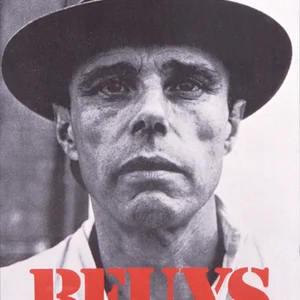

Joseph Beuys (1921-1986) was a major postwar German artist — sculptor, draughtsman, and performer. A theorist of “social sculpture,” he expanded the notion of art to encompass the transformation of society and was a central figure in European contemporary art.
Joseph Beuys(1921 — 1986)
Joseph Beuys
Allemagne
7 min read
Frequently asked questions
Famous Quotes
« Every man is an artist.»
Key Facts
- Born in 1921 in Krefeld, he served as an airman in the Luftwaffe during the Second World War.
- Appointed professor of sculpture at the Düsseldorf Academy of Fine Arts in 1961, he was dismissed from the post in 1972.
- Close to the Fluxus movement, from the 1960s he created striking performances such as “How to Explain Pictures to a Dead Hare” (1965).
- He developed the concept of “social sculpture” (soziale Plastik), asserting that “every man is an artist.”
- He launched the action “7000 Oaks” at Documenta 7 in Kassel in 1982; he died in Düsseldorf in 1986.
Works & Achievements
An ordinary wooden chair topped with a wedge of fat. An emblematic work in which the soft, ever-changing material embodies the idea of transformation so dear to the artist.
A founding performance of action art in which Beuys, his face covered in gold, explains art to a dead animal. It asserts the superiority of intuition over cold reason.
A suit cut entirely from felt, editioned as a multiple work of art. The material of warmth and protection becomes a symbol of care and survival.
A three-day New York performance shared with a wild coyote. A meditation on the wounds inflicted on Native American peoples and on reconciliation.
An installation in which rolls of felt line the walls of a sealed room housing a piano. The work creates an enveloping silence and warmth.
A vast ecological action involving the planting of 7,000 trees in Kassel, each paired with a basalt stele. A manifesto-work of “social sculpture” that transformed the city.
An installation shown at Documenta 6, in which honey circulated through pipes across the building. A metaphor for the flow of energy within the social body.
Anecdotes
In 1965, Joseph Beuys staged one of his most famous performances, “How to Explain Pictures to a Dead Hare.” His face covered in honey and gold leaf, he walked through a Düsseldorf gallery murmuring explanations to a dead hare cradled in his arms. For him, the animal symbolized intuition, capable of understanding art better than some rational humans.
All his life, Beuys claimed that in 1944 his Luftwaffe plane crashed in Crimea and that nomadic Tatars saved him by wrapping him in fat and felt to keep him warm. Whether true or embellished, this legend became the founding myth of his work: felt and fat, materials of warmth and survival, recur constantly in his sculptures.
In 1974, Beuys shut himself in a New York gallery for a week with a wild coyote for the performance “I Like America and America Likes Me.” Arriving and leaving by ambulance without ever touching American soil, he wanted to commune with the sacred animal of Native Americans, denouncing the way modern America had crushed its first peoples.
At Documenta 7 in Kassel in 1982, Beuys launched “7000 Oaks,” an ecological project to plant 7,000 trees, each paired with a basalt stone marker. He planted the first oak himself; the last was planted in 1987 by his son, a year after the artist's death.
A professor at the Düsseldorf Academy of Fine Arts, Beuys refused to select his students and accepted everyone who had been rejected. In 1972, his refusal to apply the numerus clausus got him dismissed by the ministry, sparking a long battle and demonstrations of support.
Primary Sources
Every human being is an artist, that is to say a being who, out of his freedom, can help to shape and transform the whole of social life, understood as a total work of art.
My definition of art is this expanded concept by which every creative human activity is sculpture: thought itself is a sculpture.
Coyote: for three days, the artist shares the gallery space with a wild coyote, wrapped in felt, accompanied by straw, the Wall Street Journal and a shepherd's crook.
Urban reforestation instead of urban administration: I want to plant seven thousand oaks, each marked with a basalt stele, to make the city greener and transform consciousness.
Key Places
City in the Rhineland where Joseph Beuys was born in 1921. He spent his childhood in the nearby region of Cleves.
Institution where Beuys studied and then taught sculpture for more than ten years. His dismissal in 1972 sparked a fierce controversy there.
German city where Beuys lived and worked for most of his career, and where he died in 1986.
Host city of Documenta, the major contemporary art exhibition. There, Beuys launched his ecological project “7000 Oaks” in 1982.
Site of the performance “I Like America and America Likes Me” in 1974 and of his retrospective at the Guggenheim in 1979.
Region where Beuys's plane reportedly crashed in 1944, an episode at the origin of the founding myth of his work.
Typical Objects

A material of pressed wool that Beuys used for his sculptures and performances. It symbolized warmth, insulation, and survival, echoing the myth of his rescue in Crimea.

Beuys shaped blocks and wedges of animal fat, an unstable material that shifted from solid to liquid depending on the heat. For him it embodied energy, transformation, and the potential for change.

The wide-brimmed grey hat that never left Beuys and became his visual signature. He had turned it into a true attribute of his artist-shaman persona.

The khaki multi-pocket vest that Beuys wore constantly, a complement to his hat and shirt. It contributed to his instantly recognizable look.

During his lecture-performances, Beuys covered blackboards with diagrams and words to lay out his theories about society. These boards were then preserved as works in their own right.

For the project “7000 Oaks,” each tree planted was accompanied by a column of raw basalt. The hard, unchanging stone formed a contrast with the living, growing tree.

Materials with which Beuys coated his face during certain performances. Honey evoked organic life and the collective work of bees, gold spiritual value.
School Curriculum
Vocabulary & Tags
Key Vocabulary
Daily Life
Morning
Beuys often started early in his studio or at the Düsseldorf Academy, surrounded by felt, fat, and accumulated objects. He devoted his mornings to drawing, jotting down ideas, and preparing his installations.
Afternoon
His afternoons were structured around teaching and endless discussions with his students, which he considered an essential part of his art. He also led public debates on democracy and ecology.
Evening
In the evening, Beuys took part in lectures, performances, or activist meetings. Tireless, he often extended these exchanges late into the night, chalkboard in hand.
Food
A heavy smoker and coffee lover, Beuys led an unregulated life, his mind always turned toward his work rather than toward meals. Honey, which he revered as a symbol, interested him more as an artistic material than as a food.
Clothing
His outfit had become a recognizable uniform: a wide-brimmed gray felt hat, a khaki multi-pocket fisherman's vest, a white shirt, and jeans. This unchanging silhouette was an integral part of his public persona.
Housing
Beuys lived and worked in Düsseldorf, in a world of studios cluttered with works, raw materials, and objects laden with meaning. His home and his place of creation merged with his laboratory of ideas.
Historical Timeline
Period Vocabulary
Liens externes & ressources
Références
Œuvres
Chaise de graisse (Fettstuhl)
1964
Comment expliquer les tableaux à un lièvre mort
1965
Le Paquet de feutre (Filzanzug / costume de feutre)
1970
J'aime l'Amérique et l'Amérique m'aime
1974
Plight (Détresse)
1985
Pompe à miel sur le lieu de travail
1977