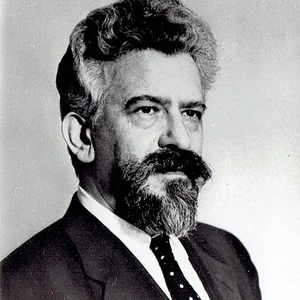
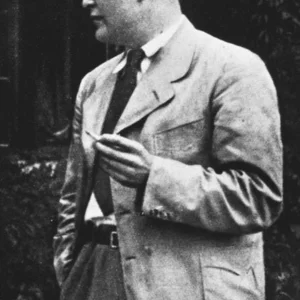
American Orthodox rabbi and philosopher of Lithuanian origin, a major figure of modern Jewish Orthodoxy in the 20th century. A theorist of the encounter between traditional Talmudic study and Western philosophical thought, he trained generations of rabbis in the United States.
Joseph Soloveitchik(1903 — 1993)
Joseph Soloveitchik
Allemagne
6 min read
Frequently asked questions
Key Facts
- Born in 1903 in Pruzhany (Russian Empire, present-day Belarus) into the Soloveitchik rabbinical dynasty
- Earned a doctorate in philosophy from the University of Berlin in 1932 (dissertation on Hermann Cohen)
- Emigrated to the United States in 1932 and became a leading figure of Orthodox Judaism in Boston
- Led the rabbinical seminary at Yeshiva University in New York for decades, ordaining thousands of rabbis
- Published 'Halakhic Man' (Ish ha-Halakha, 1944) and 'The Lonely Man of Faith' (1965), major works of Jewish thought; died in 1993
Works & Achievements
Foundational essay describing the ideal of the religious man who approaches the world through the categories of Jewish law. A key text of his thought.
Reflection on the method of a religious philosophy grounded in the objective sources of Halakhah rather than in subjective experience.
A meditation on the two Adams of the Genesis account, which became his most widely read work, including beyond Judaism.
A study of the quest for God through the contradictory movement of flight and attraction within the human soul.
The creation in Boston of a modern, co-educational Orthodox school, a model of Jewish education in the United States.
Teaching Talmud at Yeshiva University; he ordained roughly two thousand rabbis, shaping an entire generation.
Anecdotes
Joseph Soloveitchik was born into the prestigious Brisk rabbinic dynasty: his grandfather Chaim Soloveitchik had revolutionized the study of the Talmud with a rigorous method of logical and conceptual analysis. Young Joseph first learned this “Brisk method” from his father Moshe, before going on to teach it to thousands of students in turn.
After a traditional Talmudic education, he enrolled at the University of Berlin in the 1920s, where in 1932 he defended a philosophy dissertation on the thought of the German philosopher Hermann Cohen. This dual grounding — Talmud and Western philosophy — would make him the theorist of “modern Orthodoxy.”
Settling in Boston in 1932, he founded the Maimonides School there in 1937, one of the first Orthodox Jewish schools in the United States to offer coeducational classes for boys and girls and to combine religious subjects with a general curriculum. The institution still exists today.
For nearly forty years, he taught the Talmud at Yeshiva University in New York, where his students simply called him “the Rav” (the Master). He is estimated to have ordained around two thousand rabbis, thus training a large part of the modern American Orthodox rabbinate.
Each year, at the lecture given in memory of his father, thousands of listeners would come to hear him speak for several hours, blending sharp Talmudic analysis with philosophical reflection: these “yahrzeit shiurim” remain famous.
Primary Sources
When the halakhic man encounters a gushing spring of water, he sees in it a reality governed by precise rules: the amount of water needed for a ritual bath, the distinction between flowing water and standing water.
The man of faith is lonely. He is alone because, in his experience of God, he confronts a reality that others do not share and that he cannot fully communicate.
There can be no Jewish philosophy without a return to the objective sources of Judaism: the Halakhah is the given datum from which all religious thought must be reconstructed.
The quest for God is born of two opposing movements of the soul: the flight away from Him and the irresistible longing to find Him again.
Key Places
Birthplace of Joseph Soloveitchik, in a region with a strong Lithuanian Talmudic tradition.
He studied philosophy there in the 1920s and earned his doctorate in 1932 on the thought of Hermann Cohen.
He settled there in 1932, founded the Maimonides School in 1937, and lived there until his death in 1993.
In the heart of Washington Heights, he taught the Talmud there for nearly forty years as Rosh Yeshiva of the RIETS seminary.
A modern Orthodox, co-educational school he founded in 1937 in the suburbs of Boston, still operating today.
Typical Objects

A vast compilation of legal debates and rabbinic discussions, at the heart of Jewish study. Soloveitchik subjected it to conceptual analysis according to the Brisk method.

A bound tome containing a talmudic tractate, lying open on the lectern during lessons. It is the daily tool of the master and his students.

A ritual fringed shawl worn by Jewish men during the morning prayer. A symbol of being wrapped in the divine presence.

Small leather boxes containing biblical verses, bound to the arm and forehead during daily prayer. They recall the link between thought, action and faith.

A slanted stand holding the volume being studied, used standing, in the study hall of the yeshiva. Standing before it, Soloveitchik delivered his long Talmud lectures.

Notebooks and loose sheets in which he wrote, often in Hebrew, his essays blending Halakha and philosophy. Several were not published until decades later.
School Curriculum
Vocabulary & Tags
Key Vocabulary
Daily Life
Morning
His day begins with the morning prayer, prayer shawl over the shoulders and tefillin on the arm. Then, very early, comes the meticulous preparation of the Talmud class he will teach, rereading the texts and sharpening his analyses.
Afternoon
The afternoon is devoted to teaching: before his yeshiva students, he delivers long and highly demanding lessons, sometimes lasting several hours. In them he blends tight Talmudic argumentation with forays into philosophy.
Evening
In the evening, he receives students, answers questions of Jewish law (responsa) and continues his own reading, from the Talmud to the German philosophers. It is also the time to write his essays.
Food
He strictly observes the Jewish dietary laws (kashrut): meat and milk kept separate, foods certified compliant. His table, plain and simple, reflects a way of life turned toward study rather than material pleasures.
Clothing
He wears the dark suit and hat of the rabbis of the Lithuanian tradition, closer to the Western clergyman than to Hasidic dress. This attire embodies his ideal of an Orthodox Judaism in dialogue with the modern world.
Housing
He lives in an urban apartment in Boston, dividing his time with New York, where he teaches. His home is above all that of a man of study, cluttered with volumes of Talmud and works of philosophy.
Historical Timeline
Period Vocabulary
Liens externes & ressources
Références
Œuvres
Ish ha-Halakhah (Halakhic Man / L'Homme de la Halakha)
1944
The Halakhic Mind (L'Esprit halakhique)
rédigé en 1944, publié en 1986
The Lonely Man of Faith (L'Homme de foi solitaire)
1965
U-Vikkashtem mi-Sham (Et de là tu chercheras)
1978
Fondation de la Maimonides School
1937
Formation du rabbinat orthodoxe moderne
1941-1985