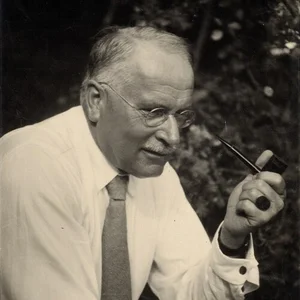

Swiss psychiatrist and psychoanalyst, founder of analytical psychology. Initially close to Freud, he distanced himself to develop his own concepts such as the collective unconscious and archetypes. His work has profoundly influenced psychology, spirituality, and the study of myths.
Carl Jung(1875 — 1961)
Carl Gustav Jung
Suisse
6 min read
Frequently asked questions
Famous Quotes
« Everything that irritates us about others can lead us to an understanding of ourselves.»
« Who looks outside, dreams; who looks inside, awakes.»
Key Facts
- Born in 1875 in Kesswil, Switzerland, and died in 1961 in Küsnacht.
- Collaborated closely with Sigmund Freud from 1907 before a break in 1913.
- Founded analytical psychology and developed the concepts of the collective unconscious and archetypes.
- Introduced the notions of psychological types (introversion/extraversion) in 1921.
- Developed the concept of synchronicity and the process of individuation.
Works & Achievements
A work that broadens the notion of the libido beyond the sexual and sets in motion the break with Freud.
Introduces the notions of introversion and extraversion, which would later inspire numerous personality tests.
A major theory holding that humanity shares a common psychic foundation populated by universal images.
A central notion describing the path by which a person becomes fully themselves by integrating their unconscious.
A study connecting the symbols of ancient alchemy to the processes of transformation of the psyche.
An illustrated journal of his visions, which became a major work for understanding the genesis of his thought.
The creation of an entire school of psychology, distinct from Freudian psychoanalysis.
A training and research center ensuring the transmission of his work throughout the world.
Anecdotes
In 1907, Jung met Freud in Vienna for the first time: their conversation reportedly lasted thirteen hours without interruption, so much did they have to say to each other. Freud saw in him his heir, his “son” and “crown prince” of psychoanalysis.
Jung spent years building a stone tower with his own hands on the shore of Lake Zurich, at Bollingen. He lived there without electricity or running water, chopping his own wood and cooking over a fire, to recover a simple and meditative life.
As a boy, Jung had carved a little wooden manikin that he hid in the attic with a painted stone, writing it secret messages in code. As an adult, he saw in this the first sign of his interest in symbols and the unconscious.
After his break with Freud in 1913, Jung went through a long inner crisis during which he recorded his dreams and visions. He set them down in a manuscript bound in red leather, the “Red Book,” which remained secret until its publication in 2009.
Jung made many journeys to study other cultures: he stayed with the Pueblo Indians of New Mexico, in East Africa, and in India, convinced that myths from all over the world revealed common structures of the human mind.
Primary Sources
My life is the story of the self-realization of the unconscious. Everything that lies in the unconscious wants to become event.
The psyche possesses a historical dimension that far surpasses individual memory, and myths are its expression.
My soul, where are you? Do you hear me? I speak, I call you — are you there?
There are two fundamental attitudes, introversion and extraversion, which determine the orientation of consciousness.
Key Places
Village in the canton of Thurgau, on the shore of Lake Constance, where Jung was born in 1875 into a pastor's family.
University psychiatric clinic where Jung began his career under Eugen Bleuler and conducted his word-association experiments.
Stone retreat that Jung built with his own hands on the shore of Lake Zurich to meditate, write and live simply.
Town on the shore of Lake Zurich where Jung lived, practised in his home consulting room and died in 1961.
City where Jung met Freud in 1907, the heart of the budding psychoanalytic movement.
University where Jung and Freud gave lectures in 1909, marking the introduction of psychoanalysis to America.
Typical Objects

A red leather-bound manuscript in which Jung recorded his dreams, visions, and reflections, illustrated with his own illuminations and mandalas. In it he explored the images that arose from his unconscious.

A symbolic circular figure that Jung drew to represent the wholeness of the psyche and the process of individuation. He saw in it a universal symbol of the Self.

The armchair and consulting-room setting where Jung received his patients for sessions of analytical psychology. Listening to dreams held a central place there.

Jung painted and illuminated the images of his unconscious himself, notably in the Red Book. Visual creation was part of his method of inner exploration.

A stone cube that Jung himself engraved with symbols and Latin inscriptions in the garden of his tower. On it he inscribed his meditations on time and the soul.

A notebook in which Jung meticulously recorded his own dreams and those of his patients, the raw material of his analytical work. For him, the dream was a pathway to the unconscious.
School Curriculum
Vocabulary & Tags
Key Vocabulary
Daily Life
Morning
Jung woke up early and paid close attention to his dreams from the night, which he wrote down immediately. At Bollingen, he often began the day with manual tasks such as splitting wood or lighting the fire.
Afternoon
The afternoon was devoted to receiving his patients in his practice in Küsnacht, where he listened to their dreams and conducted analysis. He also dedicated time to writing his books and to his abundant correspondence.
Evening
In the evening, Jung read texts on mythology, alchemy, and philosophy from all over the world. At the tower, which had no electricity, he lit his way with an oil lamp and meditated in quiet.
Food
Jung enjoyed simple, hearty cooking, often prepared by himself at Bollingen. He was fond of wine, pipe tobacco, and convivial meals shared with his loved ones and visitors.
Clothing
In town, he wore the sober suit of the Swiss bourgeois physician of the early 20th century, with a tie and round glasses. In the countryside, he adopted rustic work clothes, sometimes an apron and a cap.
Housing
Jung lived in Küsnacht in a large house on the shore of Lake Zurich, which also housed his practice. At Bollingen he had built a rudimentary stone tower, a refuge deliberately cut off from modern comforts.
Historical Timeline
Period Vocabulary
Liens externes & ressources
Références
Œuvres
Métamorphoses et symboles de la libido
1912
Types psychologiques
1921
Concept d'inconscient collectif et d'archétypes
années 1910-1930
Le processus d'individuation
années 1920-1940
Psychologie et alchimie
1944
Le Livre Rouge (Liber Novus)
1915-1930 (publié en 2009)
Fondation de la psychologie analytique
à partir de 1913