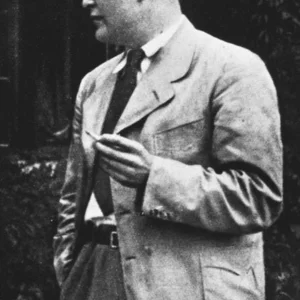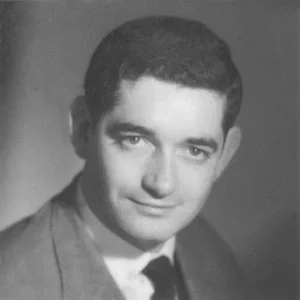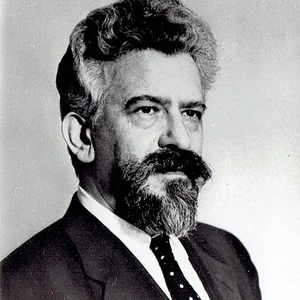

An American rabbi, theologian and Jewish philosopher of Polish origin, Abraham Joshua Heschel was one of the great spiritual figures of the 20th century. A thinker on Judaism and biblical prophecy, he stood alongside Martin Luther King in the American civil rights movement.
Abraham Joshua Heschel(1907 — 1972)
Abraham Joshua Heschel
États-Unis, Pologne
6 min read
Frequently asked questions
Famous Quotes
« In a free society, some are guilty, but all are responsible.»
« When I marched in Selma, my legs were praying.»
Key Facts
- Born in 1907 in Warsaw into a family of prestigious Hasidic dynasties.
- Expelled from Germany by the Nazis in 1938, he emigrated to the United States in 1940.
- Published 'The Sabbath' (1951) and 'God in Search of Man' (1955), major works of modern Jewish theology.
- Marched alongside Martin Luther King during the Selma to Montgomery march in 1965.
- Took part as a Jewish adviser in the Second Vatican Council (the Nostra Aetate declaration) and died in 1972.
Works & Achievements
An essay on humanity's spiritual quest and the experience of the divine. One of his most widely read books.
A poetic meditation on the Jewish day of rest, described as “a cathedral in time.” A classic of spirituality.
A grand synthesis of his philosophy of Judaism, grounded in wonder and revelation.
A major study of the biblical prophets and their demand for justice, which inspired his social engagement.
A philosophical reflection on the dignity and meaning of human existence.
His march at Selma alongside Martin Luther King made him a symbol of the alliance between faith and social justice.
His dialogue with the Catholic Church helped transform the relationship between Judaism and Christianity.
Anecdotes
In March 1965, Abraham Joshua Heschel marched alongside Martin Luther King during the Selma to Montgomery march in Alabama, for the voting rights of Black Americans. Afterward, he wrote a phrase that became famous: “I felt my legs were praying.” For him, the struggle for justice was a form of prayer.
Born in Warsaw into a great lineage of Hasidic masters, the young Abraham was considered a child prodigy. By the age of nine, he already knew entire passages of the Talmud by heart, and some believed he would become a great rabbi of this mystical tradition of Eastern Europe.
In October 1938, the Nazis expelled Heschel from Germany along with thousands of other Jews of Polish origin. He narrowly escaped the Holocaust by reaching London and then the United States in 1940. His mother and three of his sisters, who remained in Europe, would perish during the war.
Heschel formed a close friendship with Martin Luther King. In December 1972, ten days before his death, he still took part in a public gathering. King had called him “a great prophetic voice” of their time.
During the Second Vatican Council, in the 1960s, Heschel met with leaders of the Catholic Church to help change their view of Judaism. His influence contributed to the text “Nostra Aetate” (1965), which rejected the collective accusation against the Jews and opened a new dialogue between religions.
Primary Sources
The Sabbath is a cathedral in time. It is not about escaping the world, but about learning to dwell in harmony with eternity within time.
I propose that you demand of religious leaders a personal sacrifice… The moral situation calls for spiritual grandeur and moral audacity.
The prophets remind us of the moral horror of injustice. To us, an injustice is regrettable; to the prophets, it is a disaster.
Radical amazement is the proper attitude before the mystery of existence. The beginning of our knowledge is wonder.
Key Places
Heschel's birthplace, at the heart of a thriving Jewish and Hasidic community before the war.
Heschel studied philosophy there in the 1920s and 1930s and earned his doctorate, before being driven out by the Nazis.
Heschel's first teaching position after arriving in the United States in 1940.
Heschel taught Jewish ethics and mysticism there from 1945 onward; he became a leading voice of American Judaism.
Starting point of the 1965 civil rights march, where Heschel marched alongside Martin Luther King.
A stop in Heschel's exile after his expulsion from Germany in 1938, before his departure for America.
Typical Objects

White fringed shawl (tzitzit) that Jews wear during prayer. Heschel wrapped himself in it to pray morning after morning.

Small leather boxes containing verses from the Torah, strapped to the arm and forehead during morning prayer. They are a reminder of one's attachment to God.

Handwritten parchment containing the first five books of the Hebrew Bible. The heart of Jewish study and prayer, which Heschel tirelessly commented on.

Two candles lit on Friday evening to welcome the Shabbat. For Heschel, this moment opened “a cathedral in time.”

Small cap worn on the head by Jewish men as a sign of respect before God. Heschel wore it at all times, recognizable by his white beard.

The tools of the writer and theologian: Heschel wrote his books in several languages (Hebrew, Yiddish, German, English). His works left their mark on twentieth-century religious thought.
School Curriculum
Vocabulary & Tags
Key Vocabulary
Tags
Daily Life
Morning
Heschel begins his day with the morning prayer, wrapped in his tallit and his tefillin. Like many scholars, he then devotes long hours to studying the sacred texts and to writing.
Afternoon
His afternoons are shaped by teaching at the seminary in New York, where he trains future rabbis. He also receives students, journalists, and religious leaders from other faiths.
Evening
In the evening, he continues his reading and the writing of his books, often late into the night. On Friday evenings, everything comes to a halt to welcome the Sabbath with family.
Food
Heschel observes kashrut, the Jewish dietary laws that distinguish permitted foods from forbidden ones. Festive meals, such as the Sabbath meal, are sacred as much as convivial occasions.
Clothing
He is recognizable by his long white beard, his kippah, and his plain professor's suits. For prayer, he dons the traditional fringed shawl.
Housing
He lives in an apartment in New York, near the seminary where he teaches. His home overflows with books in Hebrew, Yiddish, German, and English.
Historical Timeline
Period Vocabulary
Liens externes & ressources
Références
Œuvres
Man Is Not Alone (L'homme n'est pas seul)
1951
The Sabbath (Le Shabbat)
1951
God in Search of Man (Dieu en quête de l'homme)
1955
The Prophets (Les Prophètes)
1962
Who Is Man? (Qui est l'homme ?)
1965
Engagement dans le mouvement des droits civiques
1965
Contribution à Nostra Aetate (Vatican II)
1965