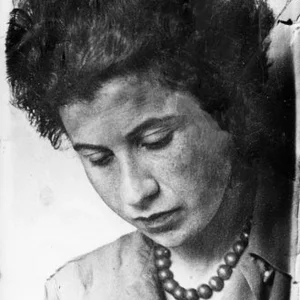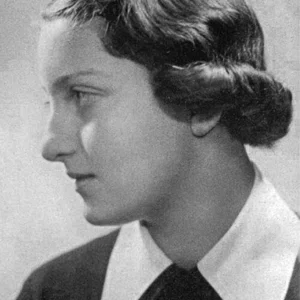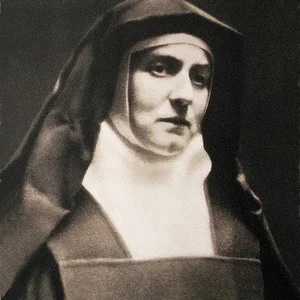

Edith Stein, a German philosopher and student of Husserl, converted from Judaism to Catholicism and became a Carmelite nun under the name Teresa Benedicta of the Cross. Arrested by the Nazis because of her Jewish origins, she died at Auschwitz in 1942. Beatified and then canonized by John Paul II, she is co-patroness of Europe.
Edith Stein(1891 — 1942)
Edith Stein
Allemagne
9 min read
Frequently asked questions
Famous Quotes
« Do not accept anything as truth if it lacks evidence.»
« Whoever seeks the truth seeks God, whether they know it or not.»
Key Facts
- Born in 1891 in Breslau (now Wrocław) into a devout Jewish family, she became agnostic in her teens.
- In 1916, she earned her doctorate in philosophy under Edmund Husserl and became his assistant.
- In 1922, she converted to Catholicism after reading the autobiography of Saint Teresa of Ávila.
- In 1933, following Hitler's rise to power, she entered the Carmelite convent in Cologne under the name Sister Teresa Benedicta of the Cross.
- Arrested by the Gestapo in August 1942, she was deported and murdered at Auschwitz. Canonized by John Paul II in 1998.
Works & Achievements
Her doctoral thesis, which philosophically analyzes the human capacity to understand another's experience. It is a major contribution to Husserlian phenomenology and the philosophy of consciousness.
A collection of lectures on the vocation, nature, and role of women in society and the Church. Edith Stein puts forward an original vision reconciling equal rights with complementarity between the sexes.
Her major philosophical work, attempting a synthesis between Husserl's phenomenology and the metaphysics of Saint Thomas Aquinas. She explores the questions of being, the soul, and God.
Memoirs of her youth in a Jewish family in Breslau, written in the face of rising antisemitism to bear witness to the dignity and richness of German Jewish life.
A mystical study of Saint John of the Cross, written shortly before her arrest. She develops her theology of the paschal mystery, uniting suffering and divine love — an unfinished book that remained her spiritual testament.
Anecdotes
Edith Stein had achieved the highest grade in her doctoral dissertation in philosophy under Edmund Husserl at Freiburg in 1916, with a thesis on empathy. Yet despite her exceptional abilities, the university denied her the right to habilitate solely because she was a woman — an injustice that marked her deeply and strengthened her feminist commitment.
In 1921, during a stay with friends, Edith Stein came across the autobiography of Saint Teresa of Ávila by chance. She read it all night in one sitting and set the book down in the morning declaring: 'This is the truth.' This reading transformed her life and led her to be baptized Catholic on January 1, 1922, breaking with her observant Jewish family.
When Hitler came to power in 1933, Edith Stein wrote directly to Pope Pius XI asking him to publicly condemn Nazi antisemitism. She never received an official reply. Aware of the danger, she decided shortly afterwards to enter the Carmelite convent in Cologne, believing that her life 'as a Jewish and Christian woman' had become a symbol.
At her arrest by the Gestapo on August 2, 1942, at the convent of Echt in the Netherlands, Edith Stein said to her sister Rosa, arrested alongside her: 'Come, let us go for our people.' These few words sum up her entire spirituality: accepting to suffer with persecuted Jews as a Christian of Jewish origin.
Edith Stein was canonized by John Paul II in 1998 and proclaimed co-patroness of Europe. This decision sparked a heated debate: Jewish representatives protested, arguing that she had died as a Jew under Nazi law, and not as a Christian martyr. This debate illustrates the complexity of her identity and her legacy.
Primary Sources
I simply want to report here what I myself experienced as a member of a Jewish family, for it seems to me that this is the best way to bear witness to the truth against the lies that are circulating today.
The cross is not an end in itself. It rises and points beyond itself. It is the sign of struggle and of victory. It points the way that leads from death to life.
As a child of the Jewish people and as a Christian and a nun, I dare to speak to the father of Christendom about what is oppressing millions of Germans. For weeks we have been seeing in Germany acts that trample all justice and humanity.
The vocation of woman is to be wife and mother. But there is another vocation: that of the consecrated virgin, who renounces earthly bonds to give herself entirely to God and to mankind.
Key Places
Edith Stein's birthplace, where she was born in 1891 into a middle-class Jewish family. Her mother Augusta Courant ran a timber business there with authority and faith, serving as a role model for Edith.
Where Edith Stein earned her doctorate in philosophy in 1916 and worked as an assistant to Edmund Husserl. It was the heart of her phenomenological intellectual formation.
The convent where Edith Stein entered as a Carmelite in October 1933, after becoming aware of the Nazi danger. She received the habit there and made her religious profession under the name Sister Teresa Benedicta of the Cross.
The convent where Edith Stein was transferred at the end of 1938 to flee Nazi persecution in Germany. She was arrested there by the Gestapo on August 2, 1942, along with her sister Rosa.
The site where Edith Stein was murdered in the gas chambers on August 9, 1942. This site, a symbol of the Shoah, is a reminder that she died like millions of other Jewish victims of Nazism.
Typical Objects

The foundational works of phenomenology that Edith Stein studied diligently and helped disseminate as Husserl's assistant. Annotating, classifying, and synthesizing Husserl's manuscripts was one of her essential tasks in Freiburg.

The garment of the Discalced Carmelites, worn daily by Sister Teresa Benedicta of the Cross (her religious name). It symbolizes the detachment and contemplative life she chose in 1933.

The Liturgy of the Hours marked the rhythm of Edith Stein's monastic life at the Carmel, from Matins to Compline. The Divine Office entirely structured her days as a contemplative.

Edith Stein maintained extensive correspondence with philosophers, theologians, friends, and students until the end of her life. Her letters are today a precious source for understanding her spiritual and philosophical thought.

The cross surmounting a mountain and a star, symbol of the Carmelite Order, was for Edith Stein the sign of her mystical vocation. She chose the name 'Teresa Benedicta of the Cross' to mark her union with the suffering Christ.

This book, read in a single night in 1921, triggered Edith Stein's conversion. It remains the central symbolic object of her spiritual journey, the decisive turning point between her philosophical period and her mystical life.
School Curriculum
Vocabulary & Tags
Key Vocabulary
Daily Life
Morning
At the Carmel, Edith Stein rose well before dawn for the Matins office, recited together in the choir. After the morning Mass and a period of meditative silence, she devoted the early hours to spiritual reading and personal prayer in her cell.
Afternoon
Afternoons were divided between the manual work prescribed by the Carmelite rule — sewing, tidying, conventual tasks — and her intellectual activities. Despite the constraints of monastic life, she found time to write her philosophical and theological works, often at a small table in her cell.
Evening
Vespers and Compline closed the liturgical day in community. In the evening, during the great silence that fell after Compline, Edith Stein would write her letters or continue her work until fatigue overtook her. The nights were short, marked by the nocturnal office.
Food
Like all Discalced Carmelites, she followed a sober dietary rule: simple meals, often vegetarian, with abstinence from meat on several days each week. Vegetables from the convent garden, bread, soups, and some dairy products made up the daily fare, with fasting observed during Advent and Lent.
Clothing
The Discalced Carmelite habit: a brown tunic and scapular, a leather belt, a brown mantle, and a white veil for novices, black for professed sisters. This habit, identical for all sisters, symbolized equality and detachment from the world. Before entering the Carmel, Edith wore sober, functional clothing typical of a bourgeois intellectual of the Weimar era.
Housing
Her cell at the Carmel was tiny and bare: a wooden bed, a small table, a chair, a crucifix on the wall, and a few permitted books. Community life took place in the cloister, the refectory, and the choir. This voluntary poverty stood in stark contrast to the comfortable family home in Breslau where she had grown up.
Historical Timeline
Period Vocabulary
Visual Style
Atmosphère visuelle grave et recueillie, mêlant l'austérité de l'habit carmélite aux tonalités sombres et expressives de l'Allemagne des années 1930, entre lumière de bibliothèque et pénombre de cellule monastique.
Sound Ambience
Entre le bruissement studieux des bibliothèques universitaires allemandes des années 1910-1930 et le silence contemplatif du Carmel, le tout hanté par l'approche sourde de la barbarie nazie.
Liens externes & ressources
Références
Œuvres
Sur le problème de l'empathie (Zum Problem der Einfühlung)
1917
De la femme (Die Frau — Fragestellungen und Reflexionen)
1928-1932
Être fini et Être éternel (Endliches und ewiges Sein)
rédigé 1935-1936, publié 1950
Vie d'une famille juive (Aus dem Leben einer jüdischen Familie)
rédigé vers 1933-1939, publié 1965
La Science de la Croix (Kreuzeswissenschaft)
1942