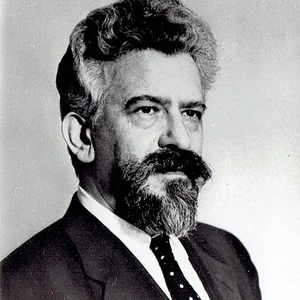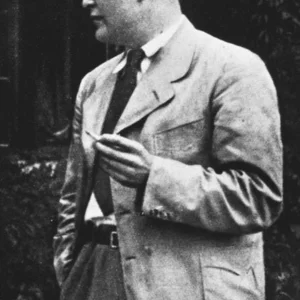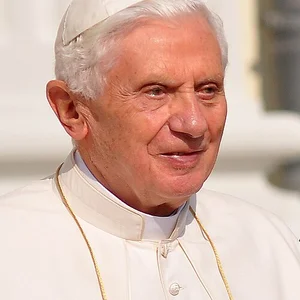

A German theologian, he was the 265th pope of the Catholic Church from 2005 to 2013. A major intellectual figure of contemporary Catholicism, he made history by becoming the first pope since the Middle Ages to voluntarily resign from his office.
Benedict XVI(1927 — 2022)
Benedict XVI
Italie, Allemagne, Vatican
5 min read
Frequently asked questions
Key Facts
- Born on 16 April 1927 in Marktl, Bavaria (Germany)
- A renowned theologian, university professor and then Archbishop of Munich (1977)
- Prefect of the Congregation for the Doctrine of the Faith under John Paul II (1981-2005)
- Elected 265th pope on 19 April 2005, taking the name Benedict XVI
- Resigned from the papal office on 28 February 2013, an unprecedented act since the Middle Ages; died on 31 December 2022
Works & Achievements
A theological essay drawn from his university lectures, which brought him worldwide recognition and remains a classic of contemporary Christian thought.
The first encyclical of his pontificate, devoted to Christian love in its forms of *eros* and *agape*.
An encyclical on Christian hope, meditating on the meaning of awaiting salvation in the modern world.
A personal trilogy on the figure of Christ, which he published under his dual name Joseph Ratzinger / Benedict XVI.
A social encyclical addressing development, the economy, and globalization in light of charity and truth.
A motu proprio facilitating the celebration of Mass according to the ancient Latin rite, a landmark measure of his pontificate.
Anecdotes
On February 11, 2013, Benedict XVI announced his resignation during a consistory... in Latin. Few of the journalists present immediately grasped the significance of his words: he became the first pope to voluntarily resign since Gregory XII in 1415.
That very evening, after the announcement, lightning struck the dome of St. Peter's Basilica. The photograph of the bolt illuminating the Vatican traveled around the world and fueled all manner of symbolic interpretations.
As a teenager in Nazi Germany, Joseph Ratzinger was forcibly enrolled in the Hitler Youth and then assigned to an anti-aircraft defense unit. At the end of the war, he deserted to return home, at the risk of his life.
Before becoming pope, he was one of the greatest theologians of his time, a renowned university professor and an expert (peritus) at the Second Vatican Council when he was only 35 years old.
A great lover of classical music, he played the piano and was especially fond of Mozart and Beethoven. A brand-new title was created for his retirement: “pope emeritus.”
Primary Sources
Aware of the gravity of this act, with full freedom, I declare that I renounce the ministry of Bishop of Rome, successor of Saint Peter.
We have come to believe in God's love: in these words the Christian can express the fundamental decision of his life.
Pray for me, that I may not flee for fear of the wolves.
This book is in no way an exercise of the magisterium; it is solely an expression of my personal search for the face of the Lord.
Key Places
Small German village where Joseph Ratzinger was born on 16 April 1927, into a modest Catholic family.
Bavarian university where he taught theology and served as vice-rector. It was here, in 2006, that he delivered his famous lecture on faith and reason.
Episcopal see he led from 1977, just before being made a cardinal and called to Rome.
Heart of the Catholic Church, where he carried out his pontificate from 2005 to 2013 and afterwards lived as pope emeritus at the Mater Ecclesiae Monastery.
The popes' summer residence near Rome, where Benedict XVI withdrew immediately after his resignation took effect on 28 February 2013.
Typical Objects

Gold ring given to each new pope, engraved with the image of Saint Peter casting his nets. It symbolizes papal authority and was once used to seal official documents.

Band of white wool adorned with black crosses, worn over the shoulders by the pope and archbishops. It evokes the sheep that the shepherd carries on his shoulders.

Red leather shoes that became one of Benedict XVI's signature articles of clothing. The red color recalls the blood of the Church's martyrs.

A staff topped with a crucifix that the pope carries during solemn celebrations. It represents the shepherd's staff guiding his flock.

Red velvet cap trimmed with white fur, a medieval legacy that Benedict XVI briefly brought back into fashion during the winter of 2005.

An instrument dear to the pope, a music lover and amateur pianist. He gladly played Mozart and Beethoven on it to recharge himself.
School Curriculum
Vocabulary & Tags
Key Vocabulary
Daily Life
Morning
The pope's day begins early, with prayer and Mass celebrated in his private chapel. This is followed by the recitation of the breviary and a period of study, for Benedict XVI remained above all an intellectual devoted to reading and writing.
Afternoon
The afternoon is devoted to audiences: heads of state, bishops, the faithful, and pilgrims follow one another. On Wednesdays, he presides over the general audience in St. Peter's Square before thousands of people.
Evening
In the evening, after dinner, he liked to relax by reading, working on his books, or playing the piano. The prayer of Compline brought his day to a close in quiet recollection.
Food
His table, plain and simple, reflected his Bavarian origins: he enjoyed simple German cooking, and his fondness for orange Fanta is well known. His meals remained modest and regular.
Clothing
He wore the white papal cassock, sometimes the red fur-trimmed mozzetta, the white zucchetto, and the famous red shoes. For major liturgies, he donned the priestly vestments and the pallium.
Housing
During his pontificate, he lived in the papal apartments of the Apostolic Palace in the Vatican. After his resignation, he withdrew to the small Mater Ecclesiae monastery, in the heart of the Vatican Gardens.
Historical Timeline
Period Vocabulary
Liens externes & ressources
Références
Œuvres
Introduction au christianisme
1968
Deus caritas est
2005
Spe salvi
2007
Jésus de Nazareth
2007-2012
Caritas in veritate
2009
Summorum Pontificum
2007