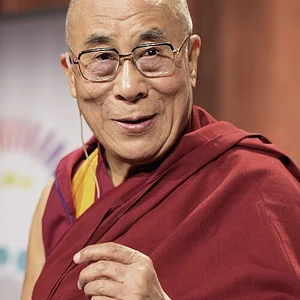

Spiritual and temporal leader of Tibet, the 14th Dalai Lama is the foremost representative of Tibetan Buddhism in the world. Exiled in India since 1959 following the Chinese invasion of Tibet, he has waged a nonviolent campaign for his people's autonomy. Nobel Peace Prize laureate in 1989.
Dalai Lama
Tenzin Gyatso, 14th Dalai Lama
8 min read
Frequently asked questions
Famous Quotes
« My religion is very simple. My religion is kindness.»
« If you think you are too small to make a difference, try sleeping with a mosquito.»
Key Facts
- 1935: born in Taktser, in the Amdo province (Tibet)
- 1940: enthroned as the 14th Dalai Lama in Lhasa
- 1959: exiled to India following the failed Tibetan uprising against Chinese occupation
- 1989: awarded the Nobel Peace Prize for his nonviolent struggle
- 2011: steps down from his political role, retaining his spiritual position
Works & Achievements
The Dalai Lama's first autobiography, written after his flight into exile, recounting the history of Tibet and the circumstances of his exile. Translated into numerous languages, it introduced the Tibetan cause to the Western world.
A speech delivered before the United States Congress proposing a negotiated solution: a peace zone in Tibet, an end to Chinese colonization, respect for human rights, and protection of the environment. It served as the starting point for diplomatic dialogue.
Co-written with psychiatrist Howard Cutler, this book became a worldwide bestseller translated into 50 languages. It synthesizes the Buddhist vision of happiness and compassion in a way accessible to non-Buddhist readers.
A reflection on the foundations of a universal ethics independent of any religion. The Dalai Lama argues for a "secular spirituality" capable of guiding a pluralistic humanity.
His second autobiography, covering the years of exile, diplomatic negotiations, and daily life in Dharamsala. It is considered the most complete account of his life and struggle.
A democratic institution established in Dharamsala, functioning as a government-in-exile with an elected parliament and full administration. The Dalai Lama served as its political leader until 2011, when he transferred leadership to an elected president.
Anecdotes
In 1937, a team of monks was sent throughout Tibet to find the reincarnation of the 13th Dalai Lama. In Taktser, they presented the two-year-old Lhamo Thondup with a collection of mixed objects — some of which had belonged to the deceased Dalai Lama. The child unhesitatingly grabbed the objects that had once been his, exclaiming in the local dialect: “It’s mine, it’s mine!” He was then recognized as the 14th Dalai Lama.
In March 1959, amid the Tibetan uprising against Chinese occupation, the Dalai Lama was forced to flee Lhasa disguised as an ordinary soldier. Traveling by night through the Himalayas, he crossed the Indian border on foot after fifteen days of grueling trekking in extreme conditions. This dramatic escape marked the beginning of sixty years of exile.
At the Nobel Peace Prize award ceremony in December 1989 in Oslo, the Dalai Lama dedicated his speech to the Tibetan people, but also to all of humanity. He championed the idea of “universal responsibility,” asserting that world peace could only come about if each individual cultivated inner peace. This speech has since been studied in many schools around the world.
Despite repeated pressure from the Chinese government, many heads of state have received the Dalai Lama. In 1997, U.S. President Bill Clinton welcomed him at the White House. Beijing protested vigorously, pointing out that China regards the Dalai Lama as a “dangerous separatist.” These diplomatic incidents highlight the persistent tension between human rights and economic interests in relations with China.
A fervent advocate of dialogue between science and spirituality, the Dalai Lama has taken part since the 1980s in numerous conferences alongside neuroscientists. He has actively encouraged research into the effects of meditation on the brain, arguing that science and Buddhism both seek to understand the nature of reality. These exchanges have helped establish contemplative neuroscience as an academic discipline.
Primary Sources
Tibet would become a zone of peace — a sanctuary open to all where humanity and nature could live in harmony. It would be demilitarized... The practice of ahimsa (non-violence) would be encouraged throughout Tibet.
I believe that universal responsibility is the key to human survival. It is the best foundation for world peace, for the equitable use of natural resources and, through its generous consideration of coming generations, for the proper care of the environment.
I was born in a stable, in a small peasant home. My mother told me later that on the night of my birth, an old dog that used to roam around the house lay down at the door and did not move.
I propose negotiations between China and Tibet for a status of genuine autonomy for the whole of Tibet... Tibetans would be responsible for their own internal affairs, including education, religion, culture, environmental protection, and the economy.
Key Places
A small high-altitude farming village where Tenzin Gyatso was born on July 6, 1935. Now part of China's Qinghai Province, the village is a quiet place of pilgrimage for Tibetans.
A palace-fortress built in the 17th century and the traditional residence of the Dalai Lamas. It was here that Tenzin Gyatso was enthroned and governed until his flight into exile in 1959. Listed as a UNESCO World Heritage Site.
A town in northern India (Himachal Pradesh) where the Tibetan government-in-exile was established in 1960. The Dalai Lama has made it his permanent home for over sixty years; it is nicknamed "Little Lhasa."
The Norwegian capital where the Dalai Lama received the Nobel Peace Prize in December 1989, in the Oslo City Hall. His acceptance speech has become a foundational text of contemporary non-violence ethics.
The place where the Buddha Shakyamuni attained Enlightenment beneath the Bodhi tree. The Dalai Lama teaches here regularly, particularly during the great Kalachakra gatherings that draw hundreds of thousands of the faithful.
Typical Objects

A necklace of 108 beads used to count mantras during daily meditation. The Dalai Lama begins each day with several hours of prayer, holding his mala.

The traditional garment of Tibetan monks, recognizable by its deep crimson and gold hues. The Dalai Lama's robe has become a worldwide symbol of Tibetan Buddhism.

A fine white silk scarf offered during respectful greetings in Tibetan tradition. The Dalai Lama both receives and presents khatas at every audience, and has been given thousands over the years.

A painting on silk depicting Buddhist deities, notably Avalokiteśvara (Chenrezig), of whom the Dalai Lama is considered an incarnation. His residence in Dharamsala is adorned with them.

An eight-spoked symbol representing the Buddha's teachings. It appears on the flag of Tibet in exile and is ever-present at ceremonies presided over by the Dalai Lama.

The Dalai Lama has worn thin metal-framed glasses for decades, and they have become a distinctive feature of his public image during speeches and audiences around the world.
School Curriculum
Vocabulary & Tags
Key Vocabulary
Daily Life
Morning
The Dalai Lama rises every morning at 3:30 a.m. He devotes the first hours of his day to meditation, the recitation of mantras, and prayer, often for four to five hours. This monastic discipline, instilled since childhood, lies at the heart of his spiritual life.
Afternoon
The afternoon is devoted to audiences, Buddhist teachings, and meetings with delegations from around the world. He receives heads of state and ordinary Tibetan pilgrims alike. He also follows international news and reads scientific journals, particularly in the field of neuroscience.
Evening
The evening is reserved for reading, short walks in the garden of his Dharamsala residence, and a final meditation session before retiring early, usually around 7 p.m. He also practices Tibetan yoga (tsa lung) to maintain his physical fitness.
Food
The Dalai Lama has been vegetarian since the 1960s, in keeping with Buddhist principles of non-violence toward living beings. His daily diet consists of tsamba (roasted barley flour, a Tibetan staple), vegetables, rice, and yak butter tea, a traditional Tibetan drink.
Clothing
He wears Tibetan Buddhist monastic robes at all times: a dark burgundy cloth draped over the left shoulder, leaving the right shoulder bare, paired with a saffron yellow tunic. This attire, identical to that of all monks, symbolizes his rejection of social distinctions. He is often recognizable by his metal-framed glasses.
Housing
The Dalai Lama lives in a modest villa in Dharamsala (northern India), surrounded by a garden. Far from the grandeur of the Potala Palace in Lhasa, his residence in exile reflects a deliberate simplicity. He receives visitors and delegations there, and the home contains a meditation room, a library, and Tibetan thangkas (sacred paintings).
Historical Timeline
Period Vocabulary
Liens externes & ressources
Références
Œuvres
Mon pays et mon peuple (My Land and My People)
1962
Plan de paix en cinq points pour le Tibet
1987
L'Art du bonheur (The Art of Happiness)
1998
Éthique pour le nouveau millénaire (Ethics for the New Millennium)
1999
La Liberté en exil (Freedom in Exile)
1990
Gouvernement tibétain en exil (CTA)
1959 — en cours