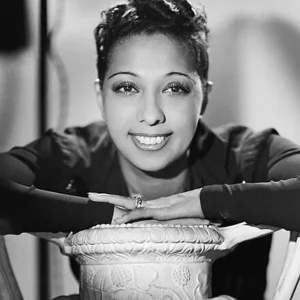

French singer, dancer, and revue performer of American origin
Joséphine Baker(1906 — 1975)
Joséphine Baker
France, États-Unis
8 min read
Frequently asked questions
Key Facts
- Née en 1906 à Saint-Louis (Missouri, États-Unis), Joséphine Baker grandit dans la pauvreté avant de devenir danseuse professionnelle.
- En 1925, elle triomphe à Paris au Théâtre des Champs-Élysées dans la Revue Nègre, devenant une icône du music-hall et du mouvement de la Harlem Renaissance en Europe.
- Durant la Seconde Guerre mondiale (1939-1945), elle s'engage dans la Résistance française et les Forces Françaises Libres, collectant des renseignements pour les Alliés.
- Elle adopte douze enfants de nationalités différentes, formant sa 'tribu arc-en-ciel', symbole de son combat contre le racisme et pour la fraternité universelle.
- En 2021, elle entre au Panthéon, première femme noire et première artiste à recevoir cet honneur en France.
Works & Achievements
African-American music-hall show presented at the Théâtre des Champs-Élysées, which revealed Joséphine Baker to Europe and caused a major cultural shock by introducing jazz and African-American dances to Parisian audiences.
The flagship revue of the Folies Bergère in which Joséphine Baker created her iconic banana costume, establishing her status as an international star and symbol of the modernity of the Roaring Twenties.
Joséphine Baker triumphed in this operetta at the Théâtre Marigny, proving her artistic versatility beyond dance and establishing herself as a genuine actress and lyric singer.
French musical film in which Joséphine Baker plays the first female lead role for a Black woman in European cinema, a historic achievement that broke a racial taboo in the film industry.
Musical comedy in which Baker plays a young Tunisian woman transformed into a Parisian star, a film that ironically questions colonial prejudices and the social codes of interwar European society.
Full commitment as an agent of the Deuxième Bureau, transmitting vital military intelligence under artistic cover, which earned her the Resistance Medal and the Legion of Honor at the Liberation.
The only woman officially at the podium during the great civil rights rally where Martin Luther King spoke, Baker carried the voice of the experience of true freedom and challenged America on its racial contradictions.
Anecdotes
When she arrived in Paris in 1925, Joséphine Baker caused a resounding scandal by dancing the 'Danse sauvage' wearing nothing but a skirt made of bananas at the Théâtre des Champs-Élysées. Within a few weeks, she became the most photographed woman in the world and the idol of all Paris.
During the Second World War, Joséphine Baker worked as a secret agent for French intelligence services. She concealed military information in her sheet music and on her body using invisible ink, traveling freely thanks to her fame as an international artist.
In 1963, Joséphine Baker was the only woman to officially speak at the March on Washington alongside Martin Luther King. Dressed in her French Army uniform, she declared before 250,000 people: 'You have a dream. I have reality.'
Joséphine Baker adopted twelve children of different nationalities and religions, whom she called her 'Rainbow Tribe'. She settled her family at the Château des Milandes in the Dordogne, transforming her estate into a living symbol of universal brotherhood and peaceful coexistence.
In 1974, ruined and evicted from her château, Joséphine Baker was taken in by Princess Grace of Monaco, who offered her an apartment. At 68, she returned to the stage in Paris to celebrate her 50-year career and received a twenty-minute standing ovation. She passed away four days after her final performance.
Primary Sources
I arrived in Paris with forty francs in my pocket. But I had something that money cannot buy: I had the will to succeed and to prove that the color of my skin was not an obstacle.
Josephine Baker placed herself entirely at the disposal of Free France. She transmitted intelligence of the utmost importance on enemy troop movements in Morocco, Spain and Portugal, at the risk of her life.
My friends and my brothers, when I come back to America, I suffer. You know what I mean. But when I return to France, I breathe. I am free. I am a complete human being.
I categorically refuse to perform before a segregated audience. If Black people cannot sit in the same seats as white people, I will not take the stage. That is my one and only condition.
Key Places
The mythical Parisian music hall where Joséphine Baker became a world star from 1926. It was here that she created the "Banana Dance" and embodied the spirit of the Roaring Twenties.
Property acquired by Joséphine Baker in 1947, where she established her "Rainbow Tribe" of twelve adopted children. She made it a living symbol of universal brotherhood until its seizure in 1969.
Site of her 1925 Parisian triumph with the Revue Nègre, where Baker caused a resounding scandal and instantly won over all of artistic Paris, launching her European career.
Joséphine Baker's birthplace, marked by the poverty and racial violence of her childhood. It was the brutality of American segregation that drove her to flee to Europe.
During the Resistance, Joséphine Baker used her tours across North Africa as cover for her espionage missions, gathering intelligence on Axis troops in Morocco and the Mediterranean.
Typical Objects

Iconic costume from the "Banana Dance" performed at the Folies Bergère in 1926, which became one of the most recognizable visual symbols of the Roaring Twenties and Joséphine Baker's artistic freedom.

Joséphine Baker proudly wore her French Air Force second lieutenant uniform at public appearances, including the March on Washington in 1963, symbolizing her dual commitment to France and civil rights.

During the Resistance, Joséphine Baker concealed secret military intelligence written in invisible ink inside her sheet music, which she transported during her tours through neutral territories.

Joséphine Baker would stroll through the streets of Paris accompanied by her tamed cheetah Chiquita, a symbol of her unapologetic eccentricity and refusal to conform to the social conventions of the time.

Decoration awarded to Joséphine Baker for her courage during the Resistance and her commitment to Free France, which she wore with pride to remind the world that patriotism and the fight against racism are inseparable.

An essential working tool for this singer and revue headliner, the microphone embodies a fifty-year career on the world's greatest stages, from Paris to New York, transforming Baker's voice into an instrument of freedom and resistance.
School Curriculum
Vocabulary & Tags
Key Vocabulary
Daily Life
Morning
Joséphine Baker rises late, after spending the night on stage until the small hours. She begins her day with a hot bath and a massage, surrounded by her pets (cats, parrots, and her cheetah Chiquita). She has a hearty breakfast of eggs, fresh fruit, and strong coffee, before attending to her voluminous fan mail.
Afternoon
The afternoon is devoted to rehearsals at the theater, where Baker oversees every detail: choreography, costumes, and lighting. She confers with dressmakers and set designers, imposing her ideas with authority. When at the Château des Milandes, she tends to her adopted children, teaching them languages and organizing educational activities.
Evening
The evening belongs entirely to the show: elaborate makeup, sculpted hair, meticulously prepared costume. Baker concentrates alone in her dressing room before taking the stage, then gives everything during two hours of performance. After the show, she receives artists, journalists, and admirers in her dressing room until dawn.
Food
Joséphine Baker happily enjoys the Creole and American cuisine of her childhood: fried chicken, red beans and rice, fruit pies. In Paris, she embraces classic French cuisine and frequents the finest restaurants. She drinks little alcohol despite the perpetual festive atmosphere of the cabarets, preferring fruit juice and mineral water to preserve her voice.
Clothing
On stage, Baker wears extravagant costumes created by the greatest Parisian couturiers: ostrich feathers, sequins, furs, and her legendary banana skirt. In everyday life, she dresses with understated but confident elegance, wearing Chanel or Schiaparelli, always at the cutting edge of fashion. She was one of the first women to popularize certain masculine cuts and to wear short hair slicked back with brilliantine.
Housing
Joséphine Baker lives in a luxurious apartment in the 16th arrondissement of Paris, decorated in an Art Deco style blending African objects with modern Parisian furniture. From 1947 onward, she lives partly at the Château des Milandes, a vast estate in the Périgord region with a park, farm, and tourist village that she develops for her 'Rainbow Tribe.' She travels constantly between Paris, North Africa, and the United States for her tours.
Historical Timeline
Period Vocabulary
Visual Style
Style Art Déco parisien des Années folles, inspiré des affiches de Paul Colin : contrastes forts, dorures et couleurs tropicales mettant en valeur la silhouette flamboyante de Baker sur les scènes parisiennes.
Sound Ambience
Ambiance sonore des cabarets et music-halls parisiens des Années folles, mêlant jazz américain, rythmes afro-caribéens et effervescence festive de la Belle Époque.
Liens externes & ressources
Références
Œuvres
La Revue Nègre
1925
La Folie du jour (Folies Bergère)
1926
La Créole (opérette d'Offenbach)
1934
Action dans la Résistance française
1940-1944
Discours à la Marche sur Washington
28 août 1963