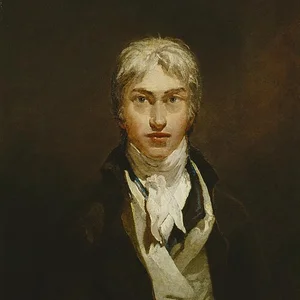

British painter and engraver (1775-1851), Turner is considered the master of Romantic landscape. A forerunner of Impressionism, he revolutionized the depiction of light, water, and atmosphere.
J. M. W. Turner(1775 — 1851)
Joseph Mallord William Turner
royaume de Grande-Bretagne, Royaume-Uni de Grande-Bretagne et d'Irlande
8 min read
Frequently asked questions
Famous Quotes
« I did not paint to be understood; I painted what I saw.»
Key Facts
- 1775: Born in London in the Covent Garden district
- 1789: Admitted to the Royal Academy of Arts at the age of 14
- 1802: Elected a full member of the Royal Academy
- 1844: Painted 'Rain, Steam and Speed', a masterpiece on industrial modernity
- 1851: Died in London, leaving nearly 550 oil paintings and 2,000 watercolors
Works & Achievements
A vast panoramic canvas blending ancient history with a raging Romantic landscape. Turner depicts nature crushing human ambition, painted at the height of the Napoleonic era.
Considered the greatest British painting, this canvas shows the famous warship being towed to her last berth to be broken up by a steam tug. It symbolizes the end of an era in the face of the triumph of industry.
A work of moral engagement depicting enslaved people thrown overboard during a storm. Painted at the heart of the abolitionist debate, it is one of Turner's rare and explicit political statements.
A near-abstract, swirling canvas in which steam, snow, and sea merge into one. Turner claimed to have had himself lashed to the mast of a ship to observe the scene: “I did not paint it to be understood, but I wished to show what such a scene was like.”
A prophetic vision of modernity: a train bursts out of a bridge through a golden haze. One of the first great depictions of the Industrial Revolution in the history of painting.
An unfinished canvas of remarkable abstraction for its time, in which forms and colors dissolve into the light of dawn. It directly prefigures Impressionism and the abstract art of the 20th century.
Anecdotes
Turner was obsessed with direct observation of the natural elements. At the age of 67, he had himself lashed to the mast of a ship during a storm in the North Sea to experience the full force of the winds and waves. This extreme ordeal gave rise to one of his most celebrated paintings, “Snow Storm — Steam-Boat off a Harbour’s Mouth” (1842), which left the critics of his day utterly baffled.
Deeply solitary and secretive, Turner spent the last decade of his life in Chelsea under the assumed name of “Mr. Booth”, passing himself off as a simple retired sailor. His neighbours had no idea they were living next door to England’s most celebrated painter. It was only at his death in 1851 that his true identity was revealed, to the great scandal of the London press.
In 1819, on his first trip to Italy, Turner was literally dazzled by the light of Venice. He produced hundreds of sketches and watercolours within just a few weeks. Venice became a recurring subject in his work, a symbol of fleeting beauty and decline — he returned there twice more.
Turner bequeathed his entire body of work to the British nation — nearly 300 oil paintings and more than 30,000 watercolours and drawings. He wished for his works to remain together and be accessible to the public. Today, Tate Britain in London houses the largest collection of his works, known as the “Turner Bequest”.
The critic John Ruskin became Turner’s most ardent champion at a time when the press was mocking his later paintings, accusing the artist of covering his canvases with “soapsuds and whitewash”. In 1843, Ruskin published the first volume of his Modern Painters in defence of Turner’s genius. Turner, who rarely spoke about his work, sent him a heartfelt letter of thanks.
Primary Sources
“If you have ever wished to see what water is — real water, not a conventional painting of water — look at Turner.”
“I have worked every day since my arrival — I have filled whole sketchbooks — the light here is of a nature I could never have imagined had I stayed in England.”
“I desire that my finished pictures remain together and never be separated. I bequeath my finished paintings to the nation, on condition that a gallery be built to house them within ten years of my death.”
“The author was in this storm on the night the Steam Boat Ariel left Harwich.”
“The Sun is God.”
Key Places
A vibrant neighborhood where Turner was born in 1775, the son of a barber. This London childhood at the heart of a bustling district shaped his curiosity for crowds and urban light.
Turner visited Venice three times and made it one of his favorite subjects. The raking light on the canals and the melancholic beauty of the city inspired some of his greatest canvases.
The residence of Lord Egremont, Turner's patron and friend. Turner stayed there regularly and painted interior scenes bathed in golden light, exploring the effects of natural light in grand spaces.
Turner spent his final years in Chelsea under the assumed name of "Mr. Booth," in a modest house overlooking the Thames. It was there that he died in 1851, surrounded by his most abstract works.
The museum that today holds the largest collection of Turner's works in the world, in accordance with his wishes expressed in his will. The Turner galleries allow visitors to trace the full evolution of his style across sixty years of his career.
Typical Objects

Turner was obsessed with warm tones, symbols of divine light. His palette dominated by chrome yellows, ochres, and lead whites was the central tool of his luminous revolution.

Turner always carried sketchbooks wherever he went. More than 300 are known, filled with quick watercolors, color notes, and sketches made on the spot during his travels across Europe.

A pioneer of outdoor watercolor, Turner used compact boxes of pigments carried to coastlines, into the mountains, or aboard ships to capture the fleeting atmosphere of the moment.

Turner was a constant presence at ports and along coastlines, armed with a spyglass to observe distant light effects on water and sails. This object reflects his deep love of the sea.

Turner built up numerous translucent glaze layers over his oils to create his characteristic atmospheric effects. This complex technique gave his canvases an inner luminosity that his contemporaries struggled to understand.

To work outdoors in all weathers, Turner wore a broad hat that let him observe without being dazzled — whether under the Venetian sun or in the storms along the Devon coast.
School Curriculum
Vocabulary & Tags
Key Vocabulary
Tags
Daily Life
Morning
Turner rose at dawn to observe and capture the morning light, which he considered the most precious for a painter. Sketchbooks in hand, he would often make his way down to the banks of the Thames or to a harbour to record the colours of the sky before the city awoke.
Afternoon
The afternoon was devoted to studio work: Turner patiently built up layers of glazes and highlights on his canvases, sometimes over several days. He was famous for his frantic last-minute retouching during the Royal Academy's Varnishing Days, reworking his hung paintings right up until the doors opened.
Evening
Despite his fame, Turner rarely frequented fashionable salons. He preferred the taverns of the harbour districts and the company of sailors and fishermen. He read widely — epic poetry, travel narratives, natural history — to feed his imagination and find subjects for his paintings.
Food
Turner led a simple, unpretentious lifestyle for a celebrated painter. He enjoyed sailors' fare: grilled fish, fresh oysters in port towns, English ale. His companion, Mrs. Booth, cooked for him during his stays in Margate and Chelsea.
Clothing
Turner dressed casually, even carelessly, favouring practical clothes that could withstand paint and sea spray. A heavy coat and a wide-brimmed hat for working outdoors — nothing about his appearance hinted at his international renown.
Housing
In London, Turner owned a studio-house on Queen Ann Street, its glazed roof letting in the north light ideal for painting. In his later years, he lived quietly in a small house in Chelsea under an assumed name, with a direct view of the Thames that inspired him every day.
Historical Timeline
Period Vocabulary
Visual Style
Style pictural romantique caractérisé par une lumière atmosphérique dorée dissolant les formes, des ciels tourbillonnants et une palette chaude où jaunes intenses, ors et bleus profonds créent une tension permanente entre chaos et sublime.
Sound Ambience
Atmosphère sonore des ports et côtes britanniques du début du XIXe siècle : vents, vagues, mouettes et premiers grondements de la révolution industrielle se mêlent dans un crescendo romantique et dramatique.