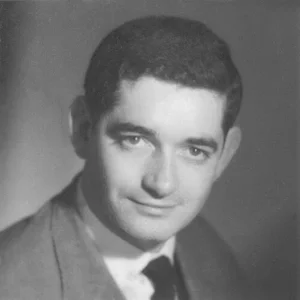

French filmmaker (1931–1990), a major figure of the French New Wave, celebrated for his poetic musicals blending vivid colors with melancholy. Director of The Umbrellas of Cherbourg and The Young Girls of Rochefort.
Jacques Demy(1931 — 1990)
Jacques Demy
France
7 min read
Frequently asked questions
Famous Quotes
« Cinema is made to move you.»
« I wanted to make films the way you make bouquets of flowers.»
Key Facts
- 1931: Born in Pontchâteau (Loire-Atlantique)
- 1961: First feature film, Lola
- 1964: Palme d'Or at Cannes for The Umbrellas of Cherbourg
- 1967: The Young Girls of Rochefort, starring Catherine Deneuve and Françoise Dorléac
- 1990: Died in Paris from leukemia
Works & Achievements
Demy's debut feature, shot in black and white in Nantes. A film about waiting and impossible love, it establishes the recurring themes that would run through his entire body of work.
A film starring Jeanne Moreau immersed in the casino world of the French Riviera. Shot in black and white with dazzling light, it confirms Demy's distinctive style.
An entirely sung musical, winner of the Palme d'Or at Cannes. A love story torn apart by the Algerian War, elevated by vivid colors and Michel Legrand's music.
A joyful musical featuring Catherine Deneuve, Françoise Dorléac, and Gene Kelly. A celebration of youth, dance, and love set in an enchanting, theatrically designed town.
A magical adaptation of Perrault's fairy tale starring Catherine Deneuve. A major popular success blending humor, poetry, and subtle social critique within a world of saturated color.
A dark musical set against a backdrop of labor strikes in 1950s Nantes. One of Demy's most ambitious and least-known works.
Demy's last completed film, with Yves Montand playing himself in a musical fiction weaving past and present together in Marseille.
Anecdotes
Jacques Demy grew up in Nantes, a city he loved passionately throughout his life. As a child, he made puppets and built small theaters, tirelessly rehearsing his shows in his father's coachwork shop. This love of performance and handcrafted stagecraft already foreshadowed the filmmaker he would become.
The Umbrellas of Cherbourg (1964) represents a unique technical and artistic challenge in French cinema: every line, even the most mundane ('Would you like some coffee?'), is entirely sung. Michel Legrand composed a continuous score over a screenplay-libretto by Demy. The film won the Palme d'Or at Cannes, astonishing a world accustomed to black-and-white auteur cinema.
For The Young Girls of Rochefort (1967), Demy had dozens of facades in this military port city repainted in vivid pastel colors, transforming it into a fairy-tale set. He recruited aging but ever-graceful Hollywood star Gene Kelly, and enlisted hundreds of Rochefort residents as extras in the grand finale parade.
Jacques Demy and filmmaker Agnès Varda formed one of the most iconic couples in French cinema. Married in 1962, they shared an artistic life together until Demy's death in 1990. Varda paid tribute to him in two moving films: Jacquot de Nantes and The Young Girls Turn 25.
Demy died on October 27, 1990 from AIDS, a disease that was heavily stigmatized at the time. Agnès Varda chose to publicly reveal the cause of his death to break a powerful taboo. He was one of the first prominent French artists whose death was linked to this epidemic, which was silently decimating thousands of people.
Primary Sources
I wanted everything to be sung because music says what words cannot. Pain, joy, love — all of it comes through more powerfully in song than in ordinary dialogue.
A film sung entirely, with painted sets in vivid colors set against a tragic love story — such is Jacques Demy's ambition for this feature film that upends the conventions of French cinema.
Color is not decorative in my work — it is dramatic. A color can express a state of mind, an era, a rupture in the narrative.
Jacques Demy's body of work occupies a world apart within French cinema: fantastical yet realistic, popular yet sophisticated, rooted in the French provinces yet open to American influence.
Key Places
Jacques Demy's hometown, it permeates his entire body of work. He filmed Lola (1961) there, and the city inspired the fairy-tale, melancholic world that runs through all of his films.
A Norman port with grey, rainy streets, chosen by Demy for The Umbrellas of Cherbourg (1964). Its facades were painted in vivid colors for this musical masterpiece, which won the Palme d'Or at Cannes.
A military port town repainted entirely in pastel colors for The Young Girls of Rochefort (1967). The shoot transformed the city into a fairy-tale set for several weeks.
Demy lived here with Agnès Varda in a bohemian studio apartment. This street in a working-class Parisian neighborhood appears in several of Varda's films and symbolizes their shared artistic life.
Demy spent several years in Hollywood in the late 1960s, captivated by the American musical film tradition. He shot The Model Shop (1969) there, an American sequel to Lola.
Typical Objects

The central tool of Demy's craft — he composed his shots with a painter's precision, choosing his lenses according to the quality of light he wanted to bring out in his colors.

Composer Michel Legrand was Demy's closest musical collaborator. Their scores, blending jazz, opera, and popular song, are inseparable from the filmmaker's world.

The symbolic object of *The Umbrellas of Cherbourg*, the umbrella embodies Demy's bittersweet melancholy around thwarted love stories — it shelters as much as it separates.

Before cinema, Demy had a deep passion for painting. He prepared his films through sketches of sets and color studies, working out his visual palette long before shooting began.

Demy was a pioneer of expressive, saturated color in French cinema of the 1960s, at a time when most New Wave filmmakers favored black and white.

A great admirer of Vincente Minnelli and Stanley Donen, Demy collected the original soundtracks of the great American musicals that inspired him to build his own Franco-musical universe.
School Curriculum
Vocabulary & Tags
Key Vocabulary
Daily Life
Morning
Jacques Demy began his days early, often by reading scripts or letters from collaborators. He would have a light coffee while browsing the newspapers, keeping a close eye on the cultural and political news of 1960s France.
Afternoon
Afternoons were devoted to production meetings, location scouting, or editing sessions. On set, he directed his actors with gentleness and a painter's precision, attentive to the slightest color harmony within the frame.
Evening
Demy spent his evenings with Agnès Varda and their friends — filmmakers, actors, and musicians. He enjoyed private screenings and lively debates about cinema, sometimes played the piano, and would listen at length to Michel Legrand's latest compositions.
Food
Like many French people from the west of France of his generation, Demy appreciated regional cuisine: seafood, buckwheat galettes, and Loire wines. Meals were for him moments of conviviality and shared creative conversation.
Clothing
Demy favored a discreet, well-groomed style typical of Parisian intellectuals in the 1960s: a tweed jacket or a light raincoat, shirt collar open. He sometimes wore brightly colored ties, echoing his passionate love of color.
Housing
He lived for many years on Rue Daguerre in the 14th arrondissement of Paris with Agnès Varda, in a studio apartment that reflected both of their artistic worlds. The walls were covered with film posters, photographs, and objects brought back from their travels across Europe and the United States.
Historical Timeline
Period Vocabulary
Visual Style
Un univers visuel de couleurs vives et saturées inspirées du fauvisme, mêlant l'esthétique des comédies musicales hollywoodiennes à la mélancolie douce-amère de la province française des années 1960.
Sound Ambience
Sons des rues animées de la province française des années 1960, mêlés aux orchestres de Michel Legrand oscillant entre fanfare joyeuse et mélodie mélancolique au crépuscule.
Liens externes & ressources
Références
Œuvres
Les Parapluies de Cherbourg
1964
Les Demoiselles de Rochefort
1967
Peau d'Âne
1970
Une chambre en ville
1982