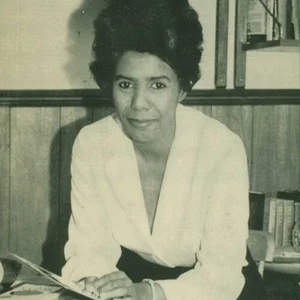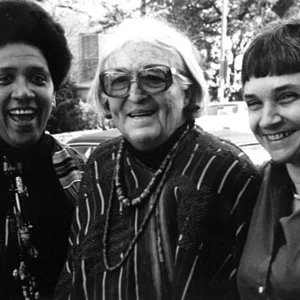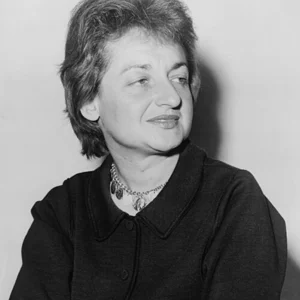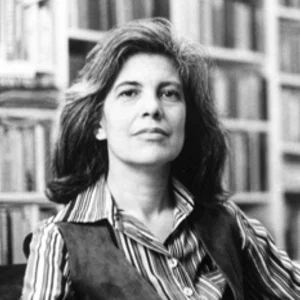

Susan Sontag (1933-2004) was a major American intellectual of the 20th century — essayist, novelist, and activist. Known for her reflections on photography, illness, and war, she profoundly shaped contemporary critical thought.
Susan Sontag(1933 — 2004)
Susan Sontag
États-Unis
8 min read
Frequently asked questions
Famous Quotes
« Photography is essentially an act of non-intervention.»
« To be educated is to learn to read slowly.»
Key Facts
- Born in 1933 in New York, she published the essay 'Notes on Camp' in 1964, which made her famous
- In 1977, she published 'On Photography', a landmark work on the image
- In 1978, 'Illness as Metaphor' analyzed the social representations of cancer and tuberculosis
- She directed theater productions in Sarajevo during the siege in 1993, a powerful act of commitment
- She died in 2004 from leukemia and remains an essential figure in American critical thought
Works & Achievements
A landmark essay published in Partisan Review that theorizes the aesthetic of camp — a taste for artifice, exaggeration, and kitsch. This text established Sontag as a major intellectual figure from the very start of her career.
A collection of critical essays in which Sontag champions a sensory approach to art against reductive interpretation. The book remains a touchstone in cultural studies and literary criticism.
A major work examining society's relationship with photographic images: their power, their limits, and their effects on our perception of reality. It continues to exert a profound influence on visual studies.
An essay drawn from her own experience with cancer in which Sontag deconstructs the cultural representations of illness — tuberculosis, cancer, and later AIDS. A foundational text in medical humanities and social studies.
A continuation of her previous essay, applied to the AIDS epidemic. Sontag challenges the moral and social stigmas attached to the disease at a moment of acute crisis.
A historical novel awarded the National Book Award, inspired by the life of Polish actress Helena Modrzejewska. It reflects Sontag's belief in fiction as a tool for intellectual exploration.
An essay in which she revisits 'On Photography' and interrogates the moral impact of war images on viewers. Published in the midst of the Iraq War, it could not have been more timely.
Anecdotes
At sixteen, Susan Sontag enrolled at the University of Chicago, admitted thanks to her exceptional precocious intelligence. There she discovered philosophy and European literature, forging an intellectual curiosity that would stay with her for the rest of her life.
In 1968, Sontag traveled to Hanoi in the midst of the Vietnam War to bear witness to American bombing raids. Her report, published as 'Trip to Hanoi', was an act of courageous political commitment at a time when criticizing American foreign policy invited fierce hostility.
During the Siege of Sarajevo in 1993, Sontag traveled to the besieged city and staged Beckett's 'Waiting for Godot' with local actors, performing by candlelight due to power outages. This powerful symbolic gesture was a demonstration of solidarity in the face of barbarity.
Diagnosed with breast cancer in 1975, Sontag survived against all odds and drew from the experience her essay 'Illness as Metaphor', in which she dismantles the cultural prejudices surrounding certain diseases. She suffered a new cancer in 1998 before succumbing to leukemia in 2004.
Her essay 'On Photography' (1977), compiled from articles published in the New York Review of Books, was an intellectual shock felt worldwide. It was the first major theoretical work to question the power and limits of the photographic image in contemporary society.
Primary Sources
Camp is a certain mode of aestheticism. It is one way of seeing the world as an aesthetic phenomenon. That way, the way of Camp, is not in terms of beauty, but in terms of the degree of artifice, of stylization.
To photograph is to appropriate the thing photographed. It means putting oneself into a certain relation to the world that feels like knowledge—and, therefore, like power.
Illness is not a metaphor, and the most truthful way of regarding illness—and the healthiest way of being ill—is one most purified of, most resistant to, metaphoric thinking.
The question of whether photographs of people killed and mutilated should be shown—and in what circumstances—remains a genuine moral question.
A writer is someone who pays attention to the world. Being a writer is practicing, with particular attentiveness and particular devotion, the art of reading the world.
Key Places
Sontag spent most of her adult life in New York, particularly in the West Village and Chelsea. The city was the center of her intellectual life and artistic commitments.
She enrolled there at 16 and received a rigorous philosophical education that lastingly shaped her critical thinking and her taste for sweeping intellectual synthesis.
Sontag spent extended periods in Paris during the 1950s, frequenting the cafés of Saint-Germain-des-Prés and immersing herself in French philosophy — Sartre, Beauvoir, Barthes, Lévi-Strauss.
In 1993, at the height of the siege of the city, she staged a production of 'Waiting for Godot' there. This symbolic act resonated around the world and embodied her belief in culture as a form of resistance.
She traveled there in 1968 during the Vietnam War, under American bombing, to bear witness to the reality of the conflict and publish a committed travel account.
Typical Objects

Sontag wrote her essays and novels on a typewriter, long refusing to switch to a computer. The mechanical clatter of the keys set the rhythm for her long working nights in her New York apartment.

She kept personal journals from adolescence onward, filling black notebooks with reading notes, thoughts, and self-analysis. These journals were published posthumously under the title 'Reborn'.

Although more a theorist of photography than a professional photographer, Sontag always brought a camera on her travels to document the world, feeding her ongoing reflection on the nature of images.

Her Manhattan apartment was overtaken by thousands of books stacked everywhere. She read in several languages and viewed reading as a fundamentally political and ethical act.

A dedicated smoker for much of her life, the cigarette was part of the image of the committed intellectual she embodied — a symbol of an entire generation of thinkers from the 1960s and 70s.
📷 Domaine public · Wikimedia Commons ↗
An inveterate traveler, Sontag journeyed to China, Vietnam, Bosnia, Israel, and across Europe. Her trips were always tied to a concrete intellectual or political engagement.
School Curriculum
Vocabulary & Tags
Key Vocabulary
Tags
Daily Life
Morning
Sontag woke late, often after a night of reading or writing that had stretched until dawn. She drank a strong black coffee before going through several newspapers — the New York Times, the Village Voice, and various European journals. She sorted through her voluminous mail, which came from intellectuals around the world.
Afternoon
Afternoons were devoted to writing in her book-crammed apartment, or to meetings with editors, artists, and filmmakers. She was a regular at SoHo art galleries and Manhattan art-house cinemas. She also taught at various universities and gave lectures.
Evening
Evenings were social and intellectually intense: dinners with artists, writers, or directors — she was close to Andy Warhol, Jasper Johns, and Joseph Brodsky. She attended film premieres, concerts, and theater performances before returning home to write or read until very late.
Food
Sontag had a simple, functional approach to food, with little interest in gastronomy. She was fond of the Greek and Italian restaurants in Greenwich Village. After her cancer diagnosis, she paid more attention to what she ate, but remained a woman of the mind with little inclination toward the pleasures of the table.
Clothing
She had a signature style: black turtleneck, dark trousers, understated jacket. She rejected conventional feminine dress codes in favor of an androgynous, intellectual look. Her natural white streak running through her dark hair had become her internationally recognized trademark.
Housing
Sontag lived in several Manhattan apartments, notably in the West Village. All of them were defined by bookshelves overflowing with stacks of books reaching to the ceiling, desks covered in manuscripts and notes, and a vinyl record collection. Every inch of living space was subordinated entirely to intellectual work.
Historical Timeline
Period Vocabulary
Visual Style
Un style visuel en noir et blanc contrasté, évoquant la photographie documentaire new-yorkaise des années 1960-70, avec une esthétique urbaine intellectuelle et engagée.
Sound Ambience
Une atmosphère nocturne d'appartement new-yorkais studieux, mêlant le bruit de la machine à écrire, les disques vinyles de musique classique et le murmure lointain de la ville.
Liens externes & ressources
Références
Œuvres
Notes on 'Camp'
1964
Contre l'interprétation
1966
Sur la photographie
1977
La maladie comme métaphore
1978
Le Sida et ses métaphores
1988
En Amérique
1999
Devant la douleur des autres
2003