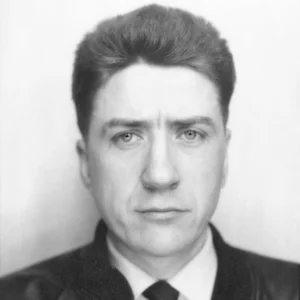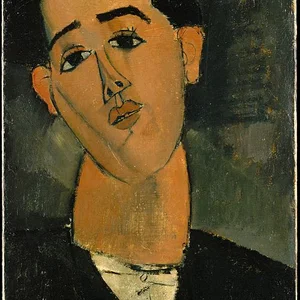

Juan Gris, born José Victoriano González-Pérez, was a Spanish painter and sculptor who settled in Paris. A major figure of Cubism, he developed a more rigorous and luminous variant of it, Synthetic Cubism.
Juan Gris(1887 — 1927)
Juan Gris
Espagne
6 min read
Frequently asked questions
Famous Quotes
« Cézanne turns a bottle into a cylinder, but I begin with the cylinder to create a special kind of individual, I make a bottle—a particular bottle—out of a cylinder.»
Key Facts
- Born in Madrid in 1887, he settled in Paris in 1906, where he joined the Bateau-Lavoir alongside Picasso.
- Around 1911–1912, he took part in the development of Cubism and exhibited his canvas *Homage to Pablo Picasso* at the Salon des Indépendants in 1912.
- He became one of the leading representatives of Synthetic Cubism, incorporating the papier collé technique from 1913 onward.
- Under contract with the dealer Daniel-Henry Kahnweiler, he developed a constructed and colorful body of work.
- He died prematurely in Boulogne-Billancourt in 1927, at the age of 40.
Works & Achievements
Cubist portrait of his friend and master Picasso. Gris's first major work, exhibited at the Salon des Indépendants, which brought him recognition.
A painting incorporating a real piece of mirror glued onto the canvas, an early example of Gris's use of real materials.
An emblematic work of Gris's synthetic Cubism, with its rigorous composition and brilliant colors.
A still life combining painting and papier collé, demonstrating Gris's mastery of the geometric organization of space.
A portrait of his companion Joséphine, showing how Gris applies the grammar of Cubism to the human figure.
A recurring figure from the commedia dell'arte among the Cubists; Gris turns it into a structured motif of colored facets.
Sets and costumes created for Diaghilev, extending the language of Cubism onto the theatrical stage.
Anecdotes
Juan Gris left Madrid for Paris in 1906, selling everything he owned. According to legend, he lost part of his money gambling during the journey, arriving in the French capital almost penniless.
In Paris, he moved into the Bateau-Lavoir, the famous run-down studio building in Montmartre, right next to his compatriot Pablo Picasso. To earn a living at first, he drew humorous caricatures for satirical newspapers.
The art dealer Daniel-Henry Kahnweiler signed a contract with Gris to buy his entire output. This gave the painter a rare measure of financial security, but the First World War, which forced Kahnweiler into exile, plunged Gris into serious hardship.
Juan Gris is nicknamed “the purest” of the Cubists. Unlike Picasso and Braque, who started from objects in order to break them down, Gris said he started from an abstract idea or a geometric structure and only then arrived at the object: “Cézanne turns a bottle into a cylinder; I make a bottle out of a cylinder.”
Of fragile health, made worse by lung and kidney problems, Juan Gris died very young, at just 40 years old, in 1927. His friend the poet Gertrude Stein and the painter Picasso were deeply affected by his early death.
Primary Sources
I work with the elements of the mind, with imagination, I try to make concrete that which is abstract, I proceed from the general to the particular, that is to say, I start from an abstraction in order to arrive at a real fact.
Cézanne makes a cylinder out of a bottle; I, on the other hand, start from the cylinder to create an individual of a special kind, out of a cylinder I make a bottle, a particular bottle.
My painting is perhaps too architectural, but I prefer the emotion that corrects the rule to the one that has no rule at all.
Juan Gris was the only person whom Picasso wished away. The relation between them was just that.
Key Places
Birthplace of Juan Gris, where he studied at the School of Arts and Manufactures before training as a painter.
Run-down communal studio in Montmartre where Gris settled upon his arrival in Paris, next door to Picasso. A hub of the Cubist avant-garde.
Small Mediterranean port in the south of France where Gris stayed in 1915 and deepened his synthetic Cubism, with brighter, more luminous colors.
Village in the Pyrénées-Orientales nicknamed “the Mecca of Cubism,” where Gris worked alongside Picasso and Braque.
Town in the Paris suburbs where Juan Gris spent his final years and died in 1927.
Liens externes & ressources
Références
Œuvres
Hommage à Pablo Picasso (Portrait de Picasso)
1912
Nature morte à la nappe à carreaux
1915
Portrait de Joséphine Gris (Portrait de la femme de l'artiste)
1916
Arlequin
1917
Décors pour Les Tentations de la bergère (Ballets russes)
1924