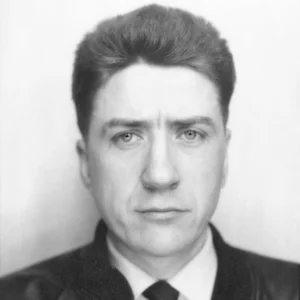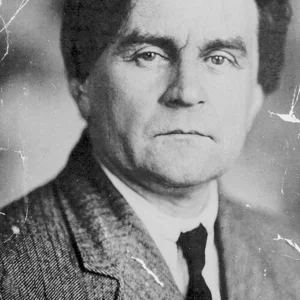

Russian and later Soviet painter and theorist, founder of Suprematism, a major movement in abstract art. His painting *Black Square* (1915) is one of the most radical works of modern art.
Kazimir Malevich(1879 — 1935)
Kazimir Malevich
Union soviétique, Empire russe
5 min read
Frequently asked questions
Famous Quotes
« I have transfigured nothingness and emerged from nothing into creation, that is, into Suprematism, into the new pictorial expression.»
« The square is not a subconscious form. It is the creation of intuitive reason.»
Key Facts
- Born in 1879 near Kiev, in the Russian Empire, into a family of Polish origin.
- Founded Suprematism and presented his works at the “0,10” exhibition in Petrograd in 1915.
- Painted *Black Square* in 1915, a pictorial manifesto of radical abstraction.
- Published in 1915 the manifesto “From Cubism and Futurism to Suprematism.”
- Died in Leningrad in 1935, after being marginalized by Soviet Socialist Realism.
Works & Achievements
A Russian Futurist opera that featured the very first appearance of the square motif, the seed of Suprematism.
The manifesto work of Suprematism, one of the most radical and famous images in modern art.
A Suprematist composition in which a simple red shape represents, according to Malevich, the feeling of revolution.
A canvas made of colored bars suspended in space, evoking the sensation of flight and pure space.
The extreme limit of abstraction: a barely visible white square on a white background, an image of creative “nothingness.”
A major theoretical book, published by the Bauhaus, that spread the ideas of Suprematism across the West.
Models of utopian architecture transposing Suprematism into three-dimensional space.
Anecdotes
In December 1915, at the Futurist exhibition “0,10” in Petrograd, Malevich hung his *Black Square* high up in a corner of the room, in the very spot where, in traditional Russian homes, the religious icon was placed. The message was clear: he was offering a new “icon” for an art stripped of all representation.
The *Black Square on a White Ground* did not stay perfectly black: over time the paint cracked, and beneath it one can make out traces of color, a sign that Malevich painted his square on top of an earlier composition. Analyses have even revealed a pencil inscription under the surface.
At the Vitebsk art school, Malevich and Marc Chagall clashed fiercely. Malevich drew so many students into his abstract group UNOVIS that Chagall, discouraged, eventually left the very school he had founded.
When Malevich died in 1935, his friends organized a Suprematist funeral: his coffin was decorated with a black square, a circle, and a cross, and a *Black Square* adorned his grave. He had designed this ritual himself.
In the 1920s, Malevich built models of abstract spatial architecture that he called “architectons” and “planits”: imaginary floating cities with no specific function, like sculptures arrived from a cosmic future.
Primary Sources
“I have transformed nothingness into the zero of form, and from zero I overflowed into creation, that is, into Suprematism, the new painterly realism, non-objective creation.”
“The square is not a subconscious form. It is the creation of intuitive reason. The face of the new art. The square is a living, royal infant.”
“Suprematism is the beginning of a new culture: our world of art has become new, non-objective, pure.”
Key Places
City in the Russian Empire (today in Ukraine) near which Malevich was born in 1879 into a family of Polish origin.
Malevich trained as a painter here in the early 20th century and mingled with the Russian avant-gardes (Cubo-Futurism).
This is where the “0.10” exhibition took place in 1915, at which the *Black Square* was shown for the first time.
City in Belarus where Malevich taught from 1919 onward and founded the UNOVIS group, after his conflict with Chagall.
The name given to Petrograd after 1924; Malevich continued his research here and died here in 1935.
Typical Objects

The painter's basic tools, which Malevich pushed to the extreme by reducing painting to pure geometric forms on a light background.

A plaster model made of assembled white geometric blocks, a kind of utopian architecture with no function, designed by Malevich in the 1920s.

Malevich designed costumes and sets, notably for the Futurist opera *Victory over the Sun*, where the idea of the square first took shape.

Texts such as *The Non-Objective World*, in which Malevich sets out his philosophy of Suprematism and justifies abstract art.

Porcelain objects decorated with geometric patterns that Malevich and his students designed to bring abstract art into everyday life.
School Curriculum
Vocabulary & Tags
Key Vocabulary
Daily Life
Morning
In the morning, Malevich works in his studio, often facing stretched canvases and pots of paint. As much a theorist as a painter, he also devotes long hours to writing down his ideas about non-representational art.
Afternoon
The afternoon is dedicated to teaching and to discussions with his students, notably in Vitebsk within the UNOVIS group. Debates about the future of art there are lively and impassioned.
Evening
In the evening, he takes part in avant-garde meetings, reads Futurist manifestos, and exchanges ideas with other artists committed to the Russian cultural revolution.
Food
Like most Russians of his time, he eats simply: black bread, soups such as borscht or shchi, kasha (cooked cereal porridge). The years of war and revolution often make food scarce.
Clothing
He wears the plain clothes of an early-twentieth-century intellectual: a jacket, a shirt, and sometimes the popular worker's cap after the revolution. He also enjoyed staging himself with unusual touches.
Housing
He lives in modest urban dwellings in Moscow and later Leningrad, often the shared apartments typical of Soviet Russia, where space and comfort are limited.
Historical Timeline
Period Vocabulary
Liens externes & ressources
Références
Œuvres
Carré noir sur fond blanc
1915
Carré rouge (Réalisme pictural d'une paysanne en deux dimensions)
1915
Composition suprématiste : avion en vol
1915
Carré blanc sur fond blanc
1918
Le Monde non-objectif
1927
Architectones et planites
vers 1923-1927