 flip
flipBaursak
Baursak
Why this dish? Baursaks — these golden, puffy fritters — were present at every *toï* (festival) where Kurmangazy played. They were piled into golden pyramids on the dastarkhan to celebrate a wedding, a birth, or the arrival of an honored guest. A musician as famous as Kurmangazy was welcomed with a mountain of baursaks: the generosity of the pile measured the respect accorded to him.
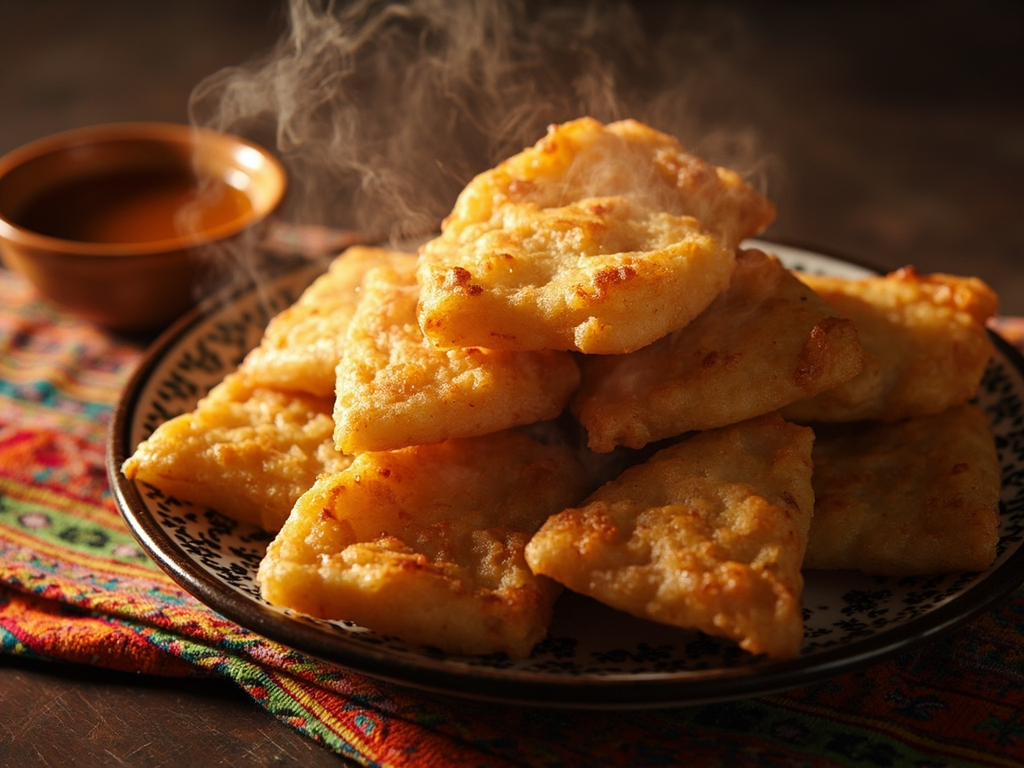
Small leavened dough fritters, fried in mutton fat until golden and puffy. Soft inside, crispy outside, traditionally piled into a pyramid on the festive cloth.
Listen, when you arrive at an *aoul* and see the mountain of baursaks on the dastarkhan, you know your *küi* has touched their hearts. The old mother fries them in fat from the fat-tailed sheep, and each one puffs up like a little cousin rejoicing at your coming. I eat them burning hot, dipped in steppe honey, and I tell myself that God put music and baursaks on earth for the same reason — so that men may gather and forget their quarrels.
- •Wheat flour — a large bowl (base)
- •Cow's or mare's milk — a bowl (liquid)
- •Mutton fat (melted tail fat) — a ladle for dough, a full *kazan* for frying (fat)
- •Natural sourdough starter — a piece (leavening)
- •Salt — a pinch (flavor)
- •Honey — for serving (accompaniment)
Baursak
Small leavened dough fritters, fried in mutton fat until golden and puffy. Soft inside, crispy outside, traditionally piled into a pyramid on the festive cloth.
Why this dish? Baursaks — these golden, puffy fritters — were present at every *toï* (festival) where Kurmangazy played. They were piled into golden pyramids on the dastarkhan to celebrate a wedding, a birth, or the arrival of an honored guest. A musician as famous as Kurmangazy was welcomed with a mountain of baursaks: the generosity of the pile measured the respect accorded to him.
Listen, when you arrive at an *aoul* and see the mountain of baursaks on the dastarkhan, you know your *küi* has touched their hearts. The old mother fries them in fat from the fat-tailed sheep, and each one puffs up like a little cousin rejoicing at your coming. I eat them burning hot, dipped in steppe honey, and I tell myself that God put music and baursaks on earth for the same reason — so that men may gather and forget their quarrels.
Ingredients (period version)
- Wheat flour — a large bowl (base)
- Cow's or mare's milk — a bowl (liquid)
- Mutton fat (melted tail fat) — a ladle for dough, a full *kazan* for frying (fat)
- Natural sourdough starter — a piece (leavening)
- Salt — a pinch (flavor)
- Honey — for serving (accompaniment)
Ingredients
- Flour — 500 g (base)
- Warm milk — 200 ml (liquid)
- Dry yeast — 7 g (1 packet) (leavening)
- Melted butter — 50 g (fat (dough))
- Sugar — 2 tbsp (flavor and yeast activation)
- Salt — 1 tsp (flavor)
- Egg — 1 (binder)
- Frying oil — 1 liter (frying)
- Honey — for serving (accompaniment)
Method
- Dissolve the yeast and sugar in warm milk. Let foam for 10 minutes.
- In a large bowl, mix flour and salt. Add the milk-yeast mixture, beaten egg, and melted butter. Knead for 10 minutes until a soft, elastic dough forms.
- Cover with a cloth and let rise in a warm place for 1.5 hours (the dough should double in volume).
- Punch down the dough. Roll out to 1.5 cm thickness and cut into diamonds or squares 4–5 cm on a side.
- Heat oil to 170°C in a large pot or deep fryer. Fry baursaks in small batches, 2–3 minutes per side, until golden and puffed.
- Drain on paper towels. Pile into a pyramid on a serving platter.
- Serve warm or at room temperature, drizzled with honey or accompanied by butter and jam.
How it was made : Baursaks were fried in melted fat from the fat-tailed sheep (*kurdiuk*), giving them a rich, characteristic flavor. The dough rose thanks to natural sourdough starter kept from batch to batch. Piled into pyramids (*tobeler*), they symbolized prosperity and hospitality. They were prepared for every important event: birth, wedding, funeral, welcoming a traveler. No Kazakh dastarkhan could open without baursaks — their absence would have been an insult.
The contemporary twist : Sprinkle with powdered sugar and cinnamon upon leaving the fryer, or fill with a touch of Kazakh wild apple jam — a "steppe-stuffed" baursak.
Sources : Будагов Лазарь, Сравнительный словарь турецко-татарских наречий, Saint-Pétersbourg, 1869 (entry "бауырсақ") · Shirin Akiner, The Formation of Kazakh Identity: From Tribe to Nation-State, Royal Institute of International Affairs, 1995
Kourmangazy · Charactorium