 flip
flipBeshbarmak (бешбармақ)
Beshbarmak (бешбармақ)
Why this dish? Abai, descended from a line of sultan-governors, regularly presided over ceremonial dastarkhans at his residence in Zhidebay and during festivities in the Chingiz-Tau mountains. Beshbarmak — literally "five fingers", as it is eaten by hand — is the dish of honor at any Kazakh reception. Distributing the mutton pieces according to the guests' rank was part of the duties of a host of his standing.
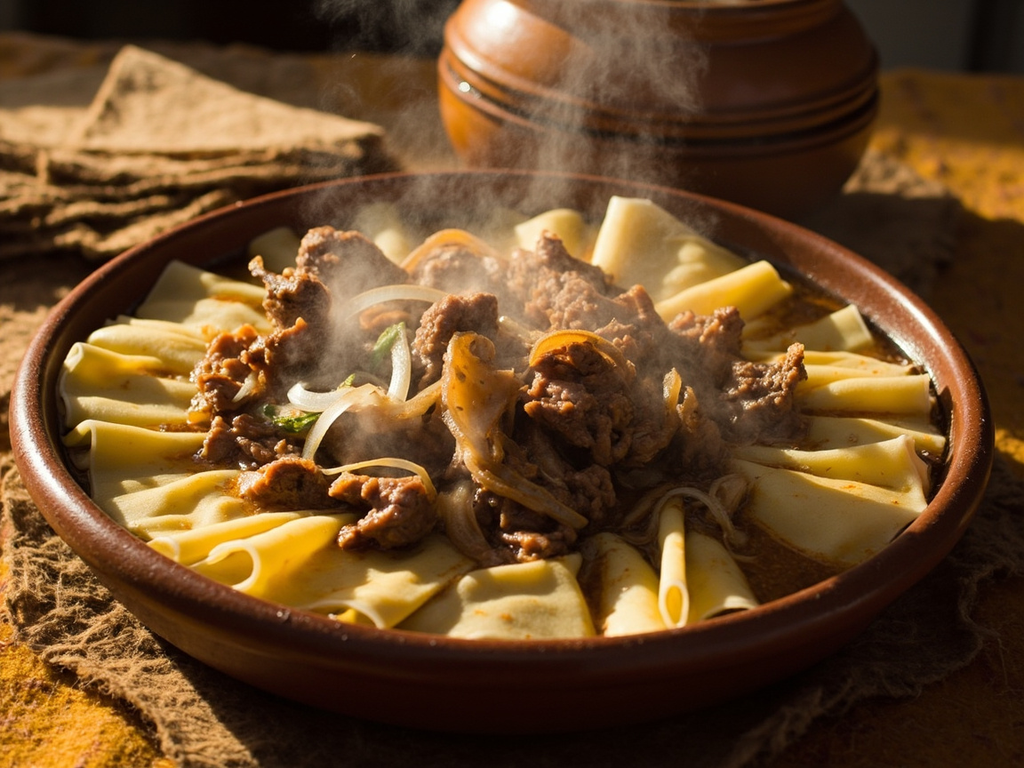
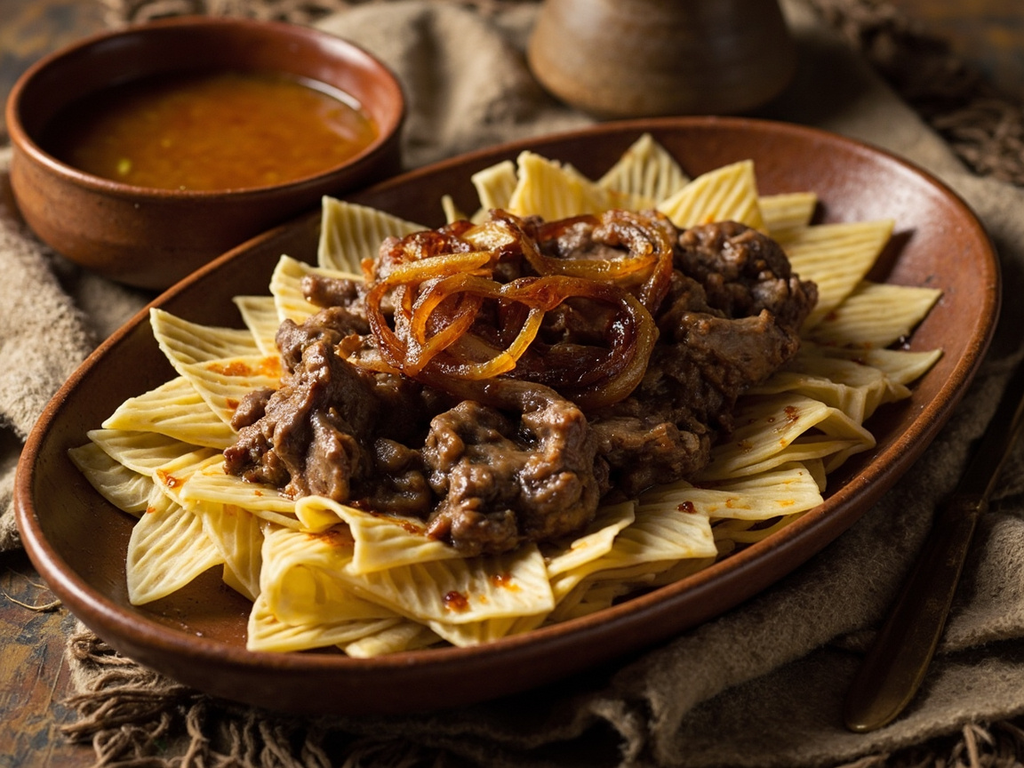
Large boiled mutton dish served on sheets of pasta (jalpak kespe), topped with onions melted in fatty broth, accompanied by sörpa served separately. Each guest receives a piece assigned according to their rank.
Friend, know that among us a man is judged by his dastarkhan. When I receive a traveler passing through the steppe, the mutton is already boiling before his mount is unsaddled. The head is presented to the eldest; the pelvis goes to the guest of honor. The pasta sheets drink the broth's juice and the fat perfumes the fingers — that is why it is called beshbarmak, the five fingers. I watch my guests eat and I know whether my hospitality is worthy of the memory of my fathers.
- •Whole sheep (a young ram) — one animal, about 15-20 kg (Main meat, boiled for a long time)
- •Fat tail of sheep (kuyryk-may) — the whole tail (Cooking fat and topping)
- •Wheat flour — several handfuls (Dough for jalpak (sheets))
- •Wild or cultivated onions — an armful (Melting garnish in the broth)
- •Salt — to taste (Seasoning)
- •Spring water — abundant (Broth)
Beshbarmak (бешбармақ)
Large boiled mutton dish served on sheets of pasta (jalpak kespe), topped with onions melted in fatty broth, accompanied by sörpa served separately. Each guest receives a piece assigned according to their rank.
Why this dish? Abai, descended from a line of sultan-governors, regularly presided over ceremonial dastarkhans at his residence in Zhidebay and during festivities in the Chingiz-Tau mountains. Beshbarmak — literally "five fingers", as it is eaten by hand — is the dish of honor at any Kazakh reception. Distributing the mutton pieces according to the guests' rank was part of the duties of a host of his standing.
Friend, know that among us a man is judged by his dastarkhan. When I receive a traveler passing through the steppe, the mutton is already boiling before his mount is unsaddled. The head is presented to the eldest; the pelvis goes to the guest of honor. The pasta sheets drink the broth's juice and the fat perfumes the fingers — that is why it is called beshbarmak, the five fingers. I watch my guests eat and I know whether my hospitality is worthy of the memory of my fathers.
Ingredients (period version)
- Whole sheep (a young ram) — one animal, about 15-20 kg (Main meat, boiled for a long time)
- Fat tail of sheep (kuyryk-may) — the whole tail (Cooking fat and topping)
- Wheat flour — several handfuls (Dough for jalpak (sheets))
- Wild or cultivated onions — an armful (Melting garnish in the broth)
- Salt — to taste (Seasoning)
- Spring water — abundant (Broth)
Ingredients
- Lamb shoulder and leg with bone — 1.5 kg (Main meat)
- Fatty sheep tail (or 100 g lamb fat) — 200 g (Traditional fat)
- Flour — 400 g (Jalpak dough)
- Egg — 1 (Binder for dough)
- Water — 150 ml + 3 L for broth (Dough and broth)
- Onions — 4 large (Garnish)
- Salt — 2 tsp (Seasoning)
- Black pepper — 1 tsp (Seasoning)
- Fresh parsley — 1 bunch (Finishing)
Method
- Place the lamb with bones in a large pot, cover with 3 liters of cold water. Bring to a boil, skim carefully, add salt, then reduce heat and simmer covered for 2.5 to 3 hours, until the meat falls off the bone.
- While cooking, prepare the dough: mix flour, egg, a pinch of salt and 150 ml water. Knead until smooth and elastic. Let rest 30 minutes under a cloth.
- Roll out the dough very thinly (2 mm) on a floured surface. Cut into large diamonds or squares about 10 cm on each side — these are the jalpak.
- Slice the onions into half-moons. Melt them in 3-4 ladles of fatty broth taken from the pot, over medium heat, for 15 minutes.
- Remove the meat from the broth, cut into generous pieces following the joints. Keep warm.
- Bring the broth to a simmer. Cook the jalpak for 3-5 minutes, remove with a slotted spoon.
- Assemble: place the pasta sheets on a large oval platter, distribute the meat on top, generously cover with the melted onions and their juice. Serve the sörpa (broth) separately in individual bowls.
How it was made : In the 19th-century steppe, a whole sheep was slaughtered for the occasion. The cooking was done in a kazan (cast-iron cauldron) placed on an open fire, inside or in front of the yurt. The dough was rolled out directly on a tanned hide. The distribution of pieces followed a strict protocol: the head to the eldest, the pelvis (janbas) to the main guest, the ribs to women, the vertebrae to children.
The contemporary twist : Serve on an oval earthenware platter with low edges, sprinkle with chopped parsley and a drizzle of concentrated broth reduced to a short sauce for a glossy finish.
Sources : Алтынбеков М., Қазақтың дәстүрлі тағамдары (Traditional Kazakh Dishes), Almaty, 2007 · Zardykhan, Zharmukhamed, « Food Culture of the Kazakh Nomads », Central Asian Survey, vol. 23, 2004
Abai Kunanbaev · Charactorium