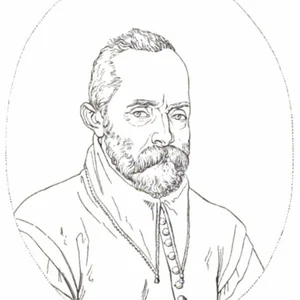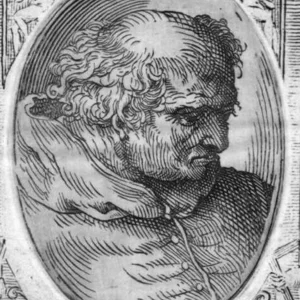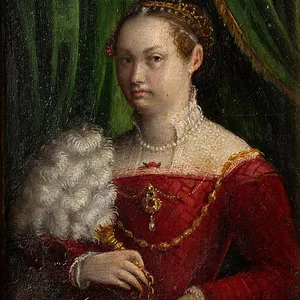

Lavinia Fontana (1552-1614) was a Bolognese painter considered the first professional female artist in the history of Western art. The daughter of painter Prospero Fontana, she excelled in portraiture and mythological scenes, working for the papal court in Rome.
Lavinia Fontana(1552 — 1614)
Lavinia Fontana
Italie
8 min read
Frequently asked questions
Key Facts
- Born in Bologna in 1552, daughter of Mannerist painter Prospero Fontana, who was her first teacher
- In 1577, she married Gian Paolo Zappi, who gave up his own career to manage hers — an extraordinary arrangement for the time
- She was the first known woman to receive large-scale public and official commissions, including altarpieces for churches
- Called to Rome around 1603 by Pope Clement VIII, she became the official painter of the papal court
- She produced more than one hundred documented works while raising eleven children, pursuing a paid professional career unique for a woman in the 16th century
Works & Achievements
Painted on the occasion of her marriage, this self-portrait shows Lavinia in an aristocratic setting, playing the harpsichord. It is one of the earliest paintings to depict a woman artist in a cultivated, professional environment.
This early work already demonstrates Lavinia Fontana's mastery of figural group compositions and her ability to integrate the tradition of the Bolognese school within a Counter-Reformation devotional framework.
A masterpiece of aristocratic female portraiture, this painting showcases Lavinia Fontana's virtuosity in rendering embroidered textiles, jewelry, and the psychological depth of her sitters. It is housed in the Musei di Palazzo Poggi in Bologna.
A signed and dated religious painting held in the Uffizi Gallery in Florence. It demonstrates Lavinia Fontana's ability to treat biblical subjects with a distinctive narrative sensitivity, poised between Mannerism and the naturalism of the Counter-Reformation.
One of Lavinia Fontana's rare works on a mythological subject, this late canvas is remarkable for its depiction of the female nude — nearly unique in the output of a woman artist of the early modern period. It is held at the Galleria Borghese in Rome.
A typical commission for the private devotion of noble Roman and Bolognese families, this painting illustrates the careful craftsmanship and luminous softness characteristic of Lavinia Fontana's mature style.
Anecdotes
Lavinia Fontana was the first woman to receive an official commission for an altarpiece in a public church in Italy. In 1589, she painted a large Nativity scene for the Basilica of San Lorenzo in Damaso in Rome — an unprecedented honor for a woman artist at the time.
Unlike virtually all women of her era, Lavinia Fontana continued her career as a painter after her marriage in 1577 to Gian Paolo Zappi. Her husband, himself a painter but less talented, became her assistant and managed her correspondence and contracts, reversing the traditional gender roles.
Lavinia Fontana was summoned to Rome by Pope Clement VIII in 1603 to become the official painter of the papal court. There she mingled with the greatest collectors and patrons of her time — an absolutely extraordinary position for a woman artist.
She was the mother of eleven children, most of whom died in infancy. Despite this demanding household, she maintained a remarkable artistic output, proudly signing her works with her full name and sometimes the word "virgo" before her marriage.
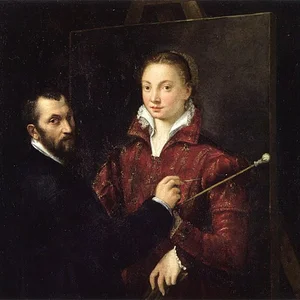
A self-portrait by Lavinia Fontana, painted in 1579, shows her in her studio surrounded by her painting tools and antique statuettes used as models. This work is one of the earliest female self-portraits to depict a woman in a professional and intellectual context.
Primary Sources
Although Vasari does not mention Lavinia Fontana in his 1568 edition, later additions and commentators on his work highlight the Bolognese artistic lineage she belongs to, stemming from the workshop of her father Prospero Fontana.
In this correspondence preserved in the Bologna archives, Lavinia Fontana discusses her works in progress and seeks the cardinal's support for an ecclesiastical commission, attesting to her network of patrons and her command of the codes of learned epistolary courtesy.
Malvasia devotes several pages to Lavinia Fontana in his collection on Bolognese painters, calling her the 'gloria di Bologna' and citing her numerous commissions for the Roman nobility and prelates of the papal court.
Lavinia Fontana signed this 1581 work 'LAVINIA FONTANA ZAPPIA FACIEBAT', asserting both her own artistic identity and her status as a wife — a signature that reveals her dual professional and conjugal identity.
Key Places
It was in her father's workshop, in the heart of Bologna, that Lavinia Fontana received her complete artistic training and produced her first important works. Bologna was at the time a major intellectual and artistic center of northern Italy.
Summoned to Rome by Pope Clement VIII in 1603, Lavinia Fontana spent the final years of her career there as official painter to the Vatican. The Eternal City was the heart of Counter-Reformation patronage and brought her her most prestigious commissions.
This Roman basilica housed one of Lavinia Fontana's first major public commissions — a Nativity painted in 1589 for the high altar. It represents the official recognition of her talent by ecclesiastical institutions.
The residence of one of the noble Bolognese families for whom Lavinia Fontana painted several portraits. These aristocratic commissions formed the foundation of her reputation and her network of patrons.
Typical Objects

Central to Lavinia Fontana's daily work, her wooden palette held carefully mixed precious pigments — lapis lazuli, vermilion, ochre — which she blended with great care to achieve the luminous flesh tones and sumptuous fabrics characteristic of her portraits.

Lavinia Fontana kept casts of antique sculptures in her studio, as seen in her 1579 self-portrait. These models allowed her to study anatomy and drapery without relying on live models — a practice that was difficult to access for a woman artist.

For her commissions of mythological and allegorical scenes, Lavinia Fontana consulted iconographic reference books such as Alciato's Emblemata, essential sources of learned imagery during the Renaissance.

Lavinia Fontana's portraits are celebrated for the meticulous detail with which she rendered pearl necklaces, brooches, and embroidery worn by her aristocratic sitters — prestigious objects that clients sometimes lent her as reference.

An exceptional document in the history of women artists, Lavinia Fontana's marriage contract (1577) included a clause allowing her to continue practicing her profession as a painter — a testament to her already established social and artistic standing.

Essential precision instruments for detailed painting, these fine brushes allowed Lavinia Fontana to work with the meticulous touch characteristic of the Bolognese school, particularly when rendering the lace, fur, and jewelry in her portraits.
School Curriculum
Vocabulary & Tags
Key Vocabulary
Daily Life
Morning
Lavinia Fontana rose early to make the most of the natural light essential for painting. She would begin her day with a brief mass, then head to her studio where she prepared her colors — grinding pigments in linseed or walnut oil — before receiving her models.
Afternoon
The afternoon was devoted to posing sessions with aristocratic clients, sometimes accompanied by conversation and music to keep the sitter animated. She also supervised the work of her assistants and her husband Gian Paolo, who was responsible for backgrounds and minor retouching.
Evening
In the evening, Lavinia Fontana managed correspondence with her patrons and sponsors, responded to requests for new commissions, and kept the workshop accounts. She also found time to study collections of mythology and engravings to expand her iconographic repertoire.
Food
Like the bourgeois families of Bologna, the Fontanas ate fresh pasta, roasted meats, seasonal vegetables, and white bread. Bologna, nicknamed 'la Grassa' (the Fat One), was renowned for its generous cuisine featuring cured meats, cheeses, and wines from the Emilian hills.
Clothing
In her studio, Lavinia Fontana wore good-quality but practical dresses, without the extravagant adornments she painted on her sitters. When receiving important clients or in Roman society, she wore more elaborate outfits — dresses with lace collars and embroidered bodices — befitting her status as an official painter.
Housing
In Bologna, the Fontana family lived in a bourgeois house near the paternal workshop in the city center. In Rome, after 1603, Lavinia Fontana had lodgings close to the Vatican, with a spacious studio well-lit enough to receive models and work on large-format pieces.
Historical Timeline
Period Vocabulary
Visual Style
Maniérisme bolonais tardif : carnations lumineuses sur fonds sombres, costumes brodés rendus avec une précision orfèvre, poses élégantes et expression psychologique subtile.
Sound Ambience
L'atelier de Lavinia Fontana à Bologne ou Rome : grattements de pinceaux, broyage de pigments, cloches d'église au loin et frémissement des soieries des modèles aristocratiques.
Liens externes & ressources
Références
Œuvres
Sainte Famille avec sainte Marguerite et d'autres saints
1578
Minerve en train de s'habiller
c. 1613