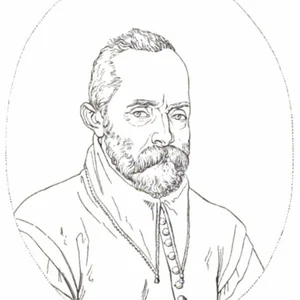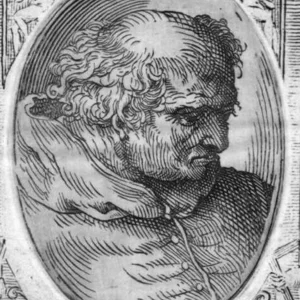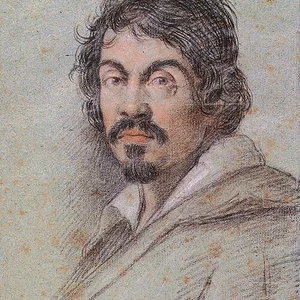

An Italian painter at the turn of the 17th century, Caravaggio revolutionized Western art through his radical use of chiaroscuro and his realistic portrayal of religious subjects. A violent and tormented figure, he fled Rome after committing a murder in 1606 and died at the age of 38.
Caravaggio(1571 — 1610)
Caravaggio
duché de Milan
9 min read
Frequently asked questions
Key Facts
- 1571: Born in Milan (Lombardy)
- 1592–1600: Settles in Rome and paints for powerful cardinal patrons
- 1600: Completes the large canvases for the Contarelli Chapel in Rome, which bring him fame
- 1606: Kills a man in a brawl and flees Rome, sentenced to death in absentia
- 1610: Dies at Porto Ercole at the age of 38, while hoping to receive a pardon
Works & Achievements
A masterpiece in the Contarelli Chapel in Rome, this painting depicts the moment Christ calls the tax collector Matthew. The diagonal ray of light cutting across the tavern scene stands as one of the most influential innovations in the entire history of painting.
Striking in its violence and realism, this painting shows the Jewish widow Judith severing the head of the Assyrian general. Holofernes's grimacing face and the spurting blood perfectly embody Caravaggio's naturalist revolution.
Painted for the banker Ciriaco Mattei, this work depicts the moment the risen Christ is recognized by his disciples. The theatrical gestures, the still life in the foreground, and the dramatic lighting make it a perfect example of his mastery of chiaroscuro.
The only work Caravaggio signed with his name — in the saint's blood. Painted for the Co-Cathedral of Saint John in Valletta, Malta, it is his largest canvas and one of his most austere, stripping the scene down to its essential elements within an oppressively empty space.
Painted for the Pio Monte della Misericordia in Naples, this work brings together all seven acts of Christian charity within a single nocturnal composition. Produced on commission during his exile, it testifies to an undiminished mastery despite the dramatic circumstances of his life.
In this late version held at the Borghese Gallery, Caravaggio gave Goliath's severed head his own features — interpreted as an act of symbolic self-condemnation. Sent to Cardinal Scipione Borghese, it may have accompanied a plea for a pardon.
Anecdotes
In 1606, Caravaggio killed Ranuccio Tomassoni during a brawl in Rome, most likely following a wager on a tennis match. Sentenced to death in absentia, he was forced to flee the city where he had built an extraordinary reputation. This violent episode marked the beginning of his years of wandering between Naples, Malta, and Sicily.
Caravaggio used ordinary people — beggars, prostitutes, innkeepers — as models for his sacred figures. This practice deeply shocked his patrons: his painting 'The Death of the Virgin' was rejected by the Carmelites in 1606 because the Virgin looked too much like a drowned woman, her body bloated and her feet bare.
Admitted into the Order of Malta in 1608 as a 'Knight of Grace', Caravaggio was imprisoned a few months later after another violent assault on a higher-ranking knight. He escaped from the Castle of Sant'Angelo in Valletta — an escape considered almost miraculous — and was expelled from the Order 'like a foul and fetid limb'.
Caravaggio painted directly onto the canvas without preparatory drawings, a revolutionary technique for the time. X-ray analysis has revealed significant pentimenti (corrections) in his works, proof that he composed and reworked his compositions on the fly during the actual execution of the painting.
He died in July 1610 at Porto Ercole, aged 38, under mysterious circumstances, while making his way back to Rome in hopes of obtaining a papal pardon. Recent research suggests he suffered from chronic lead poisoning due to his heavy use of lead white in his paintings, which may have worsened his erratic behavior.
Primary Sources
Giovanni Baglione describes Caravaggio as a painter with such a powerful naturalistic style that he scorned the works of Raphael and Michelangelo, claiming that only the living model was worthy of imitation.
Malvasia records the words of the painter Louis Finson, who knew Caravaggio in Naples: 'He never worked without a model before him, refusing to execute a single stroke without the aid of nature.'
The Order of Malta's inquiry establishes that Michelangelo Merisi known as Caravaggio, a Knight of Grace, committed serious assault upon a Knight of Justice and escaped from the prison of Castel Sant'Angelo.
Del Monte, Caravaggio's chief Roman patron, writes: 'Michelangelo da Caravaggio is a most peculiar genius, but of unmatched skill in rendering natural things with a vigor that no other possesses.'
When questioned in 1603 about the author of defamatory pamphlets against Baglione, Caravaggio declares: 'I call a good painter one who knows how to paint well and to imitate natural things.'
Key Places
A small town in Lombardy from which Michelangelo Merisi took his nickname. His family took refuge there during the plague of 1576, and he spent his childhood there following his father's death.
The site of his first public triumph: the three large canvases devoted to Saint Matthew (1599–1600) unveiled his stylistic revolution to the world, grounded in dramatic chiaroscuro and the realistic depiction of figures.
The residence of Cardinal Francesco Maria Del Monte, Caravaggio's principal patron in Rome between 1595 and 1606. It was in this palace that the painter found protection, lodging, and commissions during his years of Roman glory.
Capital of the Order of Malta, where Caravaggio was received as a knight in 1608 and painted his largest work: 'The Beheading of Saint John the Baptist'. He was also imprisoned there before making a dramatic escape.
A place of refuge during his two periods on the run (1606–1607 and 1609–1610). There he produced major works for local patrons, including 'The Seven Works of Mercy', while seeking to obtain a pardon from Rome.
A small Tuscan port where Caravaggio died on 18 July 1610, under poorly understood circumstances, as he was making his way back to Rome having learned that his papal pardon was imminent.
Liens externes & ressources
Références
Œuvres
La Décollation de saint Jean-Baptiste
1608
David avec la tête de Goliath
1609-1610