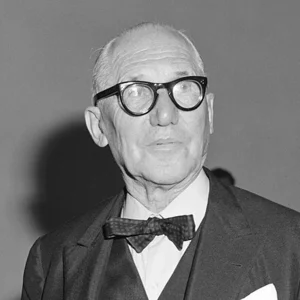

Franco-Swiss architect, urban planner, decorator, painter, sculptor, and writer
Le Corbusier(1887 — 1965)
Le Corbusier
France, Suisse
8 min read
Frequently asked questions
Key Facts
- Charles-Édouard Jeanneret, dit Le Corbusier, naît en 1887 en Suisse et s'installe définitivement à Paris en 1917.
- En 1923, il publie 'Vers une architecture', ouvrage fondateur qui théorise les principes de l'architecture moderne.
- Il formule dans les années 1920 les 'cinq points de l'architecture nouvelle' : pilotis, toit-terrasse, plan libre, fenêtre en bandeau et façade libre.
- Il conçoit l'Unité d'habitation de Marseille (1947-1952), modèle de logement collectif moderne intégrant commerces et équipements.
- Il est l'un des fondateurs du CIAM (Congrès Internationaux d'Architecture Moderne) en 1928, influençant l'urbanisme mondial au XXe siècle.
Works & Achievements
A manifesto of modern architecture, this book influenced an entire generation of architects. Le Corbusier sets out his vision of a pure, functional, and industrial architecture.
The absolute symbol of the International Style, it embodies the five principles of modern architecture. Listed as a historic monument, it is today one of the most studied buildings in architecture schools worldwide.
The first building-city integrating housing, shops, and communal facilities within a single structure raised on pilotis. A prototype for a model of collective living that inspired thousands of projects around the world.
A masterpiece of sculptural architecture and light manipulation, this chapel breaks with the rationalism of his early work. It is considered one of the most important architectural works of the 20th century.
A monumental civic ensemble comprising the Legislative Assembly, the Secretariat, and the Palace of Justice. Inscribed on the UNESCO World Heritage List in 2016, it remains the most accomplished example of his large-scale urban planning.
A system of proportions based on human stature and the Fibonacci sequence, published as a book in 1950. A universal design tool that he applied to all his buildings to harmonize spaces on a human scale.
A Dominican convent combining the brutalism of raw concrete with the requirements of monastic life. Its cells, suspended cloisters, and light-filled spaces make it a major work of modern religious architecture.
Anecdotes
Le Corbusier never received formal architectural training. Self-taught, he learned his craft by traveling across Europe, visiting monuments and drawing incessantly. It was during a trip to Greece and Italy in 1911, which he called his 'Voyage d'Orient' (Journey to the East), that he forged his fundamental aesthetic convictions about light and geometry.
Charles-Édouard Jeanneret adopted the pseudonym 'Le Corbusier' in 1920, inspired by the surname of a maternal ancestor. The name sounded like a manifesto: 'le corbeau' (the crow) evokes construction, but also a solitary and determined figure. He signed all his writings and architectural projects under this name, while keeping his real name for his painting.
Le Corbusier was a passionate painter and produced more than 400 canvases throughout his life. He co-founded the Purist movement with Amédée Ozenfant in 1918, as a reaction against the excesses of Cubism. In his view, art had to return to pure, refined forms — much like his buildings. Yet his painting remains largely unknown to the general public, overshadowed by his architecture.
The Cité Radieuse in Marseille, inaugurated in 1952, was nicknamed 'la Maison du Fada' by the locals, meaning 'the madman's house' in Provençal. The building housed 337 apartments, a school, a grocery store, a laundry, and even a hotel on the rooftop. Today a listed historic monument, it is both inhabited and visited by thousands of tourists every year.
Le Corbusier died on August 27, 1965, drowning in the Mediterranean Sea at Roquebrune-Cap-Martin, where he owned a tiny 15 m² cabin he had built for himself. He, the architect of large housing estates and new cities, chose to live in the smallest possible space facing the sea. This modest cabin, the 'Cabanon', is today a listed historic monument.
Primary Sources
A house is a machine for living in. Baths, sun, hot water, cold water, temperature at will, preservation of food, hygiene, beauty through good proportions.
Decoration is of the order of the superfluous, of excrement. Purity and economy are the cardinal virtues of the new spirit.
The keys to urban planning lie in the four functions: dwelling, working, recreation, and circulation. Sun, greenery, and space are the three raw materials of urban planning.
I have the extraordinary good fortune of finding in the golden section and the Fibonacci sequence confirmation that the measure of man could harmoniously govern architectural space.
The Acropolis of Athens taught me that architecture is the masterly, correct, and magnificent play of volumes assembled under light.
Key Places
Le Corbusier's birthplace where he took his first steps as an architect under the guidance of Charles L'Eplattenier. It is here that he built his first houses before settling in Paris.
A vertical city-building inaugurated in 1952, considered the synthesis of all his theories on modern collective housing. Listed as a historic monument, it remains inhabited and is one of the most visited buildings in France.
Built between 1950 and 1955, this chapel with its organic and sculptural forms marks a turning point in Le Corbusier's work, abandoning pure geometry in favour of a more expressive and spiritual architecture.
An entire city planned and built from 1951 on commission from Prime Minister Nehru to serve as the capital of Punjab. A unique civic ensemble in the world, with its Capitol complex listed as a UNESCO World Heritage Site.
Built from 1928 to 1931, it perfectly illustrates Le Corbusier's five points of modern architecture: pilotis, roof terrace, free plan, free facade, ribbon window. A masterpiece of the International Style.
A tiny 15 m² cabin built in 1952 for himself on the shores of the Mediterranean. The ultimate paradox of an architect of large housing complexes who chose to live in minimal space; it is here that he died in 1965.
Typical Objects

Fundamental tools of technical drawing, Le Corbusier handled them daily to design his rigorous geometric plans. His sketchbooks contain thousands of precise hand-drawn drawings.

A true visual signature of Le Corbusier, his round thick black-framed glasses became inseparable from his image. They symbolized modernity and a certain intellectual rigour he carefully cultivated.

A ruler graduated according to the Modulor system he invented in 1945, based on human body proportions and the Fibonacci sequence. He made it a universal architectural design tool to harmonize inhabited space.

Designed with Charlotte Perriand and Pierre Jeanneret, this chromed steel and leather chaise longue is one of the most iconic pieces of modern design. It illustrates his conviction that furniture must be functional, beautiful, and mass-produced.

Le Corbusier painted every morning before working on architecture. His Purist still lifes, featuring manufactured objects with clean forms, directly fed his thinking on volumes and light in architecture.

Le Corbusier's material of choice, which he used for its textures, free forms, and plasticity. The term 'Brutalism' (from béton brut) in architecture is directly linked to his innovations in the use of this material.
School Curriculum
Vocabulary & Tags
Key Vocabulary
Daily Life
Morning
Le Corbusier rose early and devoted his mornings to painting, a discipline he considered essential to his architectural thinking. From 8am to 1pm, he painted in his Parisian studio on rue Nungesser-et-Coli, refusing all appointments before lunch. This routine was maintained throughout his life, even during periods of major construction projects.
Afternoon
The afternoon was entirely dedicated to architecture: meetings with collaborators and clients at his office on rue de Sèvres, reviewing plans and models, writing manifestos and books. He supervised ongoing projects with absolute exacting standards, not hesitating to completely question work that was well advanced. His studios operated as genuine schools where young architects from around the world came to learn.
Evening
In the evenings, Le Corbusier enjoyed dining in the company of intellectuals, artists, and industrialists at Parisian cafés and restaurants. He was a gifted lecturer and tireless traveller, spending many evenings preparing his international talks or writing his vast correspondence. An avid reader, he annotated extensively the works of philosophy, art, and science that he collected.
Food
Le Corbusier was sober and regular in his eating habits, appreciating simple Mediterranean cuisine during his stays on the Côte d'Azur. He drank coffee abundantly and enjoyed wine, particularly the wines of the Midi which he consumed during his stays in Roquebrune. His meals were often occasions for extended intellectual discussion rather than gastronomic indulgence.
Clothing
Le Corbusier cultivated a carefully constructed appearance: dark three-piece suit, bow tie or necktie, and above all his iconic round thick black-framed glasses. This near-uniform attire was part of his public image as a rigorous modernist. He always wore a pocket square in his jacket and paid close attention to his appearance during his many public engagements.
Housing
From 1934, Le Corbusier lived in an apartment he designed himself on the top floor of a building on rue Nungesser-et-Coli in Paris, complete with his painting studio and a terrace. In summer, he retreated to his Cabanon in Roquebrune-Cap-Martin, a concrete cell measuring 3.66 m × 3.66 m that he designed in 1952 as the ultimate demonstration of the Modulor, and which he considered perfectly sufficient for living.
Historical Timeline
Period Vocabulary
Visual Style
Géométrie puriste et béton brut : lignes horizontales nettes, blanc éclatant sous la lumière méditerranéenne, accents de couleurs primaires et textures de béton brut selon la polychromie architecturale de Le Corbusier.
Sound Ambience
L'atelier parisien de Le Corbusier, entre crayon sur calque, sons de chantier moderniste et rumeurs urbaines du Paris des années 1930-1950.
Liens externes & ressources
Références
Œuvres
Vers une architecture
1923
Villa Savoye, Poissy
1931
Cité Radieuse (Unité d'habitation), Marseille
1952
Chapelle Notre-Dame-du-Haut, Ronchamp
1955
Capitole de Chandigarh, Inde
1953-1965
Le Modulor
1950
Couvent Sainte-Marie-de-la-Tourette, Éveux
1960