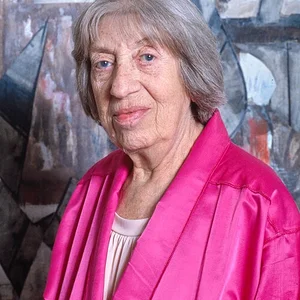

American painter and a major figure of Abstract Expressionism. A pioneer of the movement in New York, she developed a powerful body of work that was long overshadowed by that of her husband Jackson Pollock, before finally being fully recognized.
Lee Krasner(1908 — 1984)
Lee Krasner
États-Unis
5 min read
Frequently asked questions
Famous Quotes
« I like a canvas to breathe and be alive.»
Key Facts
- Born in 1908 in Brooklyn (New York) into a family of Russian Jewish immigrants
- Trained at the National Academy of Design during the 1920s and 1930s
- Married the painter Jackson Pollock in 1945, a central figure of Abstract Expressionism
- Created her major series of collages and abstract paintings in the 1950s and 1960s
- First woman painter to be given a retrospective at the Museum of Modern Art (MoMA) in 1984, the year of her death
Works & Achievements
Small, densely worked canvases made of repeated marks evoking handwriting; one of her major contributions to abstraction.
Canvas painted just before Pollock's death, a turning point toward more figurative and organic work.
An immense composition of plant and bodily forms, a powerful assertion of her personal language.
Canvases painted at night in browns and whites, sweeping gestures born of insomnia after Pollock's death.
A large, brightly colored canvas referencing the Greek earth-goddess, celebrating vital and feminine force.
Works composed from her own cut-up drawings, recycling pieces she had judged failures.
A monumental canvas of vivid, bursting forms, shown at her London retrospective.
Anecdotes
Born Lena Krassner in Brooklyn to a family of Jewish immigrants from Ukraine, she changed her first name to “Lee,” deliberately neutral. In an art world dominated by men, this androgynous name kept her from being immediately pigeonholed as a “woman painter.”
When her teacher Hans Hofmann wanted to compliment her, he told her: “This is so good you would not know it was painted by a woman.” This clumsy compliment sums up all the sexism of the art world of the time, which Krasner would have to fight her whole life.
Unable to sleep after the death of Jackson Pollock, she began painting at night. Distrusting how she perceived colors under artificial light, she worked almost entirely in brown (raw umber) and off-white: this is the “Night Journeys” series.
Krasner was a great recycler of her own work: when dissatisfied, she would cut up her old drawings and canvases — and sometimes Pollock's abandoned pieces — to recompose them into collages. Destroying in order to recreate was part of her method.
Long presented merely as “Pollock's wife,” she was not fully recognized until the end of her life. In 1984, the MoMA in New York devoted a major retrospective to her, but she died a few months before she could truly savor the recognition.
Primary Sources
I like a canvas to breathe and be alive. Be alive is the point.
I never stopped painting. Painting is not separate from life; it is one with it.
I couldn't sleep, so I painted at night. Since I didn't trust color under the evening light, I stayed with browns and whites.
Key Places
The neighborhood where Lee Krasner was born, into a family of Jewish immigrants from Ukraine who had settled in the United States.
New York art schools where Krasner received her academic training in drawing and painting.
Krasner studied here in the late 1930s and absorbed the ideas of the European avant-garde.
The house and barn-studio where she lived with Pollock from 1945, and where she produced her large-scale works after 1956.
The site of her first major retrospective in 1965, marking her international recognition.
The city where Lee Krasner died in 1984, shortly before the retrospective devoted to her by the MoMA.
Typical Objects

Essential tools of the Abstract Expressionist, used for sweeping, energetic gestures across large canvases.

The favored support of the New York School painters, who loved dimensions large enough to envelop the viewer.

Krasner cut up her own discarded drawings and canvases to recompose them; collage was at the heart of her practice.

Oil paint, sometimes mixed with other materials, provided the thick substance and the colors of her compositions.

After Pollock's death, Krasner took over the barn studio at Springs, a space that became legendary in Abstract Expressionism.

Trained in academic drawing, Krasner filled sketchbooks with figures and still lifes before turning to abstraction.
School Curriculum
Vocabulary & Tags
Key Vocabulary
Daily Life
Morning
Krasner often organized her morning around practical matters: managing the house in Springs and, during Pollock's lifetime, supporting her husband's career. She liked to observe the natural light before contemplating a day of painting.
Afternoon
The afternoon was devoted to working in the studio, standing before large canvases, alternating between moments of prolonged observation and rapid gestures. She reworked, scraped, and started over tirelessly, demanding of herself.
Evening
In the evening, especially after 1956, her insomnia drove her to paint late into the night. This is how the *Night Journeys* came to be, created in browns and whites under artificial light.
Food
Her diet was that of a twentieth-century New Yorker, shaped by her Eastern European Jewish roots. In Springs, the couple often welcomed friends and artists around convivial meals.
Clothing
In the studio, she wore practical, loose-fitting work clothes stained with paint. In town and at gallery openings, she took greater care with her appearance, elegant and self-assured.
Housing
After 1945, she lived in a wooden house in Springs, on Long Island, with a barn converted into a studio. This place, now a museum (the Pollock-Krasner House), was the heart of her creative work.
Historical Timeline
Period Vocabulary
Liens externes & ressources
Références
Œuvres
Série « Little Image »
1946-1949
Prophecy
1956
The Seasons
1957
Série « Night Journeys »
1959-1962
Collages des années 1950
vers 1953-1955