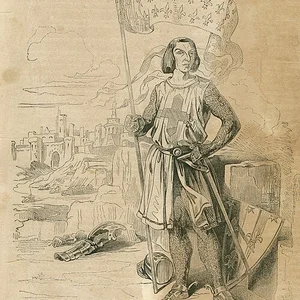

King of France from 1226 to 1270, Louis IX is renowned for his piety, his commitment to the Crusades, and his reform of royal justice. Canonized in 1297, he embodies the ideal of the medieval Christian king and strengthened the prestige of the French monarchy.
Frequently asked questions
Key Facts
- 1226: Becomes King of France at the age of 12 following the death of his father Louis VIII
- 1248–1254: Takes part in the Seventh Crusade in the Holy Land
- 1270: Leads an Eighth Crusade, dies in Tunis
- 13th century: Reforms justice by establishing the right of appeal to the king and codifying laws
- 1297: Canonized by Pope Boniface VIII, becomes patron of jurists and builders
Works & Achievements
A jewel of Rayonnant Gothic architecture erected on the Île de la Cité to house the relics of the Passion. Its stained glass windows covering 618 m² are among the finest medieval ensembles preserved in the world.
A major legislative text prohibiting corruption among royal officers, regulating justice, and imposing moral standards on the administration. It marks a decisive step in the construction of a centralized and reformed royal state.
An ordinance limiting papal interference in the appointment of clergy within the kingdom of France. The first act asserting a degree of autonomy for the French Church vis-à-vis Rome.
A hospital founded in Paris to shelter three hundred blind people, often injured crusaders. A pioneering institution of medieval public assistance, it still exists today under the name of the Hôpital National des Quinze-Vingts.
A text written shortly before his death, passing on to his son and successor his principles of governance, faith, and justice. A precious document illustrating the ideal of the medieval Christian king.
A diplomatic agreement putting an end to a century-long conflict between the Capetians and the Plantagenets. Louis IX, by ceding certain territories in the name of Christian peace, obtained recognition of French suzerainty by Henry III.
Anecdotes
Louis IX had the habit of rendering justice in person under an oak tree in the forest of Vincennes, accessible to all his subjects regardless of rank. This practice, recorded by his friend and biographer Jean de Joinville, illustrates his vision of a fair and direct royal justice. Any man or woman could come before him to submit a dispute.
During the Seventh Crusade, captured at Mansourah in 1250 following a crushing defeat in Egypt, Louis IX refused to give in to panic and personally negotiated his own ransom. When his captors threatened to torture him to extract more, he held firm to his terms with impressive composure. He was ultimately released for 400,000 livres tournois.
Louis IX regularly practiced bodily mortification: he wore a hair shirt and had himself flogged by his confessor every Friday. His extreme piety was known throughout the court, yet he refused to make a show of it in public, believing humility to be the foremost of Christian virtues.
The king was famous for inviting the poor, lepers, and the infirm to his table and serving them himself. He personally funded several hospitals, including the Quinze-Vingts in Paris, founded around 1260 to house three hundred blind people. This conspicuous charity was also a political act affirming the sacred nature of his royal office.
In 1239, Louis IX acquired what he believed to be the Crown of Thorns of Christ from the Emperor of Constantinople, Baldwin II, for the considerable sum of 135,000 livres tournois. To house this relic, he had the Sainte-Chapelle built in Paris, a jewel of Rayonnant Gothic architecture, consecrated in 1248. The cost of the chapel was far less than that of the relic itself.
Primary Sources
He arranged all his affairs in such a manner that, when he was at Pontoise, he would go to hear his mass in the church of the Friars Minor; and after he had eaten, he would go to the forest of Vincennes and sit at the foot of an oak tree, and have us sit around him.
Dear son, the first thing I teach you is that you love God with all your heart and with all your strength, for without this no one can be saved. Be careful not to do anything that displeases God, that is to say, mortal sin.
We expressly forbid all our bailiffs, provosts, mayors and others, wherever they exercise their functions, from receiving any gift or present of value from anyone under their jurisdiction, whether for themselves, their wives or their children.
Know that we were taken prisoner on the Tuesday after mid-Lent, and that the greater part of our army has been captured or killed. We ask you to pray to God for us and for those who died in his service.
Louis, King of France, shone with glorious radiance through his virtues: he practiced humility, charity toward the poor, justice toward his subjects, and died serving God during the Crusade, leaving behind a pacified kingdom and a reformed Church.
Key Places
A palatine chapel built between 1242 and 1248 to house the relics of the Passion, including the Crown of Thorns. A masterpiece of Rayonnant Gothic, it embodies both Louis IX's devotion and the symbolic power of the Capetian monarchy.
The place where Louis IX rendered justice under an oak tree, accessible to all his subjects regardless of rank. This practice, recorded by Joinville, became the iconic image of the just king close to his people.
The site of Louis IX's coronation in 1226, at the age of 12. The Gothic cathedral of Reims is the symbol of the divine legitimacy of the kings of France, and his coronation was celebrated there with great pomp despite the political tensions of the regency.
The site of Louis IX's defeat and capture in 1250, during the Seventh Crusade. The city was the scene of a disastrous battle against the Mamluks, marking the tragic turning point of the crusade and the king's imprisonment.
The place where Louis IX died on August 25, 1270, during the Eighth Crusade. Struck by an epidemic of dysentery or typhus, he died on his camp bed, surrounded by his sons, uttering the word 'Jerusalem'.
The royal necropolis where Louis IX's relics were enshrined after his death and canonization. His effigy is preserved there, making Saint-Denis the centre of the Capetian dynastic cult.
Typical Objects

A relic purchased in 1239 from the Latin Emperor of Constantinople, believed to be the crown worn by Christ during the Passion. Louis IX had the Sainte-Chapelle built specifically to house it, making it a sacred treasure of the Capetian monarchy.

A garment of horsehair or metal worn directly against the skin as a form of mortification. Louis IX wore it regularly as a sign of penance and devotion, a practice attested by his biographer Jean de Joinville.

Royal regalia carried during the coronation ceremonies at Reims. The scepter symbolized the king's temporal authority, while the hand of justice represented his role as guarantor of order and equity within the kingdom.

A blue court mantle strewn with golden fleurs-de-lis, symbol of Capetian royalty. Louis IX also wore the crusader's mantle — a white tunic bearing a red cross — during his two expeditions to the Holy Land.

Louis IX was a great patron of illuminated manuscripts, most notably the Psalter of Saint Louis and the Bible Moralisée. These devotional books reflect his deep piety and the royal patronage that spread the Parisian Gothic style.

A leather bag worn over the shoulder, the traditional attribute of the crusader and the pilgrim. Louis IX adopted it as a symbol of his spiritual commitment during his two crusades, displaying a deliberate humility that contrasted with royal magnificence.
School Curriculum
Vocabulary & Tags
Key Vocabulary
Daily Life
Morning
Louis IX rose before dawn to attend Matins and Lauds, the first canonical hours sung by the chaplains. He then spent a long time in personal prayer and reading the Gospels before receiving his advisors for the affairs of the kingdom.
Afternoon
The afternoon was devoted to administration: audiences, judicial hearings, and the royal council. Louis IX actively participated in debates and personally settled important disputes, intent on delivering personal and equitable justice to his subjects.
Evening
In the evening, after Compline, Louis IX conversed with theologians, Franciscans, or Dominicans on matters of faith and morality. He supped frugally, often in the company of the poor whom he had invited to his table and whom he sometimes served with his own hands.
Food
Louis IX followed an austere diet, marked by frequent fasts and strict abstinence on the days prescribed by the Church. He avoided overly refined dishes out of humility, although royal banquets were lavish for his guests and foreign ambassadors.
Clothing
Louis IX wore the royal blue mantle scattered with golden fleurs-de-lis during official ceremonies, but dressed plainly in daily life, in rough cloth or grey serge, refusing adornments he deemed too ostentatious. He discreetly wore a hair shirt beneath his clothing as a sign of penance.
Housing
Louis IX resided primarily at the Palais de la Cité in Paris, a royal complex whose palatine chapel he had enlarged to create the Sainte-Chapelle. He also regularly stayed at Vincennes, appreciating the forest for rendering justice and for quiet contemplation.
Historical Timeline
Period Vocabulary
Visual Style
Esthétique du gothique rayonnant parisien, inspirée des enluminures du Psautier de Saint Louis : or, bleu lapis et rouge vermillon sur fond de parchemin, architecture en ogive et fleurs de lys.
Sound Ambience
Univers sonore médiéval mêlant les cloches des offices religieux, les chants liturgiques et l'animation des chantiers gothiques de Paris au XIIIe siècle.
Liens externes & ressources
Références
Œuvres
Construction de la Sainte-Chapelle
1242-1248
Grande Ordonnance de réforme de 1254
1254
Pragmatique Sanction de Bourges
1269
Fondation des Quinze-Vingts
vers 1260
Enseignements à son fils Philippe (testament spirituel)
1270
Traité de Paris avec l'Angleterre
1259