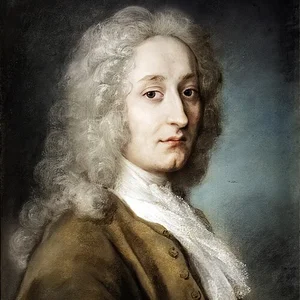

Louis Vigée (1715–1767) was a French painter and poet, member of the Royal Academy of Painting. He is best known as the father of Élisabeth Vigée Le Brun, one of the greatest portrait painters at the court of Louis XVI.
Louis Vigée(1715 — 1767)
Louis Vigée
France
7 min read
Frequently asked questions
Key Facts
- Born in 1715 in Paris, died in 1767
- Admitted to the Royal Academy of Painting and Sculpture as a portrait painter
- Worked primarily in pastel portraiture
- Father of Élisabeth Vigée Le Brun (1755–1842), celebrated portraitist of Marie Antoinette
- Passed on his passion for painting to his daughter from a very early age
Works & Achievements
Throughout his career, Louis Vigée produced portraits commissioned by Parisian notables, both noble and bourgeois. His mastery of pastel earned him a loyal clientele among the wealthy circles of the capital during the reign of Louis XV.
Every candidate for the Académie Royale was required to submit a work for assessment by its members. The acceptance of Louis Vigée's reception piece confirmed the quality of his painterly technique and opened the doors of the institution to him.
Alongside his work as a painter, Louis Vigée composed poems that reflect his dual artistic and literary sensibility. This body of work is sparsely documented, but is mentioned with affection in the memoirs of his daughter Élisabeth.
Anecdotes
Louis Vigée encouraged his daughter Élisabeth to paint and draw from a very young age. When he caught her doodling in her school notebooks instead of doing her lessons, he would not scold her — he would admire her sketches with enthusiasm. This paternal kindness proved decisive in shaping the vocation of the future great portraitist.
A painter who specialized in pastel, Louis Vigée excelled at portraiture by capturing the liveliness of his subjects' gaze and the naturalness of their expressions. His refined, colorful technique was perfectly in keeping with the Rococo aesthetic favored at the court of Louis XV, where lightness and grace were the supreme values of painting.
Louis Vigée was also a poet in his spare time, a literary passion that complemented his career as an academic painter. This dual artistic sensibility — rare among visual artists of his era — reflects the richness of Parisian cultural life during the Age of Enlightenment.
As a member of the Académie royale de peinture et de sculpture, Louis Vigée belonged to the artistic elite recognized by the French monarchy. Admission to this prestigious institution, founded in 1648, was a consecration that opened the doors to official commissions and the great Parisian salons.
Louis Vigée died in 1767 when his daughter Élisabeth was only twelve years old. This premature loss left a deep mark on the young girl, who remembered throughout her life the decisive influence her father had on her vocation. In her celebrated *Souvenirs*, written toward the end of her life, Élisabeth Vigée Le Brun recalls with emotion the memory of this father taken too soon.
Primary Sources
My father, who was a pastel painter and member of the Royal Academy of Painting, encouraged me from my earliest childhood in the taste I showed for the arts. To him I owe the first development of my natural abilities, and his loss, which came all too soon, was a grief from which I never fully recovered.
Mention of reception sessions and academic deliberations in which associate members took part, including portrait pastellists admitted during the reign of Louis XV.
The official catalogues of the biennial Salon exhibitions at the Louvre listed the works shown by members of the Royal Academy, making it possible to trace the pastellists active in Paris under Louis XV.
Key Places
Louis Vigée lived and worked his entire career in Paris, the cultural and artistic heart of Enlightenment France. It was in the capital that he received portrait commissions, moved in academic circles, and raised his daughter Élisabeth.
Founded in 1648, the Académie royale brought together the elite of French artists recognized by the monarchy. Louis Vigée was a member, which allowed him to exhibit at the Salon du Louvre and belong to the official artistic community.
The biennial exhibition of works by Académie members, open to the public in the galleries of the Louvre, was the foremost showcase for artists of the era. Louis Vigée displayed his pastel portraits there before a wide and curious Parisian audience.
The central Paris neighborhood where the Vigée family lived and worked, in a bourgeois and artisanal environment close to artists' studios. It was here that Élisabeth Vigée Le Brun took her first steps as an artist, drawing and watching her father paint.