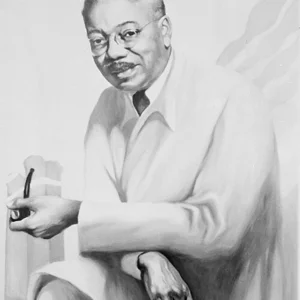

Aaron Douglas was an African American painter and illustrator, a major figure of the Harlem Renaissance. Nicknamed the “father of African American art,” he developed a style blending geometric patterns, silhouettes, and references to African art to celebrate Black history and identity.
Aaron Douglas(1899 — 1979)
Aaron Douglas
États-Unis
5 min read
Frequently asked questions
Key Facts
- Born in 1899 in Topeka, Kansas
- Moved to Harlem in 1925 and became a central figure of the Harlem Renaissance
- Created the illustrations for Alain Locke’s anthology “The New Negro” (1925)
- Painted the mural series “Aspects of Negro Life” at the New York Public Library (1934)
- Founded and headed the art department at Fisk University; died in 1979
Works & Achievements
First major commissions that established his style and made him the visual artist of the Harlem Renaissance.
Series of drawings inspired by Black sermons, blending Egyptian art, cubism, and African American culture.
Numerous magazine illustrations that widely disseminated his art to the Black American public.
Set of murals tracing African American history and culture.
Cycle of four murals, his masterpiece, recounting the journey of African Americans from Africa to the modern city.
Panel from the cycle showing a jazz musician and the migration to industrial cities, a symbol of hope and modernity.
Anecdotes
In 1925, Aaron Douglas left his high school teaching position in Kansas City to settle in Harlem, the vibrant black neighborhood of New York. He quickly became the emblematic painter of the movement, earning the nickname 'father of African American art.'
Philosopher Alain Locke and sociologist W.E.B. Du Bois noticed his talent and commissioned illustrations for the magazines *The Crisis* and *Opportunity*. Douglas invented a distinctive style: flat silhouettes in gradations of purple and blue, crossed by concentric circles of light.
In 1934, during the Great Depression, Douglas was paid by a U.S. government program (the Public Works of Art Project) to paint four massive murals titled 'Aspects of Negro Life.' They tell the story of African Americans, from ancestral Africa to the modern city.
To illustrate the 1927 poetry collection 'God's Trombones' by James Weldon Johnson, Douglas drew inspiration from ancient Egyptian art, Cubism, and the sermons of Black preachers from the South. His figures seem both carved in stone and in motion.
In 1937, Douglas founded the art department at Fisk University in Nashville, Tennessee. He taught painting there for nearly thirty years, training generations of Black artists until his retirement in 1966.
Primary Sources
The manifesto of the Harlem Renaissance, illustrated by Aaron Douglas, presents his drawings as the visual expression of a "new," proud, and assertive Black identity.
A collection of sermons in verse accompanied by Douglas's illustrations, which translate the voices of African American preachers into images.
A mural commissioned for the 135th Street branch of the New York Public Library, depicting emancipation and the trials of the post-slavery era.
In his letters from the 1920s, Douglas confides his desire to create art that expresses "the soul of the Black people" and his pride in participating in Harlem's artistic life.
Key Places
Douglas's hometown, where he grew up before leaving to study art.
Neighborhood where Douglas settled in 1925 and became the iconic painter of the Harlem Renaissance.
Harlem library where the 1934 murals “Aspects of Negro Life” are preserved.
Historically Black university where Douglas founded the art department and taught for nearly thirty years.
City where Douglas stayed in 1931 to study art at the Académie Scandinave.
Typical Objects

Douglas favored flat areas of soft colors applied with gouache and oil, which gave his silhouettes their smooth, velvety appearance.

For his book and magazine illustrations, he drew in black and white line, creating sharp contrasts between figures and background.

Magazine of the NAACP edited by W.E.B. Du Bois, for which Douglas illustrated numerous covers and pages.

To paint his immense murals, Douglas worked perched on scaffolding, in the manner of Italian Renaissance painters.

Major sources of inspiration: he integrated the stylized forms of African art into his modern compositions.

The music of Harlem, jazz and blues, infused his world and is reflected in the rhythm and movement of his figures.
School Curriculum
Vocabulary & Tags
Key Vocabulary
Tags
Daily Life
Morning
In the morning, Douglas would head to his Harlem studio or his teaching office. He would sketch his compositions in pencil, planning the silhouettes and circles of light that would structure his works.
Afternoon
The afternoon was devoted to painting itself—long hours of patient application of gouache and oil, or working on scaffolding for his large murals.
Evening
In the evening, he frequented Harlem's intellectual and artistic circles, discussing with writers like Langston Hughes and thinkers like W.E.B. Du Bois, often to the sound of jazz.
Food
His table reflected the African American and urban cuisine of the era: Southern dishes brought by the Great Migration, but also simple food of a modest-income New York City dweller.
Clothing
Douglas dressed with the understated elegance of a 1920s–1930s intellectual: three-piece suit, tie, hat—the polished image of the proud and cultured "New Negro."
Housing
He lived in a Harlem apartment, and later in a house in Nashville near the Fisk campus, combining living quarters with artistic workspace.
Historical Timeline
Period Vocabulary
Visual Style
Silhouettes plates et géométriques, cercles concentriques de lumière et dégradés de violet et bleu, mêlant Art déco et motifs africains.
Sound Ambience
L'ambiance sonore du Harlem des années 1920 : jazz et blues, sermons, rumeur de la rue et silence concentré de l'atelier.
Liens externes & ressources
Références
Œuvres
Illustrations pour The New Negro
1925
Illustrations pour God's Trombones
1927
The Crisis et Opportunity (couvertures)
1926-1930
Song of the Towers
1934