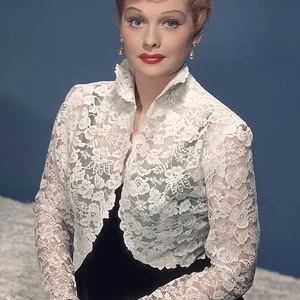

An American comedic actress, producer, and businesswoman, she became a television icon thanks to the sitcom “I Love Lucy” (1951-1957). A pioneer, she was the first woman to head a major Hollywood production studio, Desilu.
Lucille Ball(1911 — 1989)
Lucille Ball
États-Unis
5 min read
Frequently asked questions
Key Facts
- Born in 1911 in Jamestown (New York State), died in 1989 in Los Angeles
- Star of the sitcom “I Love Lucy” broadcast from 1951 to 1957, a huge ratings success
- Co-founder and later head of the studio Desilu Productions, the first woman to lead a major Hollywood studio (1962)
- Pioneer of multi-camera television filming techniques on film stock, which became an industry standard
- Honored with several Emmy Awards over the course of her career
Works & Achievements
Iconic sitcom that made her a worldwide star and revolutionized the conventions of television comedy.
Production studio she ran on her own from 1962, becoming the first woman to head a major Hollywood studio.
Method developed by her team to film in front of a live audience, still used today.
Successful new sitcom that extended her popularity after “I Love Lucy.”
Third major television series led by Lucille Ball, confirming her staying power on screen.
Under her leadership, Desilu launched these legendary series that other studios had turned down.
Anecdotes
Before triumphing on television, Lucille Ball had experienced many failures in Hollywood: she was nicknamed “the Queen of the B movies,” low-budget productions. It was only at the age of 40, with “I Love Lucy,” that she became a worldwide star, proving that it is never too late to succeed.
For the sitcom “I Love Lucy,” she insisted on casting her husband, the Cuban musician Desi Arnaz, in the leading role, even though CBS executives found it inconceivable to show a “mixed” couple on screen. Its success proved them spectacularly wrong.
In 1953, the episode in which Lucy's character gives birth aired on the very same day as the real birth of Lucille Ball's son: 44 million viewers watched it, far more than President Eisenhower's inauguration the following day.
It was Lucille Ball and Desi Arnaz's team that invented the method of filming with three cameras in front of a live audience, on film. This technique is still used today to shoot many sitcoms.
Having become head of the Desilu studio, she was the first woman to run a major Hollywood studio. It was she who gave a chance to series that others had turned down, such as “Star Trek” and “Mission: Impossible.”
Primary Sources
The episode depicting the birth of Lucy's baby was watched by roughly 44 million viewers, a ratings record for the era.
Questioned at the height of the Cold War about her 1936 registration with the Communist Party, she explained that she had done so solely to please her socialist grandfather, with no political conviction.
A first-person account of her career, from her difficult early days in Hollywood to her television success and her leadership of the Desilu studio.
Key Places
Lucille Ball's hometown, in the northeastern United States. A museum dedicated to her now stands there.
A district of Los Angeles, the world capital of cinema, where Lucille Ball had a rough start before becoming a star.
Production studios founded by Lucille Ball and Desi Arnaz, where “I Love Lucy” and later “Star Trek” were filmed.
The city where the young Lucille Ball tried to learn acting and worked as a model before heading to California.
The city where Lucille Ball died in 1989, after a long career celebrated around the world.
Typical Objects

Film camera used for studio shooting. Lucille Ball's team popularized filming simultaneously with three cameras in front of a live audience.

A black-and-white receiver taking pride of place in American homes of the 1950s. It was the object through which “I Love Lucy” entered millions of households.

A written text laying out the dialogue and gags of an episode. Lucille Ball rehearsed each scene meticulously to perfect the comic timing.

A statuette honoring the best American television productions. Lucille Ball won several over the course of her career.

Lucille Ball was famous for her brilliantly red hair, achieved with dyes. It was a key part of her image as a comedian.

A device hung overhead or set in place to capture the actors' voices during filming. Essential to the sound of the television comedies of the era.
School Curriculum
Vocabulary & Tags
Key Vocabulary
Tags
Daily Life
Morning
During the filming of *I Love Lucy*, Lucille Ball arrived early at the Desilu studio for makeup and styling of her famous red hair. She would then go over the script for that week's episode.
Afternoon
Afternoons were devoted to intensive rehearsals. A perfectionist, she fine-tuned every gag and every pratfall down to the last detail with her fellow cast members.
Evening
At the end of the week, the episode was filmed in the evening before a live audience, in the atmosphere of a stage show. Once home, she returned to family life with her two children.
Food
Like many well-off Americans in the 1950s, she ate meals typical of the era: meats, canned vegetables, and desserts. Coffee got her through the long workdays at the studio.
Clothing
On screen, she wore the dresses and aprons of the model American housewife of the 1950s. Out in town and at galas, she sported elegant outfits worthy of a Hollywood star.
Housing
Lucille Ball lived in a large, comfortable home in the residential neighborhoods of Los Angeles, near the studios. Her home reflected the modern comfort of the postwar American dream.
Historical Timeline
Period Vocabulary
Liens externes & ressources
Références
Œuvres
I Love Lucy (série télévisée)
1951-1957
Fondation de Desilu Productions
1950
The Lucy Show (série télévisée)
1962-1968
Here's Lucy (série télévisée)
1968-1974
Production de Star Trek et Mission impossible
1966-1967