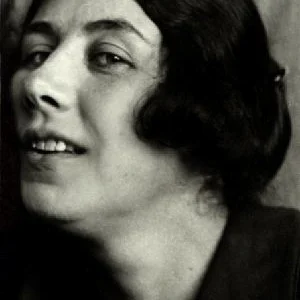

Lyubov Popova (1889-1924) was a Russian painter and designer, a major figure of the avant-garde. A pioneer of Constructivism and Suprematism, she put her art at the service of the revolution before her premature death from scarlet fever.
Lyubov Popova(1889 — 1924)
Lyubov Popova
Union soviétique, Empire russe
6 min read
Frequently asked questions
Key Facts
- Born in 1889 near Moscow into a wealthy family
- Traveled to Paris in 1912-1913, where she discovered Cubism in the studio of Le Fauconnier and Metzinger
- Developed her 'Painterly Architectonics' from 1916 onward, a synthesis of Cubism and Suprematism
- Joined Productivist Constructivism after 1917, creating theater sets (The Magnanimous Cuckold, 1922) and textile designs
- Died in 1924 in Moscow of scarlet fever, at only 35 years old
Works & Achievements
A Futurist-Cubist painting in which a figure in motion shatters into colored planes. A key work of her figurative avant-garde period.
Abstract compositions of colored planes held in balance, treating painting as a kind of construction. This is Popova's most personal contribution to abstract art.
Canvases dominated by lines and dynamic forces, on the border between painting and engineering. They herald her move toward Constructivism.
A moving wooden stage structure for the play staged by Meyerhold. A masterpiece of Constructivist set design, free of illusion or painted scenery.
A Constructivist staging incorporating real objects and machines for Meyerhold. Here theater becomes a revolutionary platform.
Colorful geometric patterns created for the First State Textile Factory. Popova brings abstract art into everyday life.
Anecdotes
Around 1912-1913, Popova left Russia for Paris and enrolled at the private academy La Palette, where the Cubist painters Jean Metzinger and Henri Le Fauconnier taught. Returning to Moscow, she brought back the lessons of French Cubism, which she would fuse with Futurism to create her own style.
Popova named her abstract paintings from 1916-1918 “painterly architectonics”: for her, painting meant building, just as an architect stacks colored volumes in balance on the canvas. It was this idea of art as construction that would later lead her toward Constructivism.
In 1921, at the famous exhibition “5×5=25” in Moscow, five artists (including Popova, Alexandra Exter, and Varvara Stepanova) each presented five works. There Popova announced that she was giving up easel painting to put her talent at the service of industry and the new society.
In 1922, Popova designed the set for the play “The Magnanimous Cuckold” staged by the director Meyerhold: instead of a painted backdrop, she built an actual wooden machine with wheels, ladders, and platforms on which the actors climbed and spun. The theater became a workshop in motion.
Popova died in May 1924 of scarlet fever, at only 35, just days after her young son was carried off by the same disease. Her dazzling career lasted barely a dozen years, but she left behind a body of work considered today one of the most inventive of the Russian avant-garde.
Primary Sources
All the experimental techniques presented here should be regarded as a series of preparatory steps toward concrete material constructions.
Constructivism must lead to communism through the material organization of life, abandoning pure art in favour of industrial production.
Construction in painting is the sum of the energy of its parts; colour participates in the construction as energy, and line as direction.
Key Places
Family estate near Moscow where Lyubov Popova was born in 1889. Her wealthy merchant family gave her a refined education and a love of art.
Private Parisian academy where Popova studied around 1912-1913 under the Cubists Metzinger and Le Fauconnier. There she discovered the experiments of the French avant-garde.
Higher art and technical studios where Popova taught from 1920 onward. It was the great laboratory of Soviet design and art.
Avant-garde stage where Popova created her machine-like sets, notably for *The Magnanimous Cuckold* in 1922. There she applied her Constructivist ideas to live performance.
Factory where Popova designed printed fabrics in 1923-1924. There she put art at the service of mass production.
City where Popova lived, worked, and died of scarlet fever in 1924. It was the heart of the creative ferment of the Russian avant-garde.
Typical Objects

Wooden structure made of platforms, wheels and ladders that Popova built for Meyerhold's theatre. The set no longer imitates a place but offers a machine for the actors to perform on.

Geometric patterns in bright colours that Popova designed for the First State Textile Factory. The artist wanted to dress the Soviet people in modern, mass-produced shapes.

Abstract painting in which coloured planes overlap like volumes held in balance. Here Popova treats painting as a construction made of energy and direction.

Compositions mixing letters, numbers and coloured bands that the Constructivists used for propaganda and publishing. The form had to serve a clear and effective message.

The painter's tools that Popova used intensively during her painting period. She used them to spread crisp flat areas of colour and to layer hues on top of one another.

Functional work clothing devised by the Constructivists for the worker or the actor. Popova and Stepanova designed plain, practical models of it for the stage.
School Curriculum
Vocabulary & Tags
Key Vocabulary
Daily Life
Morning
Born into a well-off family, the young Popova devoted her mornings to studying drawing and visiting museums. As an adult and committed artist, she would head to her studio or the teaching halls of VKhUTEMAS first thing in the morning.
Afternoon
Afternoons were spent painting, preparing her stage-set models, or discussing theory with the other artists of INKhUK. Debates about the role of art in the new society could last for hours.
Evening
In the evening, she attended rehearsals at Meyerhold's theatre or rejoined the circle of avant-garde artists — Malevich, Tatlin, Stepanova, Rodchenko. Readings, lectures, and exhibitions punctuated an intense intellectual life.
Food
In the Moscow of the revolutionary years and the civil war, food was often rationed and frugal: black bread, kasha (buckwheat porridge), soups, and tea. Popova shared the hardships of everyday Soviet life despite her well-off origins.
Clothing
Popova adopted plain, practical outfits, in keeping with the Constructivist ideal of functional clothing. She rejected bourgeois fashion and worked on designing modern garments for the worker and the actor.
Housing
She lived in Moscow, where housing was often communal and cramped after the Revolution. Her studio, crowded with canvases, models, and samples, was both a living space and a workplace.
Historical Timeline
Period Vocabulary
Liens externes & ressources
Références
Œuvres
Décor de « La Terre cabrée »
1923
Dessins de tissus imprimés
1923-1924