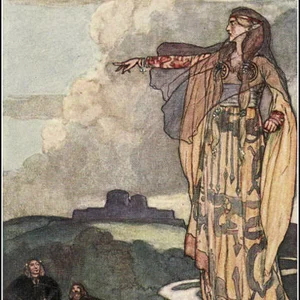

Macha is a goddess of Irish Celtic mythology, a sovereign figure linked to war, fertility, and kingship. She appears in several forms and is one of the goddesses associated with the warrior triad of the Morrígna.
Macha
Macha
6 min read
Frequently asked questions
Key Facts
- Goddess of Irish mythology, counted among the Morrígna (a triad of warrior goddesses with Badb and the Morrígan)
- Associated with sovereignty, war, fertility, and horses
- Gives her name to Emain Macha, the legendary capital of Ulster and centre of the Ulster Cycle
- The tale of her being forced to run while pregnant explains the curse of the warriors of Ulster (the Ulaid)
- A figure attested in medieval Irish manuscripts that compiled a much older oral tradition
Works & Achievements
Macha is said to have traced out the outline of the royal fortress of Ulster herself, giving her name to this great seat of power.
Macha's most famous deed: she condemns the men of Ulster to suffer the pangs of childbirth, a central plot device of the epic of the *Táin*.
According to the *Lebor Gabála*, she reigned as supreme ruler, the only woman on the list of High Kings, and subdued her rivals.
Together with the Morrígan and Badb, Macha forms a triad of goddesses who decide the outcome of battles.
A trial in which the pregnant Macha outruns the royal chariot team, illustrating her connection to horses and sovereignty.
Anecdotes
According to the most famous Irish tale, Macha married a farmer named Crunniuc on the condition that he never speak of her. But he boasted to the king that she could run faster than his horses. Forced to race while she was pregnant, Macha won but gave birth to twins as she crossed the finish line.
As punishment for the humiliation inflicted upon her, the dying Macha cursed the warriors of Ulster: in their hours of greatest danger, they would be struck with the pains of childbirth for five days and four nights. This curse explains, in the great epic of the Táin, why the hero Cúchulainn must defend the province alone.
The capital of the kings of Ulster, Emain Macha (today Navan Fort, near Armagh), bears her name. Legend tells that Macha herself traced its outline with the brooch of her cloak, which would explain the meaning of the name: “the twin of Macha.”
Another Macha, nicknamed Macha Mong Ruad (“Macha of the Red Hair”), is presented in the texts as the only woman to have reigned as supreme sovereign of Ireland, a sign of the royal power attached to this name.
Macha forms, together with the Morrígan and Badb, a triad of warrior goddesses, the Morrígna. In the form of crows, these goddesses flew over the battlefields and announced or decided the fate of the warriors.
Primary Sources
Macha declared to the men of Ulster that, because of the dishonour they had inflicted upon her, whenever a great peril threatened them they would be seized by the pangs of childbirth for five days and four nights, and this until the ninth generation.
Macha Mong Ruad, daughter of Áed Rúad, was queen of Ireland and had the fortress of Emain Macha raised by captive kings.
When the danger to the Ulstermen was at its greatest, the weakness of Macha fell upon them, and only the young Cúchulainn, who was not subject to it, was able to stand against the armies of Connacht.
The heads of men slain in battle are called “the acorns of Macha” (mesrad Machae), for Macha is one of the three goddesses of war.
Key Places
Legendary capital of the kings of Ulster, near Armagh, whose name means “the twin of Macha.” A major ceremonial site of Iron Age Ireland.
City whose name means “Macha's height.” It later became the religious centre of Christian Ireland under Saint Patrick.
Kingdom in the north of Ireland, the setting for Macha's curse that strikes its warriors, and the backdrop of the heroic cycle of Cúchulainn.
Legendary plain associated with the goddess, where several episodes of her race and her founding of Emain Macha take place.
Peninsula in the northeast of Ireland at the heart of the Táin Bó Cúailnge, where Macha's curse leaves Cúchulainn to defend Ulster alone.
Typical Objects

Large fibula used to fasten the Celtic cloak. Legend says that Macha used her brooch to trace the outline of the fortress of Emain Macha.

A horse-drawn vehicle that the pregnant Macha was forced to race against. The chariot is an emblem of Celtic royal and warrior prestige.

The black bird in whose form Macha and the other Morrígna flew over battlefields to herald death.

Symbol of the kingship embodied by Macha Mong Ruad, presented as the supreme queen of Ireland. Macha personifies the sovereignty of the land.

An expression for the severed heads of enemies killed in battle, regarded as an offering to the goddess of war.

An animal closely associated with Macha, a goddess linked to sovereignty and to swiftness, which she outruns in a race.
School Curriculum
Vocabulary & Tags
Key Vocabulary
Daily Life
Morning
As a divine figure, Macha has no human daily routine in the strict sense, but the tales show her appearing in the world of mortals at dawn, sometimes in the guise of a mysterious woman arriving at a farmer's house. The Celts paid tribute to her through morning rituals tied to the fertility of the land.
Afternoon
The texts associate her with work and races: she spins wool, tends the hearth, then makes her way to the site of a royal assembly or a horse race. The afternoon is also the time of the battles she soars over in the form of a crow.
Evening
In the evening, Macha belongs to the world of the afterlife and of omens. She was said to appear at dusk near fords and battlefields, foretelling the death of warriors for the following day.
Food
As a goddess, Macha does not eat as humans do. But she is linked to the abundance of harvests and livestock: the offerings intended for her included the fruits of the earth, milk, and the meat of the farm animals of Celtic Ireland.
Clothing
She is imagined dressed in the manner of Celtic nobles: a long robe of dyed wool, a great cloak (*brat*) fastened by an ornate brooch, and her famous red hair in the case of Macha Mong Ruad, a sign of strength and royalty.
Housing
Her domain is the royal stronghold of Emain Macha, a site of circular ramparts of earth and wood crowning a hill, but also the Celtic Otherworld (the *sidh*) from which the deities come.
Historical Timeline
Period Vocabulary
Liens externes & ressources
Références
Œuvres
Fondation d'Emain Macha
temps mythiques
La malédiction des Ulates
temps mythiques
Le règne de Macha Mong Ruad
chronologie légendaire des rois d'Irlande
Rôle dans la triade des Morrígna
tradition mythologique
La course contre les chevaux du roi
temps mythiques