
Absyrtos (or Apsyrtus) is a prince of Colchis, son of King Aeëtes and brother of Medea. He appears in the mythological cycle of the Argonauts, where he dies during the flight of Medea and Jason carrying off the Golden Fleece.
Absyrtos
Apsyrtus
6 min read
Frequently asked questions
Key Facts
- Son of Aeëtes, king of Colchis, and brother of Medea
- Killed by Medea and Jason during the Argonauts' flight with the Golden Fleece
- According to one version, his body is dismembered and scattered at sea to delay Aeëtes' pursuit
- The murder constitutes a pollution (miasma) purified by the sorceress Circe
- A figure handed down by Apollonius of Rhodes (Argonautica) and Apollodorus
Works & Achievements
In Apollonius of Rhodes, Absyrtus leads the ships sent by Aeëtes in pursuit of the Argonauts, in the role of a military commander.
Ancient geography attributes the name of the Adriatic archipelago to his death, anchoring the myth in a real place.
His body torn to pieces becomes one of the major literary examples of the tragic motif of delaying dismemberment.
He belongs to one of the great Greek legendary cycles, transmitted by Apollonius, Apollodorus, Ovid and Hyginus.
His murder prompts the episode in which Circe cleanses Jason and Medea of the crime of bloodshed, a key stage in the Argo's return.
Anecdotes
Absyrtus is the brother of Medea, the sorceress of Colchis. When Medea betrays her father to help Jason steal the Golden Fleece, it is her own family she abandons — and Absyrtus will pay the most terrible price for it.
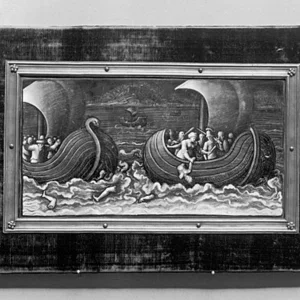
According to the most famous version, reported by Apollodorus, Medea kills her young brother Absyrtus during their flight and cuts his body into pieces that she throws into the sea. Her father Aeëtes, who is pursuing them, must stop to gather his son's limbs and give him a burial, which allows the Argonauts to escape.
The very name of the place of his death is said to have passed into ancient geography: the Absyrtides Islands (Apsyrtides), in the Adriatic off the coast of Illyria, are said to have been named after the spot where the prince was killed, according to the tradition reported by Apollonius of Rhodes.
Ancient authors do not agree on Absyrtus's age: for Apollodorus he is a small child carried off from the palace, while for Apollonius of Rhodes he is a young adult warrior who commands the Colchian fleet launched in pursuit of the fugitives.
In Apollonius's version, Absyrtus does not die at sea but falls into an ambush: Medea lures him by trickery to a sanctuary of Artemis, where Jason strikes him dead — a sacrilegious murder that the heroes will then have to have purified by the sorceress Circe.
Primary Sources
During the pursuit, Medea killed her brother Apsyrtus, cut him into pieces, and cast his limbs into the depths. Aeëtes, gathering the scattered limbs of his son, slowed the pursuit.
Medea lured her brother by guile away from the host; and Jason, springing forward, struck him with his sword. The hero, mortally hit, stained with his crimson blood the robe and veil of his sister.
The maiden tears apart her brother's body and scatters his limbs across the fields, so that her father, delayed, must stop to gather them up.
Medea, fleeing with Jason, killed her brother Absyrtus, whom she had brought along, and cut him limb from limb, scattering him along the road so that her father would be forced to gather his remains.
Key Places
Kingdom of King Aietes on the shore of the Black Sea, homeland of Absyrtus and Medea, and the land where the Golden Fleece is kept.
Royal residence of Colchis from which Medea abducts her young brother during the flight, according to Apollodorus's version.
Region where, in Apollonius of Rhodes, Absyrtus's fleet catches up with the Argonauts and where the deadly trap is sprung.
Island temple where Medea lures her brother by a ruse and where Jason strikes him dead, a sacrilegious murder.
Adriatic archipelago off the coast of Illyria, said to take its name from the dismemberment of Absyrtus.
Typical Objects

Hide of the marvelous ram, hung from an oak tree and guarded by a dragon; the object of the quest during which Absyrtos meets his death.

Legendary galley of the Argonauts, built with the help of Athena and fitted with a prophetic beam; aboard it unfolds the deadly flight of Absyrtos.

The hero's sword whose blow, in Apollonius of Rhodes, strikes down Absyrtos, lured into an ambush near the sanctuary of Artemis.

Garments of the sorceress that the blood of Absyrtos dyes crimson during the murder, a striking image of the family's defilement.

Emblem of the power of Aeëtes and of the royal house of Colchis to which Absyrtos, the crown prince, belonged.

Fragments of Absyrtos's body that Medea scatters over the waves or along the path to delay the pursuit of Aeëtes, a central motif of the legend.
School Curriculum
Vocabulary & Tags
Key Vocabulary
Tags
Daily Life
Morning
A prince at the court of Colchis, Absyrtus is said to have begun his days in the palace of **Aeëtes**, at the foot of the **Caucasus**. Like a royal son of the heroic age, his mornings combined weapons training, running exercises, and the care of horses.
Afternoon
A young prince's afternoon was divided between military training and assisting the king in the affairs of the kingdom. According to the version by **Apollonius**, in which he is an adult, he is said to have inspected the warships and commanded men.
Evening
Evenings gathered the royal household around banquets in the great hall, where the deeds of ancestors were sung and the gods were honored with libations. **Aeëtes**, son of the Sun, presided over these family assemblies.
Food
The diet of the Colchians, a people living along the shores of the **Black Sea**, was based on fish, game, grains, fruit, and honey. To the royal feasts were added roasted meats and wine served in precious cups.
Clothing
A prince of Colchis wore richly woven tunics and dyed cloaks, sometimes adorned with gold, a mark of the rank of the house of **Aeëtes**. Weapons and jewels completed the attire of the aristocratic warriors.
Housing
Absyrtus lived in the palace of **Aeëtes** at Aia, a vast royal dwelling described by **Apollonius** with its courtyards, fountains, and bronze gates, a work attributed to **Hephaestus** in honor of the son of the Sun.
Historical Timeline
Period Vocabulary
Liens externes & ressources
Références
Œuvres
Commandement de la flotte colchidienne
Âge héroïque
Origine du nom des îles Absyrtides
Antiquité
Figure du démembrement (sparagmos)
IIIe s. av. J.-C. – IIe s. ap. J.-C.
Personnage du cycle des Argonautes
Antiquité grecque
Sujet de la purification de Circé
Antiquité