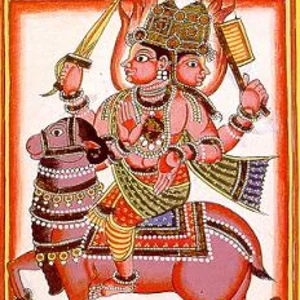

Agni is the god of fire in Vedic and Hindu mythology. The personification of sacrificial fire, he serves as an intermediary between humans and the gods by carrying offerings up to the heavens through smoke. He ranks among the most frequently invoked deities of the Rigveda.
Agni
Agni
6 min read
Frequently asked questions
Key Facts
- God of fire and sacrifice in the Vedic religion of ancient India (approx. 1500-500 BCE)
- Among the most celebrated deities of the Rigveda, whose very first hymn is dedicated to him
- Conceived as the intermediary who carries the offerings of humans up to the gods through flame and smoke
- Present in the domestic fire, the sacrificial fire, and lightning, he survives in later Hinduism
- Invoked during fire rituals (yajna) still practiced in the Hindu tradition
Works & Achievements
More than 200 hymns are dedicated to him, making him the second most celebrated deity after Indra. They form the heart of his renown.
Agni is defined as the bearer of offerings to the heavens. This intermediary function structures the entire Vedic sacrificial ritual.
Agni is presented as the priest of the gods, the celestial model for the human priest. He honors and sanctifies the office of the officiant.
An episode in which a famished Agni devours an entire forest with the help of Krishna and Arjuna. An emblematic tale of his nature as both benevolent and destructive.
Agni becomes one of the guardians of the cardinal points (lokapala), watching over the southeast. His cosmic role thus extends beyond the Vedic period.
Agni's fire remains present in Hindu ceremonies, notably weddings celebrated around the sacred fire. His worship is one of the most continuous in religious history.
Anecdotes
Agni holds a place of honor in the Rigveda: the very first hymn of the collection (1.1) is dedicated to him and opens with the word “Agni.” This simple detail shows just how central this god of fire was in Vedic religion.
For the Vedic priests, Agni had three visible forms: the fire of the domestic hearth, the lightning in the stormy sky, and the Sun. A single deity thus connected the home, the atmosphere, and the firmament.
Agni was regarded as the “mouth of the gods”: it was believed that the offerings (clarified butter, plants, grains) cast into the sacrificial fire were carried by the smoke up to the deities. The fire priest accordingly bore the title of hotar, “the one who invokes.”
The Sanskrit word “agni” is related to the Latin “ignis” (which gave English “igneous” and “ignition”) and to the Slavic “ogon.” These similarities reveal a common Indo-European origin, several millennia old.
In some hymns, Agni is called the “ever-young” god: extinguished each evening and then rekindled each morning by the friction of two pieces of wood, he was endlessly reborn, which made him a symbol of perpetual renewal.
Primary Sources
I praise Agni, the priest set at the forefront of the sacrifice, the officiating god, the hotar who brings the greatest treasures.
To you, O Agni, belong all the gods; you are Indra, you are Vishnu the vast, you are the lord of prayer.
Here is the kindling wood, here is the prepared hearth; bring forth Agni, the mother ready to bring him into the world by friction.
Agni is the light, the whole sacrifice rests upon him; without Agni, the offering would not reach the gods.
Key Places
Region of the “seven rivers” where the Vedic peoples who sang the hymns to Agni once lived. It is the geographical cradle of the Rigveda.
The fire of the family hearth, kept burning at all times, was one of Agni's earthly forms. Every home thus had its own fire altar.
A marked-out ritual space where the fire altars were set up for the great public sacrifices. Agni was invoked there as the priest of the gods.
A mythical forest that Agni devours with flames with the help of Krishna and Arjuna, in a famous episode of the epic. A mythological place illustrating his devouring power.
The Sun and lightning were regarded as celestial manifestations of Agni. The god thus connected the Earth to the heavens.
Typical Objects

A hearth lit according to precise rules, where the priest placed the offerings intended for the gods. Agni was the deity embodied in these flames.

Two pieces of wood rubbed against each other to produce fire through friction. Agni was said to be born from this act, like a child from its parents.

Wooden ladles used to pour clarified butter (ghee) into the fire. They were the main instruments of the officiating priest.

Purified fat poured into the flames as a favored offering to Agni. Its bright combustion symbolized the rising of prayers toward the heavens.

A sacred drink pressed and offered during sacrifices, often associated with Agni and the other gods. Its exact botanical nature remains debated.

In the mythological imagination, Agni travels on a chariot drawn by rams or blazing horses. It is a typical attribute of Hindu iconography.
School Curriculum
Vocabulary & Tags
Key Vocabulary
Tags
Daily Life
Morning
Since Agni is a deity, his “daily life” is read through human ritual. At daybreak, priests rekindled the sacred fire by rubbing two pieces of wood together, thus causing the god to be “reborn.” The morning was the preferred time for the first offerings.
Afternoon
Throughout the day, the household fire was carefully tended so that it would never go out. The great public sacrifices, sometimes lasting several days, mobilized several priests around different hearths dedicated to Agni.
Evening
In the evening, the fire was fed again and hymns were recited. Agni symbolically watched over the home during the night, driving away the darkness and evil spirits.
Food
Agni “feeds” on the offerings cast into the flames: clarified butter (ghee), grains, plants, wood, and sometimes the sacred drink soma. He was said to devour everything given to him, hence his nickname the “eater of offerings.”
Clothing
In the texts, Agni is described as clothed in flames and smoke, with glowing red hair and beard. Later, Hindu iconography gives him red skin, several arms, and sometimes two faces.
Housing
Agni's “dwelling” is the hearth itself: the family fireplace, the sacrificial altar and, in the sky, the Sun and the lightning. He thus inhabits both the humblest house and the most distant firmament.
Historical Timeline
Period Vocabulary
Liens externes & ressources
Références
Œuvres
Hymnes à Agni du Rigveda
vers 1500-1000 av. J.-C.
Rôle d'intermédiaire (messager des dieux)
période védique
Forme du prêtre divin (hotar)
période védique
Incendie de la forêt de Khandava
épopée du Mahabharata (vers 400 av. J.-C.-400 apr. J.-C.)
Gardien d'une direction du monde (Agneya)
hindouisme classique
Persistance dans les rituels (homa, mariage, crémation)
de l'Antiquité à aujourd'hui