
First self-made female millionaire in the USA, born to formerly enslaved parents
Madam C.J. Walker(1867 — 1919)
Madam C.J. Walker
États-Unis
8 min read
Frequently asked questions
Key Facts
- Née en 1867 en Louisiane de parents anciens esclaves, Sarah Breedlove est la première enfant de sa famille à naître libre après l'abolition de l'esclavage (1865)
- Vers 1905, elle développe une gamme de produits capillaires pour femmes noires et fonde la Madam C.J. Walker Manufacturing Company
- Elle bâtit un réseau de plusieurs milliers de vendeuses indépendantes ('Walker agents'), pionnière du marketing de vente directe
- À sa mort en 1919, elle est considérée comme la première femme self-made millionnaire des États-Unis, selon les sources de l'époque
- Elle finance activement des causes civiques, notamment la lutte contre le lynchage portée par la NAACP
Works & Achievements
A complete hair care line including shampoos, pomades, and heated combs, accompanied by a multi-step care method. This system revolutionized the relationship African American women had with their hair.
A company founded in Indianapolis, the first major corporation led by an African American woman in the United States. At its peak, it employed more than 3,000 people and a network of 20,000 sales agents.
A beauty school founded in Pittsburgh and later expanded to several cities, training hundreds of Black women in Walker techniques. These graduates became independent agents, thereby gaining economic independence.
The first large-scale direct sales network targeting African American communities, with representatives across the country and in the Caribbean. This innovative business model allowed thousands of Black women to escape poverty.
A political initiative organized by Madam Walker to petition President Wilson, accompanied by a delegation of Black citizens, calling for a federal anti-lynching law. She used her fame and fortune to weigh in on the political debate.
A residence built in Irvington-on-Hudson, entrusted to African American architect Vertner Tandy, which became a symbol of Black achievement and a hub of intellectual gathering. Listed as a National Historic Landmark in 1976.
Anecdotes
Sarah Breedlove was born in 1867 in Louisiana, the daughter of formerly enslaved people freed by the Civil War. Orphaned at six, she worked as a domestic servant to survive. It was through her own suffering from a scalp condition that caused her hair to fall out that she began searching for a remedy, developing her own hair care formula.
To launch her business, Madam Walker started by selling her products door to door in Black communities across the South. She traveled the country by train, her suitcase filled with pomades and heated combs, demonstrating her techniques directly in her clients' homes. In less than ten years, she employed thousands of sales agents across the entire country.
In 1917, Madam Walker organized a march and a petition in Washington D.C. to protest the lynching of Black Americans. She personally met with President Woodrow Wilson to urge him to legislate against these racist acts of violence. Her civic engagement was inseparable from her economic success: she viewed her fortune as a tool in service of her community.
Madam Walker was the first American woman to build a million-dollar fortune entirely through her own efforts, with no inheritance or marriage. She had a magnificent estate called Villa Lewaro built in Irvington-on-Hudson, New York, designed by an African American architect. This residence became a symbol of Black achievement and a gathering place for the intellectuals and activists of the Harlem Renaissance.
Upon her death in 1919, Madam Walker's will bequeathed two-thirds of her future estate to charitable causes and Black institutions. She had funded scholarships for young African Americans and supported organizations such as the NAACP. Her company continued to operate after her death, led by her daughter A'Lelia Walker.
Primary Sources
I am a woman who came from the cotton fields of the South. From there I was promoted to the washtub. From there I was promoted to the cook kitchen. And from there I promoted myself into the business of manufacturing hair goods and preparations.
I want to say to every Negro woman present, don't sit down and wait for the opportunities to come. Get up and make them.
It is my will and desire that at least two-thirds of the net profits of the business shall be reinvested in the business and that the remaining one-third shall be used for philanthropic purposes.
I got my start by giving myself a start. I had little or no money to invest. I had to begin with very small capital.
Key Places
Birthplace of Sarah Breedlove in 1867, on a plantation where her parents had been enslaved. This starting point in extreme poverty makes her trajectory all the more remarkable.
The city where Sarah Breedlove settled in 1905 and began developing her hair care formula. It is here that she met her third husband, Charles Walker, and took the name Madam C.J. Walker.
Headquarters of the Madam C.J. Walker Manufacturing Company from 1910 onward, with a factory, laboratory, and beauty school. The city is home today to the Madam Walker Legacy Center, a cultural venue dedicated to her memory.
A grand residence built in 1917 on the banks of the Hudson River, a symbol of African American success. Designed by architect Vertner Tandy, it hosted the leading figures of the Harlem Renaissance.
The neighborhood where Madam Walker settled around 1916 and chose as the new center of her activities. There she mingled with W.E.B. Du Bois, Langston Hughes, and activists of the nascent civil rights movement.
Typical Objects

A metal comb designed to be heated on a stove, used to straighten and style Black women's hair. It became one of the iconic tools of the 'Walker System', sold alongside the hair care products.

A hair care treatment made from sulfur and other plant-based ingredients, formulated by Madam Walker to combat hair loss. This product was the first in her line and the foundation of her entire business.

A case containing the products, demonstrations, and catalogs that thousands of Walker agents carried during their home visits. This kit represented the economic independence offered to Black women.

Before becoming an entrepreneur, Sarah Breedlove worked for many years as a washerwoman and seamstress. The sewing machine symbolizes that era of hard toil that preceded her success.

An illustrated sales brochure presenting the full hair care line and training fees. Distributed in Black communities across the United States, it also served as a recruitment tool for agents.

Madam Walker was one of the first African American women to own and drive her own automobile. She used her car for business travel and as a visible symbol of her success.
School Curriculum
Vocabulary & Tags
Key Vocabulary
Daily Life
Morning
At the height of her success, Madam Walker rose early to oversee production at her Indianapolis factory. She dictated correspondence to her secretary, responding to hundreds of letters from her agents and customers. Mornings were devoted to business management and directing her teams.
Afternoon
Afternoons were often spent traveling by train across the country to meet her agents and inspect her new stores. She also gave lectures in Black churches and associations to recruit and train new sales representatives. Her hair care product demonstrations drew entire crowds in African American communities.
Evening
In the evenings, at her villa in Harlem or Irvington, Madam Walker received Black intellectuals, journalists, and activists. She attended dinners organized by the NAACP and other associations, discussing political strategy and philanthropy. Reading Black newspapers such as the Chicago Defender was part of her daily routine.
Food
Like many Black families from the South, she had grown up with Creole and soul food cooking: fried chicken, red beans, corn, and sweet potatoes. Having become wealthy, she could afford a more varied diet but retained a strong attachment to the food of her childhood. She hosted formal dinners at her villa, blending American cuisine with more elaborate dishes for her guests.
Clothing
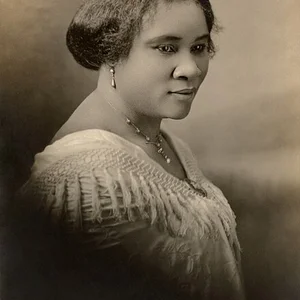
Madam Walker wore elegant Edwardian-style outfits: high-collared dresses, lace blouses, and wide ornate hats. She was determined to appear impeccable at all times, viewing her appearance as both a business statement and an assertion of dignity. Her official portraits always show her finely dressed, adorned with jewelry and furs that symbolized her success.
Housing
After years spent in modest lodgings as a domestic worker and laundress, Madam Walker had Villa Lewaro built in 1917. This neo-Palladian estate featured numerous lavishly furnished rooms, a library, a music salon, and gardens overlooking the Hudson River. She also owned an apartment in Harlem, at the heart of New York's Black cultural life.
Historical Timeline
Period Vocabulary
Visual Style
Style visuel ancré dans l'esthétique édouardienne et afro-américaine du début du XXe siècle, alliant sépia photographique, opulence bourgeoise et dignité revendicatrice.
Sound Ambience
Ambiance sonore de l'Amérique afro-américaine des années 1900-1919, entre le labeur quotidien du Sud rural et l'effervescence urbaine de Harlem naissant.
Liens externes & ressources
Références
Œuvres
Le Système Walker (Walker System)
1906
Madam C.J. Walker Manufacturing Company
1910
Lelia College of Beauty Culture
1908
Réseau national d'agentes Walker
1910-1919
Pétition contre les lynchages au Congrès
1917
Villa Lewaro
1917